


KHARTOUM: At least six people were killed in eastern Sudan as thousands took to the streets across the country on Thursday protesting against soaring prices, with some calling for the overthrow of President Omar Al-Bashir, officials and witnesses said.
A student and another demonstrator died during violent protests in Al-Qadarif, the city’s independent MP, Mubarak Al-Nur, said. Police also fired teargas at around 500 people in the capital Khartoum, some of them chanting: “The people want the fall of the regime.”
A state of emergency was declared in the eastern Sudanese city of Al-Qadarif on Thursday, an official said, after at least two people were killed in protests against soaring prices.
A curfew was also imposed from 6:00 p.m. to 6:00 a.m. local time, the city's commissioner said. A state of emergency and curfew were also declared in the northeastern city of Atbara after protests there on Wednesday.
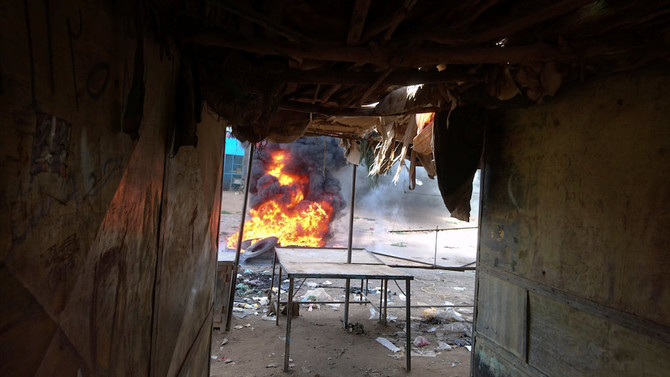
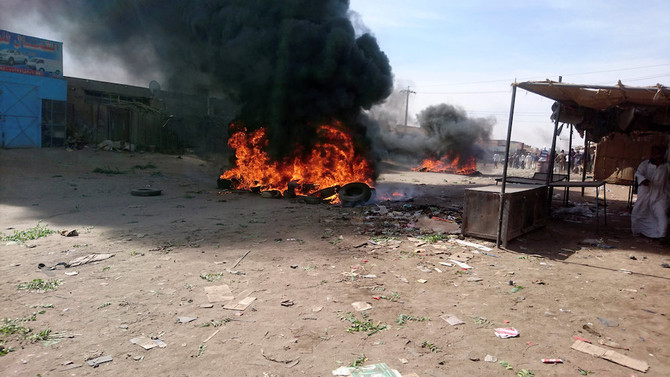
Further north, in Dongola, protesters set fire to the local offices of Bashir’s ruling National Congress Party, witnesses said. To the northeast, protesters hiding their faces behind scarves came out for a second day in Atbara, chanting “freedom,” video footage showed. Car tires were set alight.
There was no immediate comment from the government.
They were among the worst protests since crowds came out against cuts to state subsidies in 2013, when again many called for a new government — a rare act in a state dominated by the army and security services.
Public anger has been building over price rises, inflation and other economic hardships — including a doubling in the cost of bread this year and limits on bank withdrawals.
Sudan’s economy has struggled to recover from the loss of three quarters of its oil output — its main source of foreign currency — since South Sudan seceded in 2011, taking most of the oilfields.
The United States lifted 20-year-old trade sanctions on Sudan a year ago. But many investors have continued to shun a country still listed by Washington as a state sponsor of terrorism, whose president is wanted by the International Criminal Court over charges of masterminding genocide in Darfur — charges he dismisses.
The latest violence erupted in Atbara on Wednesday, where local authorities declared a state of emergency after crowds set fire to the ruling party’s office there.
“I went out to protest because life has stopped in Atbara,” said a 36-year-old man who asked not to be named.
He said he had not been able to find any bread in the shops for four days.
“Life has stopped”
“Prices have increased and I have still not been able to withdraw my November salary ... because of the liquidity crisis. These are difficult conditions that we can’t live with, and the government doesn’t care about us,” he told Reuters.
Economic conditions in Sudan have deteriorated sharply in recent months.
At 69 percent, Sudan’s inflation rate is among the world’s highest. Severe shortages have forced people to queue at bakeries and petrol stations.
In September, Bashir dissolved his government, citing Sudan’s “state of distress and frustration”, and slashed the number of ministries by a third cut costs.
In October, Sudan sharply devalued its currency after the government asked a body of banks and money changers to set the exchange rate on a daily basis.
The move led to further price increases and a liquidity crunch, while the gap between the official and black market rates has continued to widen.
“The protests began peacefully and then turned to violence and vandalism (on Wednesday),” Hatem Al-Wassilah, governor of Nile River state, which includes Atbara, told Sudania 24 TV.
“The situation in Al-Qadarif has become dangerous and the protests have developed to include fires and theft and it’s now out of control,” its independent MP, Mubarak Al-Nur, said. He said one of the protesters who died was his relative.
Bashir took power in a military-backed coup in 1989. Lawmakers this month backed a constitutional amendment to extend term limits that would have required him to step down in 2020.


