


ISLAMABAD/KABUL: Representatives of the Afghan Taliban said on Tuesday that their leaders will continue talks with American officials in the UAE for the second day to explore measures for a political solution to end the conflict in Afghanistan.
Taliban spokesman Zabihullah Mujahid said that “preliminary talks” were held in Abu Dhabi on Monday with Zalmay Khalilzad, the US’ Special Representative for Afghanistan Reconciliation, in the presence of senior officials from Saudi Arabia, Pakistan, and the UAE.
“Talks revolved around the withdrawal of occupation forces from Afghanistan, ending the oppression being carried out by the United States and her allies and views were exchanged with the said countries about peace and reconstruction of Afghanistan,” he said, adding that “meetings in this negotiations process shall continue today (Tuesday)”.
In Kabul, President Ashraf Ghani’s office released a statement which said that the Afghan negotiating team, led by Abdul Salam Rahimi, would begin a “proximity dialogue with the Taliban delegation to prepare for a face-to-face meeting between the two sides”.
The Taliban have so far refused to deal directly with President Ghani’s government which the group considers as a US puppet – one which is locked in internal divisions and is weak.
However, Afghanistan’s National Security Adviser, Hamdullah Moheb, had held talks with officials from the UAE, Saudi Arabia, and Pakistan separately in Abu Dhabi on Sunday, Moheb’s spokesperson, Tariq Aryan, told Arab News. He added that details of the meeting will be made public later, while tweeting that Rahimi would prepare the ground for talks with the Taliban.
On Monday, Mujahid had said that no talks would be held with representatives of the Kabul administration. There was no mention of any planned meeting with delegates of the Afghan government in Tuesday’s statement either.
“Claims by some media outlets associated with the Kabul administration that their representatives will also hold talks with those of the Islamic Emirate are unfounded. We strongly reject this propaganda. There is no plan of holding a meeting with representatives of the Kabul administration and neither are they present in the meeting being attended by the delegation of the Islamic Emirate,” Mujahid said on Monday.
Pakistani officials, familiar with the developments in the UAE, take credit for bringing the Taliban and Afghan representatives to the negotiating table.
Meanwhile, Prime Minister Imran Khan lauded the role played by Pakistan in the talks on Tuesday when he tweeted:
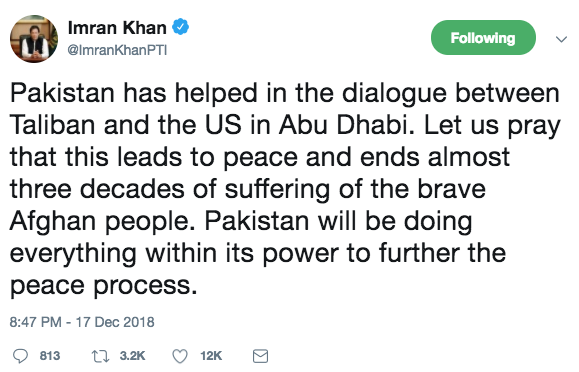
The premier had said on Friday that Pakistan would facilitate talks between the US and Taliban nearly two weeks after US President Donald Trump sought Islamabad’s help in the Afghan peace process. Khan and other leaders had promised support and facilitation in the talks.


