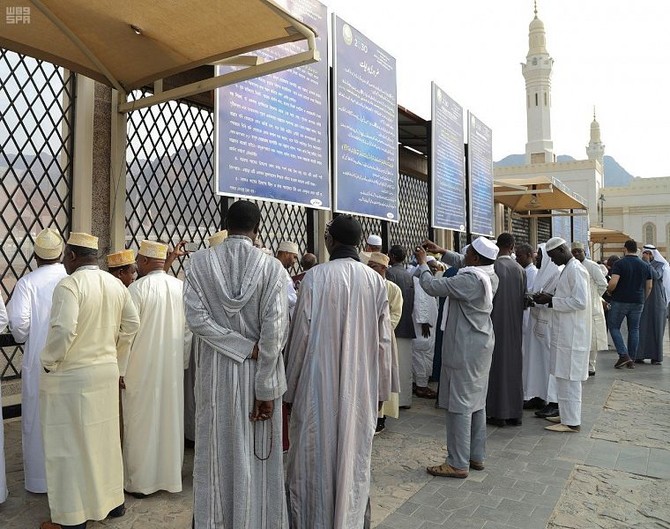
Umrah guests visit historic sites in Madinah, Saudi Arabia

1 / 6
The guests of the 13th batch of Custodian of the Two Holy Mosques Program for Umrah visited Islamic sites in Madinah. (SPA)
2 / 6
The guests of the 13th batch of Custodian of the Two Holy Mosques Program for Umrah visited Islamic sites in Madinah. (SPA)
3 / 6
The guests of the 13th batch of Custodian of the Two Holy Mosques Program for Umrah visited Islamic sites in Madinah. (SPA)
4 / 6
The guests of the 13th batch of Custodian of the Two Holy Mosques Program for Umrah visited Islamic sites in Madinah. (SPA)
5 / 6
The guests of the 13th batch of Custodian of the Two Holy Mosques Program for Umrah visited Islamic sites in Madinah. (SPA)
6 / 6
The guests of the 13th batch of Custodian of the Two Holy Mosques Program for Umrah visited Islamic sites in Madinah. (SPA)
Updated 17 December 2018
Follow

Umrah guests visit historic sites in Madinah, Saudi Arabia

JEDDAH: The guests of the 13th batch of Custodian of the Two Holy Mosques Program for Umrah on Sunday visited Islamic sites in Madinah and the King Fahd Complex for Printing the Holy Qur’an.
The head of planning department of the Ministry of Islamic Affairs and Endowments in Djibouti, Dr. Othman Hussein Mohammed, thanked King Salman for making all-out efforts to serve Islam and Muslims all over the world.
The guests — comprising 203 figures from eight African countries — thanked King Salman and Crown Prince Mohammed bin Salman for the generous hospitality, services and facilities provided for them since they left their countries until their arrival in the Kingdom. They are from Ethiopia, Senegal, Comoros, Djibouti, Mali, South Africa, Nigeria and Uganda.
With the arrival of the 13th batch of guests, the total number has reached 2,803 from various countries since the start of the program. Hajj and Umrah Minister Mohammed Salih Bentin earlier received separately in Makkah the heads of the Iraqi, Malaysian and Nigerian Hajj delegations.



New wave of Iranian drone attacks on Saudi Arabia neutralized

Updated 46 min 54 sec ago
Follow

New wave of Iranian drone attacks on Saudi Arabia neutralized

  • 13 drones downed east of Riyadh city and 8 destroyed upon entering Saudi air space
  • Drone attacks continue despite apology given by Iranian officials to Gulf states

RIYADH: Saudi Arabia’s air defenses neutralized a fresh wave of drone attacks on Sunday, the Ministry of Defense announced, as Iranian strikes on Gulf states showed no signs of abating despite Tehran’s conciliatory gestures a day earlier.

Ministry spokesman Major General Turki Al-Maliki said in posts on X that 13 drones were intercepted and destroyed east of Riyadh, while eight more were shot down shortly after entering Saudi airspace.

Sunday’s attacks follow a relentless barrage on Saturday in which the Kingdom’s air defenses intercepted and destroyed 21 drones headed toward Aramco’s Shaybah oil field deep in the Rub’ al-Khali desert, as well as five ballistic missiles fired at various times during the day.

Also on Saturday, Saudi defenses intercepted five ballistic missiles launched toward Prince Sultan Air Base in Al-Kharj, an important industrial zone approximately 80 kilometers southeast of Riyadh. It was the third attempted strike in three consecutive days on the base. A single drone was also intercepted east of Riyadh.

The Shaybah attack on Saturday was the first on the vital facility since Feb. 28, when Israel and the United States launched a massive air campaign against Iran, triggering a wave of retaliatory strikes by Tehran across the Gulf region.

The persistent attacks came despite Iranian President Masoud Pezeshkian issuing a public apology on Saturday to Gulf neighbors, saying Tehran would halt strikes unless attacks against Iran originated from their territory. “I personally apologize to the neighboring countries that were affected by Iran’s actions,” he said in a televised address.

However, Iran’s armed forces spokesman Abolfazl Shekarchi sought to qualify the pledge, saying Iran would avoid targeting neighboring countries only unless their territory was used to launch attacks against Iran — a caveat that left regional officials questioning whether the apology signaled a genuine effort to de-escalate or simply a shift in messaging while military operations continued.

The sincerity of this diplomatic overture has been met with skepticism as air defense sirens continue to wail across the Gulf. In the UAE, debris from a mid-air destruction caused minor damage to a building facade in Dubai Marina, though no injuries occurred.

The situation remains more volatile in Bahrain, where the Interior Ministry reported that an intercepted attack caused a fire in the capital, Manama, damaging a residential home and nearby structures. King Hamad bin Isa Al-Khalifa reaffirmed the kingdom’s commitment to peace and coexistence but emphasized the necessity of maintaining regional stability against persistent threats.

Inside the Kingdom, the focus remains on protecting civilian and industrial hubs. Major General Al-Maliki highlighted that the recent missile threats were the third attempted strikes in three consecutive days on Al-Kharj, an important industrial zone located 80 kilometers southeast of Riyadh. On Friday alone, five missiles and multiple drones were shot down across the Eastern Province and the capital region.

The international community has responded with a mix of condemnation and warnings. US President Donald Trump warned via social media that Iran would be “hit very hard” in response to the aggression. Meanwhile, the Gulf Cooperation Council (GCC), following an extraordinary meeting in Riyadh, affirmed the collective right of member states to defend their territories against what they termed “treacherous Iranian aggression.”