

Pakistan condemns killings in Kashmir, calls for international probe

Protesters in Indian administered Kashmir clash with Indian paramilitary soldiers in Srinagar on Sunday, a day after chaotic protests and fighting killed seven civilians and four combatants in the disputed region. (AP)
Updated 16 December 2018
Follow

Pakistan condemns killings in Kashmir, calls for international probe

  • Several people who were demonstrating peacefully shot on Saturday
  • Kashmiri leader calls for another protest on Monday

ISLAMABAD: Pakistan’s Foreign Minister Shah Mahmood Qureshi reacted sharply to the recent killings in the Pulwama district of Indian-administered Kashmir after a handful of civilians were killed and several others injured on Saturday.

On Sunday, Qureshi urged the “champions of human rights” to prevail upon the administration in New Delhi to “put an immediate halt to the Kashmiri genocide".

According to media reports, seven people were killed and dozens injured on Saturday when Indian forces opened fire at protestors in the valley. 
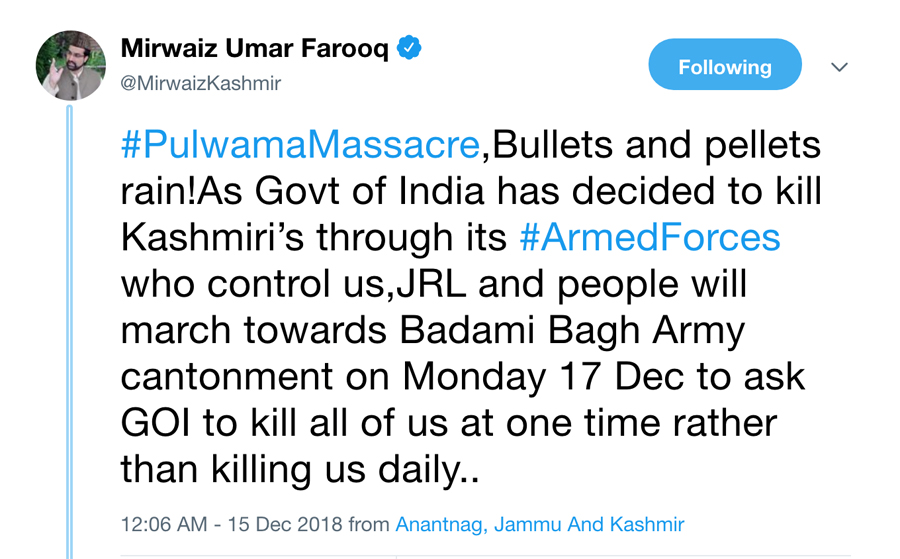
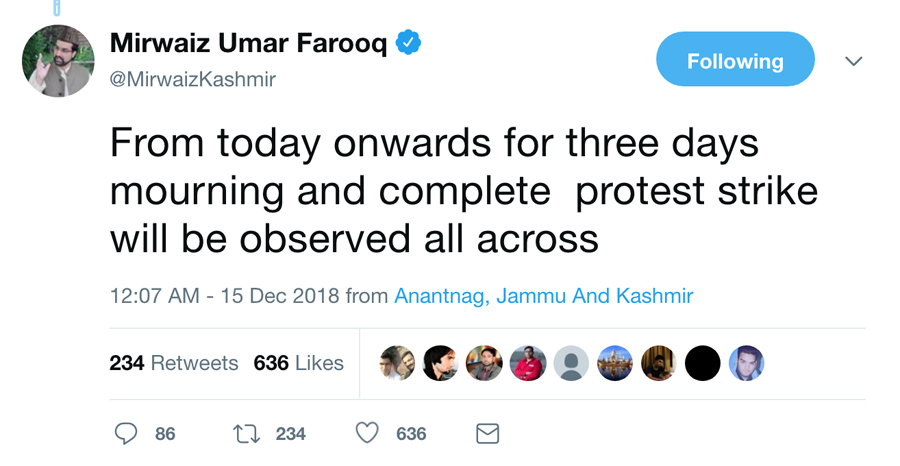
The incident also prompted Kashmiri leader, Mirwaiz Umar Farooq to call for another demonstration on Monday. He said that the protest would give Indian troops yet another opportunity to “kill all of us at one time rather than killing us daily.”

Pakistan’s Ministry of Foreign Affairs issued a statement wherein it said that “despite hollow Indian claims, Jammu and Kashmir remains an internationally-recognized dispute, pending on the agenda of the UN Security Council.” 
"The mindless killing spree carried out by the Indian occupation forces on Saturday is yet another example of the Indian atrocities against the innocent Kashmiris. India continues to kill and maim, under the garb of ‘combating terror’. In Indian-occupied Jammu and Kashmir, every man, woman or a child who protests against India’s illegal occupation and brutalities against innocent and hapless Kashmiris, is a ‘terrorist’," the statement added.

The foreign ministry reiterated Qureshi’s demand that “India has to allow investigations by an independent fact-finding commission of the OCHCR, OIC, and IPHRC into the ongoing gross human rights violations in IoK and to fulfill its obligations under the UN Security Council resolutions on Jammu and Kashmir.”


ADB, Pakistan sign over $300 million agreements to undertake climate resilience initiatives

Updated 30 December 2025
Follow

ADB, Pakistan sign over $300 million agreements to undertake climate resilience initiatives

  • Pakistan ranks among nations most vulnerable to climate change and has seen erratic changes in weather patterns
  • The projects in Sindh and Punjab will restore nature-based coastal defenses and enhance agricultural productivity

ISLAMABAD: The Pakistani government and the Asian Development Bank (ADB) have signed more than $300 million agreements to undertake two major climate resilience initiatives, Pakistan’s Press Information Department (PID) said on Tuesday.

The projects include the Sindh Coastal Resilience Sector Project (SCRP), valued at Rs50.5 billion ($180.5 million), and the Punjab Climate-Resilient and Low-Carbon Agriculture Mechanization Project (PCRLCAMP), totaling Rs34.7 billion ($124 million).

Pakistan ranks among nations most vulnerable to climate change and has seen erratic changes in its weather patterns. In 2022, monsoon floods killed over 1,700 people, displaced another 33 million and caused over $30 billion losses, while another 1,037 people were killed in floods this year.

The South Asian country is ramping up climate resilience efforts, with support from the ADB and World Bank, and investing in climate-resilient infrastructure, particularly in vulnerable areas.

“Both sides expressed their commitment to effectively utilize the financing for successful and timely completion of the two initiatives,” the PID said in a statement.

The Sindh Coastal Resilience Project (SCRP) will promote integrated water resources and flood risk management, restore nature-based coastal defenses, and strengthen institutional and community capacity for strategic action planning, directly benefiting over 3.8 million people in Thatta, Sujawal, and Badin districts, according to ADB.

The Punjab project will enhance agricultural productivity and climate resilience across 30 districts, improving small farmers’ access to climate-smart machinery, introducing circular agriculture practices to reduce residue burning, establishing testing and training facilities, and empowering 15,000 women through skills development and livelihood diversification.

Earlier this month, the ADB also approved $381 million in financing for Pakistan’s Punjab province to modernize agriculture and strengthen education and health services, including concessional loans and grants for farm mechanization, Science, Technology, Engineering and Mathematics (STEM) education, and nursing sector reforms.