Sign language and Braille Qur’ans to help pilgrims at Two Holy Mosques

1 / 3
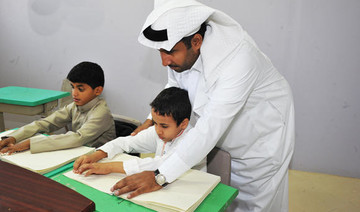
A blind Saudi reads in braille a copy of the Quran, Islam's holy book, inside a mosque on the first day of the holy fasting month of Ramadan in the coastal town of Qatif, 400 kms east of Riyadh, on May 27, 2017. (AFP)
2 / 3
3 / 3
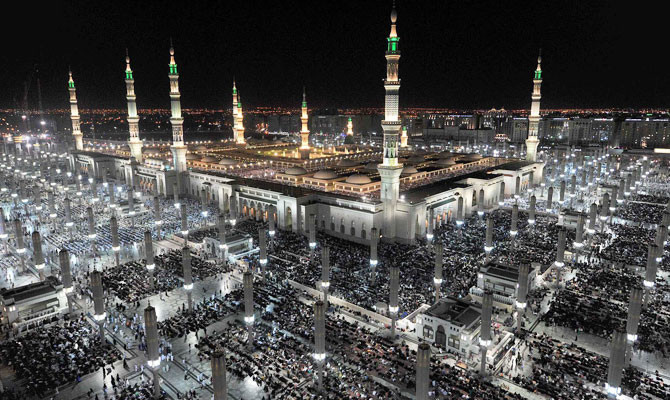
Muslim worshippers pray around the Kaaba, Islam's holiest shrine, at the Grand Mosque in Saudi Arabia's holy city of Makkah on August 15, 2018. (AFP)
Updated 16 December 2018
Follow

Sign language and Braille Qur’ans to help pilgrims at Two Holy Mosques

  • Copies of the Qur’an in Braille along with other religious booklets are available, as are on-site specialists to help pilgrims during prayer times and guide them through the mosque sites

MAKKAH: Sign language, Braille Qur’ans and electric wheelchairs are some of the new features in Makkah and Madinah to help pilgrims with disabilities to execute the religious rites of Hajj and Umrah.
An official at the General Presidency for the Affairs of the Two Holy Mosques described those with disabilities as “highly motivated people with special powers” and that services had been established to aid them, providing them with ease and comfort and avoiding complications even during peak times.
Ahmed Al-Burqati, who is tasked with helping people at the presidency, told Arab News there were designated entrances to ease access to prayer areas, including the ones on the ground and first floors of the King Fahd expansion at the Grand Mosque in Makkah.
Other provisions include a pen that serves as a Qur’an reader, and help for holding and carrying Qur’ans for people unable to hold them. Copies of the Qur’an in Braille along with other religious booklets are available, as are on-site specialists to help pilgrims during prayer times and guide them through the mosque sites, he added.
Ahmed Badawi, an Egyptian pilgrim performing Umrah, said he was not expecting to find such services awaiting him in the Grand Mosque compound.
Other special services at the holy mosques include: Wheelchairs transported in golf carts to prayer areas; designated entrances; sign language interpreters for those with hearing or speech impairments; canes for the blind and visually impaired; and electric wheelchairs to perform key religious rites such as tawaf.


Experimental farm in Al-Lith looks into future of Saudi Arabian agriculture

Updated 58 min 22 sec ago
Follow

Experimental farm in Al-Lith looks into future of Saudi Arabian agriculture

  • Research initiative reflects strategic transformation

JEDDAH: An experimental farm in Saudi Arabia’s Al-Lith Governorate is one of the research initiatives reflecting the strategic transformation taking place in the Kingdom’s agricultural sector.

The farm uses highly efficient, sustainable production models that combine scientific research with commercial application, contributing to strengthening the country’s food security system and the sustainability of water resources.

Located in the Ghumaiqa Center on an area of about 10 hectares, the cutting-edge farm is a testing platform for modern agricultural technologies that tackle the challenge of water scarcity.

The farm includes developed open fields and modern greenhouses, supported by smart irrigation encompassing drip and sprinkler irrigation alongside surface and subsurface technologies.

All the systems operate via smart controls that enable the monitoring of water consumption and ensure improved efficiency, thereby achieving a balance between agricultural production and water conservation.

The farm also uses treated and diluted low-salinity seawater.

It aims to diversify agricultural water sources, reduce reliance on freshwater, and open new horizons for agriculture in coastal and semi-arid environments.

The project represents a promising investment opportunity in the field of smart agriculture, enabling the development of commercially scalable production models, particularly for high-value vegetables and fruits, while reducing operational costs associated with water and energy, enhancing the economic feasibility of future agricultural projects.

In addition, the project contributes to transferring and localizing agricultural expertise, supporting local food supply chains, and creating an attractive environment for agricultural investment.

This aligns with Sustainable Development Goals and enhances the efficiency of the private sector in adopting innovative agricultural solutions.

Yahya bin Abdulrahman Al-Mahabi, the director of the Ministry of Environment, Water and Agriculture office in Al-Lith Governorate, told the Saudi Press Agency that the project represented the future of agriculture in the Kingdom.

He explained that the vision was based on investing in technology, enhancing the return on water per unit, and integrating scientific research with investment opportunities.

Al-Mahabi spoke of the experimental farm as a modern, scalable and replicable model applicable in several regions of the Kingdom, particularly in coastal environments.

Al-Mahabi highlighted the Ministry of Environment, Water and Agriculture’s commitment to supporting distinctive projects that contributed to achieving food security while developing rural areas and enhancing agricultural production efficiency, in line with the objectives of the Kingdom’s Vision 2030.