Pakistan army warns Pashtun rights movement not to cross ‘line’

1 / 2
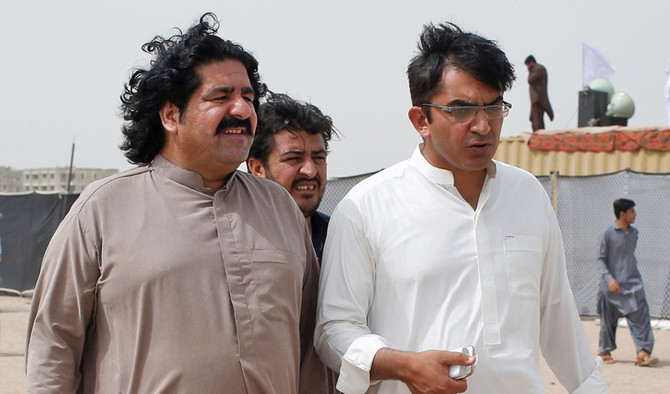
Ali Wazir (L) and Mohsin Dawar, leaders of the Pashtun Tahaffuz Movement (PTM). (REUTERS File Photo)
2 / 2
Ali Wazir (L) and Mohsin Dawar, leaders of the Pashtun Tahaffuz Movement (PTM). (REUTERS File Photo)
Updated 07 December 2018
Follow

Pakistan army warns Pashtun rights movement not to cross ‘line’

  • Backs US peace talks with the Afghan Taliban
  • Says India deliberately targeting civilians on line of control 

ISLAMABAD: Pakistan army spokesman Maj. Gen. Asif Ghafoor said Thursday the army had made all efforts to meet the demands of a Pashtun ethnic rights movement, the Pashtun Tahaffuz Movement (PTM), and warned its activists of a crackdown if they crossed a "line."

The comments by Ghafoor at a press conference came just days after Ali Wazir, the co-founder of PTM, and Mohsin Dawar, one of its main leaders, were barred from leaving the country and briefly detained.

The PTM was founded last January to protest alleged extrajudicial killings, arbitrary detentions and “disappearances” of young ethnic Pashtun men under the guise of operations against the Pakistani Taliban and other militants in the country’s northwestern tribal regions. Leaders of the movement blame Pakistan’s military for these abuses, which the army strongly denies.

While PTM has attracted thousands of people to rallies around the country, the movement had also been met with criticism for raising anti-army slogans and disrespecting thousands of soldiers martyred in the war on terror.

"They are our people, they are hurt and have suffered losses, but still they haven’t resorted to violence till now therefore we have dealt with them politely,” Ghafoor said.

"But now they are heading in a direction where the situation might arise that they cross a line.  We request them not to cross that line where the state is compelled to use authority to control them."

In April, Pakistan's powerful army chief General Qamar Javed Bajwa also criticized PTM for taking aim at the army.

“Some internal and external elements are hell-bent upon harming Pakistan’s national security. But I want to tell them that the armed forces with the support of the people of Pakistan will not let their ulterior motives to succeed," Bajwa said.

PTM gained momentum after the killing of aspiring model and shopkeeper, Naqeebullah Mehsud, by police in the port city of Karachi in January. Pashtuns thus began a peaceful sit-in in Islamabad demanding the abolition of the colonial-era Frontier Crimes Regulation law that applies to the tribal areas where most Pashtuns reside; the release of all political prisoners; the removal of landmines and army checkpoints from the tribal areas; and the recovery of missing people.
 
Ghafoor told the media that check posts had been reduced from 469 to 331 since 2016, 44 percent landmines had already been cleared and 4,000 out of 7,000 pending cases of missing persons had been settled.

Speaking about the recently concluded visit to Pakistan of U.S. special representative for Afghanistan, Zalmay Khalilzad, the army's spokesman said the army fully supported latest U.S. efforts for dialogue with the Afghan Taliban to end war in neighbouring Afghanistan.

"As much as we can, we will facilitate,” Ghafoor said when asked what Pakistan could do to help the United States negotiate a political settlement with the Taliban.

The military spokesman also raised concerns over increasing ceasefire violations by India on the Line of Control and Working Boundary. He said 55 civilians had been martyred by Indian forces this year, the highest in history. He said Indian forces were deliberately targeting civilians.

Answering questions about censorship in Pakistan media, the army spokesman denied the military was behind any moves to censor the media but urged it to play an "effective role in projecting a soft image of Pakistan."


Islamabad says surge in aircraft orders after India standoff could end IMF reliance

Updated 22 min 17 sec ago
Follow

Islamabad says surge in aircraft orders after India standoff could end IMF reliance

  • Pakistani jets came into the limelight after Islamabad claimed to have shot down six Indian aircraft during a standoff in May last year
  • Many countries have since stepped up engagement with Pakistan, while others have proposed learning from PAF’s multi-domain capabilities

ISLAMABAD: Defense Minister Khawaja Asif on Tuesday said Pakistan has witnessed a surge in aircraft orders after a four-day military standoff with India last year and, if materialized, they could end the country’s reliance on the International Monetary Fund (IMF).

The statement came hours after a high-level Bangladeshi defense delegation met Pakistan’s Air Chief Marshal Zaheer Ahmed Baber Sidhu to discuss a potential sale of JF-17 Thunder aircraft, a multi-role fighter jointly developed by China and Pakistan that has become the backbone of the Pakistan Air Force (PAF) over the past decade.

Fighter jets used by Pakistan came into the limelight after Islamabad claimed to have shot down six Indian aircraft, including French-made Rafale jets, during the military conflict with India in May last year. India acknowledged losses in the aerial combat but did not specify a number.

Many countries have since stepped up defense engagement with Pakistan, while delegations from multiple other nations have proposed learning from Pakistan Air Force’s multi-domain air warfare capabilities that successfully advanced Chinese military technology performs against Western hardware.

“Right now, the number of orders we are receiving after reaching this point is significant because our aircraft have been tested,” Defense Minister Asif told a Pakistan’s Geo News channel.

“We are receiving those orders, and it is possible that after six months we may not even need the IMF.”

Pakistan markets the Chinese co-developed JF-17 as a lower-cost multi-role fighter and has positioned itself as a supplier able to offer aircraft, training and maintenance outside Western supply chains.

“I am saying this to you with full confidence,” Asif continued. “If, after six months, all these orders materialize, we will not need the IMF.”

Pakistan has repeatedly turned to the IMF for financial assistance to stabilize its economy. These loans come with strict conditions including fiscal reforms, subsidy cuts and measures to increase revenue that Pakistan must implement to secure disbursements.

In Sept. 2024, the IMF approved a $7 billion bailout for Pakistan under its Extended Fund Facility (EFF) program and a separate $1.4 billion loan under its climate resilience fund in May 2025, aimed at strengthening the country’s economic and climate resilience.

Pakistan has long been striving to expand defense exports by leveraging its decades of counter-insurgency experience and a domestic industry that produces aircraft, armored vehicles, munitions and other equipment.

The South Asian country reached a deal worth over $4 billion to sell military equipment to the Libyan National Army, Reuters report last month, citing Pakistani officials. The deal, one of Pakistan’s largest-ever weapons sales, included the sale of 16 JF-17 fighter jets and 12 Super Mushak trainer aircraft for basic pilot training.