

UAE passport ranked world's most powerful

Updated 02 December 2018
Follow

UAE passport ranked world's most powerful

  • A United Arab Emirates passport can travel to 167 countries without the need for pre-visa requirements
  • Last year, the UAE passport was ranked No. 24

JEDDAH: Holders of the United Arab Emirates (UAE) passport can travel to 167 countries without the need for pre-visa requirements, dislodging Germany’s as the most powerful passport worldwide, an online ranking site said on Saturday.
A UAE passport holder can also obtain visas from 54 countries upon arrival, said the Passport Index in its December 2018 report.
Only 31 countries require visas for the UAE passport holder, it added. 
The UAE government hailed the new Passport Index ranking as an “exceptional achievement “, which coincides with the 'Year of Zayed' and country's 47th National Day.
The UAE passport's rank this year was a big jump from its No. 24 individual rank in Passport Index's December 2017 report.
“A new historic achievement… #UAE passport has become the strongest passport & now ranks 1st globally. The achievement coincides with 'Year of Zayed' & UAE's 47th National Day, adding to UAE's numerous accomplishments in various domains,” the Dubai Media Office tweeted.

Sheikh Abdullah bin Zayed Al Nahyan, Minister of Foreign Affairs and International Cooperation, was quoted by the Khaleej Times as saying the distinction "is a true reflection of the legacy of Sheikh Zayed, the Founding Father of the UAE. It also underscores what can be achieved through positive diplomacy, reflecting the UAE as a confident and engaged force at the global stage.” 
Issued by the Arton Capital, the Passport Index ranks countries' passports based on the number of countries a passport holder can enter without obtaining a visa or obtaining it at the time of entry. 
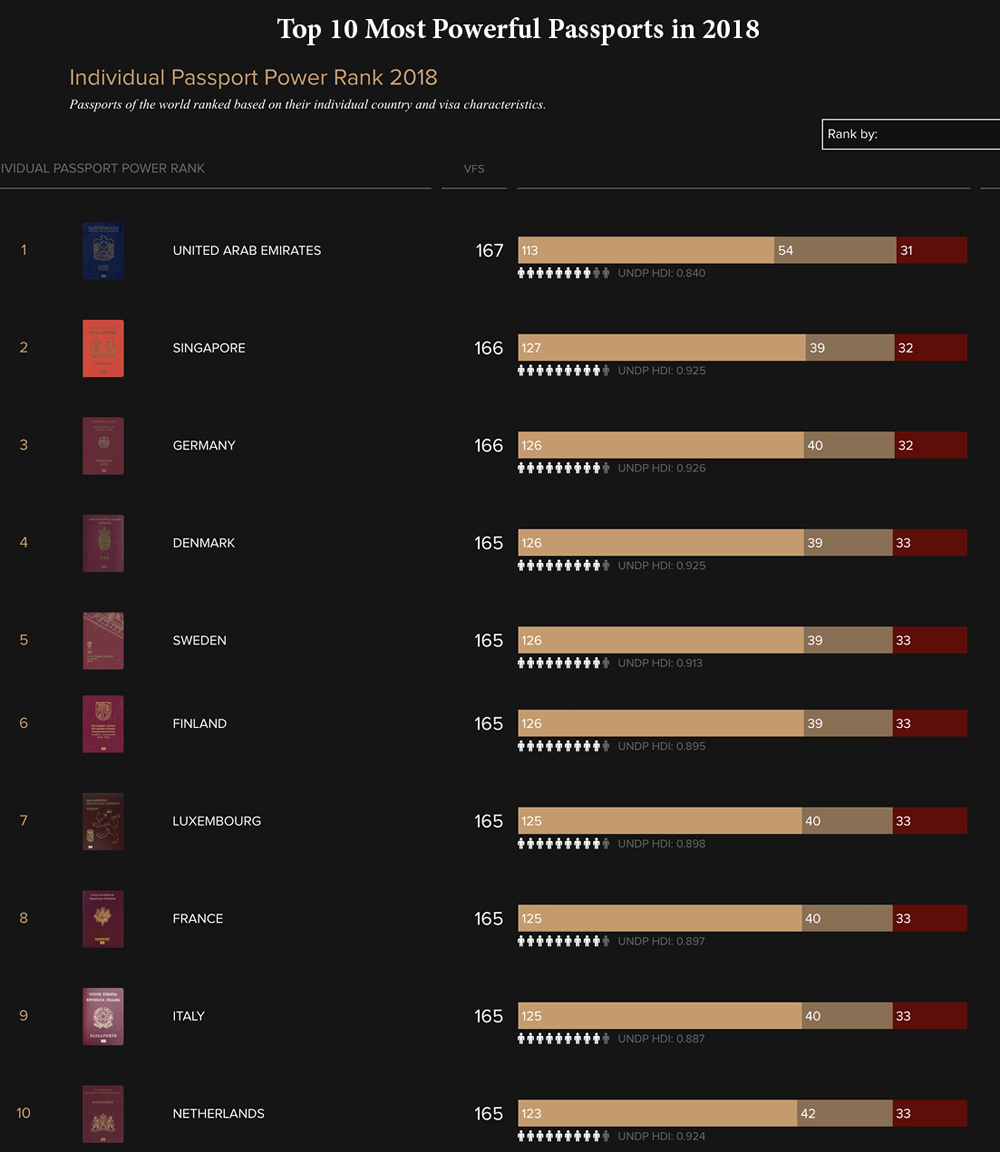
 

Top 10
Singapore took the No. 2 spot this year while last year's topnotcher, Germany, went down to No. 3.
Denmark was 4th, followed by Sweden, Finland, Luxembourg, France, Italy with the Netherlands rounding up the Top 10.
In the Middle East, the highest ranked aside from the UAE, was Turkey at No. 90.
Kuwait ranked 97; Qatar, 103; Bahrain, 105; Oman, 107; Saudi Arabia, 112; and Jordan, 165.
The region's trouble spots, such as Iran, Iraq, Syria, Lebanon and Yemen, were in the lowest ranks. 
 

Ease of travel

Armand Arton, founder and president of Arton Capital, said that the Passport Index is the most prominent rating of passport strength through an interactive platform that continuously monitors changes and developments, adding that it has become the world’s premier reference for governments.

“We continuously compare the passports of 193 countries and 6 territories of UN members and work to collect data directly and continuously, all through publicly available information, government sources and international bodies. We determine the strength of the passport based on the ability of the citizens of a country to travel to another country without the need for a visa in advance and obtaining visa access from the airport,” Arton said in a statement carried by the UAE state news agency WAM.

He added that the Emirati passport has witnessed unprecedented progress globally in the past few years, reflecting the international stature of the country. “We congratulate the UAE on this great achievement, and are pleased to work with the Ministry of Foreign Affairs and International Cooperation since the launch of the UAE Passport Force initiative,” he said.

Through this achievement, the freedom of movement to many countries of the world is added to the list of what the UAE offers its citizens.

The positive impact of ease of travel not only makes it possible for UAE nationals to travel freely for tourism, but also has economic, developmental and even humanitarian benefits, by facilitating trade and economic investment for individuals and institutions.


Aidarous Al-Zubaidi: Fugitive at large

Updated 6 sec ago
Follow

Aidarous Al-Zubaidi: Fugitive at large

  • Yemen appoints committee to probe allegations against former STC leader after the group’s collapse and his reported flight from the country
  • Preliminary findings accuse Al-Zubaidi of exploiting public office for personal gain, fueling political division and instability in south

LONDON: A special committee formed on presidential authority by Yemen’s public prosecutor’s office has made a series of findings against Maj. Gen. Aidarous Al-Zubaidi, the sacked vice-president of the country’s Presidential Leadership Council (PLC).
Al-Zubaidi, who is accused of high treason and other crimes against the state, is currently on the run.
Arab News has seen a copy of preliminary findings by the committee which reveal that Al-Zubaidi is accused of abuses of power including corruption, land grabbing and oil trading for personal gain.
On Jan. 7, the PLC issued a decree revoking Al-Zubaidi’s membership of the PLC and accusing him of high treason and other serious crimes, including forming an armed gang, killing military officers and soldiers, and undermining the country’s sovereignty.
At the same time it authorized the public prosecutor’s office to form a special committee to investigate allegations against Al-Zubaidi, empowering it to summon and arrest individuals, gather evidence and take necessary actions according to the law, with a mandate to complete the investigation quickly and to provide periodic reports to the PLC.
The committee’s preliminary findings identify a series of serious allegations against Al-Zubaidi, who is said to be responsible for multiple abuses “which have contributed to creating a state of political and popular division in the southern governorates.”
Al-Zubaidi is the leader of the Southern Transitional Council (STC). On Jan. 7, Al-Zubaidi was due to attend talks in Riyadh with a 50-member delegation from the STC, but at the last minute, he fled instead.
The committee’s findings include allegations that Al-Zubaidi is alleged to have seized large plots of land, including in the Aden Free Zone, on Al-Ummal Island, in Bir Fadl and the Ras Omran area.
The committee has also uncovered allegations that pressure was exerted on the Yemen Petroleum Company and its director, Tareq Al-Walidi, to prevent the import of fuel except through a company affiliated with Al-Zubaidi’s brother-in-law, Jihad Al-Shoudhabi, and the Minister of Transport, Abdul Salam Humaid.
For nearly two years, it is claimed, Al-Shoudhabi has been the sole supplier, earning large profits that have gone to Al-Zubaidi’s treasury.
The report also identifies commercial companies owned by Al-Shoudhabi and, “behind him,” it is claimed, Al-Zubaidi. Two are named in the report: Alahlia Exchange &  Transfers Company and Arabian Furniture Center, one of Yemen’s largest furniture companies. Both are headquartered in Aden.
All these and other “deeply regrettable acts of seizure, plunder, and financial and administrative corruption,” the committee says, “have had serious repercussions in southern circles and were a direct cause of southern division and the emergence of many grievances.”
On Thursday, a spokesman for the Saudi-led coalition in Yemen said there was reliable intelligence indicating that on the night of Jan. 7, Al-Zubaidi had departed from Aden on a ship bound for Somaliland — probably the port of Berbera, 260 kilometers south across the Gulf of Aden.
From there he is believed to have been flown on a cargo aircraft to Abu Dhabi, capital of the UAE, via Mogadishu, the coastal capital of Somalia, a flight of about 2,600 km.
Some of the crimes of which Al-Zubaidi is accused relate to the largescale military offensive launched by STC forces across southern Yemen in December.
“We know that the Southern Transitional Council worked to storm the eastern cities militarily,” a source close to the Yemeni government told Arab News.
“The pattern and scale of grave human-rights violations and acts of security and military escalation witnessed by the eastern cities in the south of the homeland — Hadhramout, Al-Mahra and Shabwah — as a result of the military incursion by the forces of the Transitional Council during the monitoring period extending from Dec. 3, are considered heinous crimes against the Yemeni people.”
According to the Yemeni Ministry of Legal Affairs and Human Rights, a total of 2,358 individual offences have been identified, including cases of extrajudicial killing and physical injuries, arbitrary arrests and captivity, enforced disappearance and displacement, and the destruction and looting of public and private property.
Backed by Saudi airstrikes, in the first week of January, the Yemeni government quickly regained the captured territories, Al-Zubaidi was sacked from the PLC and charged with treason, and the UAE announced it would withdraw its remaining troops from the country.
Following Al-Zubaidi’s disappearance on the eve of the planned talks in Riyadh, Saudi Arabia has accused the UAE of helping to smuggle the wanted man out of the country.
The same source told Arab News there is evidence that Al-Zubaidi “was receiving YER 10 billion ($42 million) monthly … deducted from the aid that Yemen was receiving.
“While Al-Zubaidi was receiving those funds, Yemeni citizens had not been receiving their lawful salaries for years, including the diplomatic corps.”
Last Thursday, Mohammed Al-Jaber, the Saudi ambassador to Yemen, announced that the Kingdom would assume responsibility for the salaries of Yemeni state employees, including military personnel, giving $90 million to cover salaries for two months.
On Friday evening, Al-Zubaidi, his whereabouts still unconfirmed, made his first public statement since his disappearance 10 days ago.
“We will no longer accept any solutions that diminish our rights or impose an unacceptable reality upon us,” he wrote in a social media post that left no doubt about his determination to undermine the internationally recognized government of Yemen.
He added: “I pledge to you ... that we will continue together until we achieve the desired national goal.
“With your determination, we will prevail. With your unity, the South will be protected, and with your will, the future state will be established.”