

Random observations of a jet-lagged journalist arriving in Buenos Aires for the G20

1 / 2
2 / 2
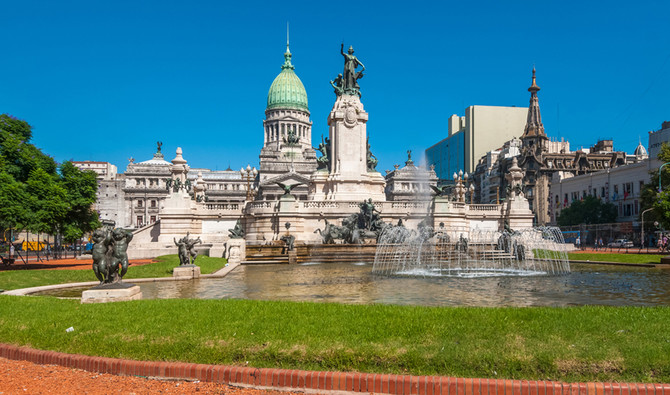
National Congress building, Buenos Aires, Argentina. (Shutterstock photo)
Updated 02 December 2018
Follow

Random observations of a jet-lagged journalist arriving in Buenos Aires for the G20

  • Latin America was at the forefront of some of the most innovative movements in art in the 20th century
  • The Malba museum is actually a wonderful place, and if I were a taxi driver, I’d angle for a fare there as often as I could

On the map Buenos Aires looks like a T-bone steak, with the outer fatty side following the shoreline of the Rio de la Plata. Plata means “silver” in Spanish, and the river — more a small sea actually, and said to be the biggest river in the world, though I bet the Amazon would object — does look kind of silver in certain sunlight. But the name was also derived in Spanish from the vast amounts of precious metal that flowed down it when the conquistadors first exploited the Latin American interior. The English, who have lost the correlation between silver and wealth, just call it the more prosaic River Plate.

***

The obligatory taxi driver story: You get into a Buenos Aires cab and ask in faltering Spanish for the Museo de Arte Latinoamericano de Buenos Aires. “Ah si,” says the Portena driver, using the acronym “Malba” like he drives there every day for his own personal pleasure. This proves to me that Argentines are deeply cultured and artistic people — even down to the average cabbie.
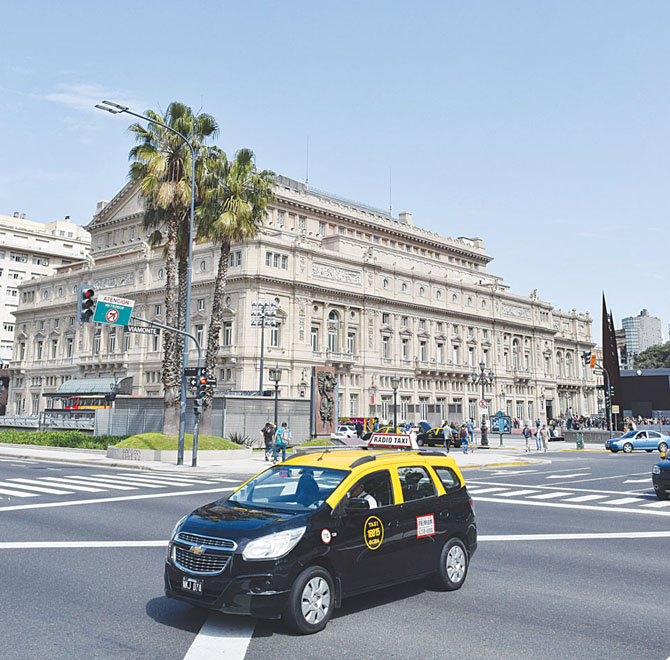


A taxicab in downtown Buenos Aires. (Shutterstock photo)

***

The Argentine economy is fragile. I went to a branch of the bank that handles my business in the UK and the UAE, wanting to take out some folding money to pay for taxis and other things. The most I could withdraw — even from my own checking account — was the equivalent of $105 (just under SR400). This tells me that the authorities are worried about another run on the very vulnerable peso.

***

The Malba museum is actually a wonderful place, and if I were a taxi driver, I’d angle for a fare there as often as I could. Latin America was at the forefront of some of the most innovative movements in art in the 20th century, from Frida Kahlo to (her husband) Diego Rivera and down to Alicia Penalba, whose massive mural sculpture “Flying Forms” will form the backdrop for the G20 wives and partners photo shoot on Saturday. I think Melania Trump will want to buy it. I think Donald will not approve. Not enough gold.

***
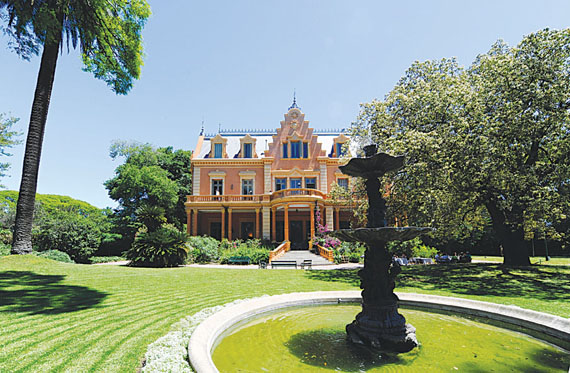


Villa Ocampo, a mansion built in 1891 in San Isidro, about 30 km north of Buenos Aires city. (AFP)

Melania might also want to buy the Villa Ocampo, a superb European-style mansion a long way up the Silver River from Malba. It was owned by one of Argentina’s leading ladies of letters, Victoria Ocampo, and is famous for its distinguished list of visitors, including writers Andre Malraux, Albert Camus and Graham Greene, and, bizarrely, Wernher von Braun, the German rocket scientist. Mrs. Trump is there at a reception on Friday, while her husband is off talking trade-war turkey with Xi Jinping. But I think UNESCO, the current owners, would ask for too much — even for a US first lady — if the villa was ever for sale. Which it is not.


***

After all that fine art, sophistication and taxi-driver talk, it was down to the nitty-gritty — getting press credentials for the G20. It is here that you encounter Argentina at its finest: A glorious mid-19th-century building hiding the most hopelessly inadequate registration system known to man. Somewhere around where the bone would have been in that T-bone steak lies the Ministry of External Relations, and it is here the world’s media have to line up for the precious lanyard that gives you access to the International Media Center. After 30 minutes in the dungeons of Esmeralda, I was happy to walk blinking back down the Avenida Santa Fe to freedom, and the Wilton Hotel, to eavesdrop on the football team of BBC journalists planning their assault on the G20. But that recollection can wait for another time.


Trump insists he struck Iran on his own terms

Updated 04 March 2026
Follow

Trump insists he struck Iran on his own terms

  • “We are now a nation divided between those who want to fight wars for Israel and those who just want peace and to be able to afford their bills and health insurance,” Marjorie Taylor Greene posted on X.
  • Rubio himself doubled down on Tuesday after meeting with US House and Senate members, while insisting that “No, I told you this had to happen anyway”

WASHINGTON, United States: President Donald Trump and his team scrambled Tuesday to reclaim the narrative on why he decided to attack Iran, after his top diplomat suggested the US struck only after learning of an imminent Israeli strike.
Secretary of State Marco Rubio alarmed Democrats — who say only Congress can declare war — as well as many of Trump’s MAGA supporters on Monday when he said: “We knew that there was going to be an Israeli action.”
“We knew that that would precipitate an attack against American forces, and we knew that if we didn’t pre-emptively go after them before they launched those attacks, we would suffer higher casualties,” Rubio told reporters.
Administration officials quickly backpedalled, insisting Trump authorized the strikes because Tehran was not seriously negotiating an accord on limiting its nuclear ambitions, and the United States needed to destroy Iran’s missile capabilities.
“No, Marco Rubio Didn’t Claim That Israel Dragged Trump into War with Iran,” White House Press Secretary Karoline Leavitt posted Tuesday on X.
At an Oval Office meeting later with Germany’s chancellor, Trump went further, saying that “Based on the way the negotiation was going, I think they (Iran) were going to attack first. And I didn’t want that to happen.”
“So, if anything, I might have forced Israel’s hand.”

- Had to happen? -

Rubio himself doubled down on Tuesday after meeting with US House and Senate members, while insisting that “No, I told you this had to happen anyway.”
“The president made a decision. The decision he made was that Iran was not going to be allowed to hide... behind this ability to conduct an attack.”
Critics seized on the muddied messaging to accuse Trump of precipitating the country into a war without a clear rationale, without informing Congress — and without a clear idea of how it might end.
They noted that just two weeks ago, Israel Prime Minister Benjamin Netanyahu pressed Trump again in Washington to take a hard line, in their seventh meeting since Trump’s return to power last year.
Some Republican allies rallied behind the president, with Senator Tom Cotton, chairman of the Senate Intelligence Committee, insisting that “No one pushes or drags Donald Trump anywhere.”
“He acts in the vital national security interest of the United States,” Cotton told the “Fox & Friends” morning show.
But as crucial US midterm elections approach that could see Republicans lose their congressional majority, Trump risks shedding supporters who had welcomed his pledge to end foreign military interventions.
“We are now a nation divided between those who want to fight wars for Israel and those who just want peace and to be able to afford their bills and health insurance,” Marjorie Taylor Greene, a top former Trump ally and a major figure in the populist and isolationist hard right, posted on X.