

We may have to wait for Sidhu to become PM – premier Khan says

1 / 5
(AN photo)
2 / 5
(AN photo)
3 / 5
(AN photo)
4 / 5
The Shrine of Baba Guru Nanak, the Sikh communities revered saint's final resting place dating back to the 1500s. It's the most sacred holy site for the Sikhs around the world. (AN photo)
5 / 5
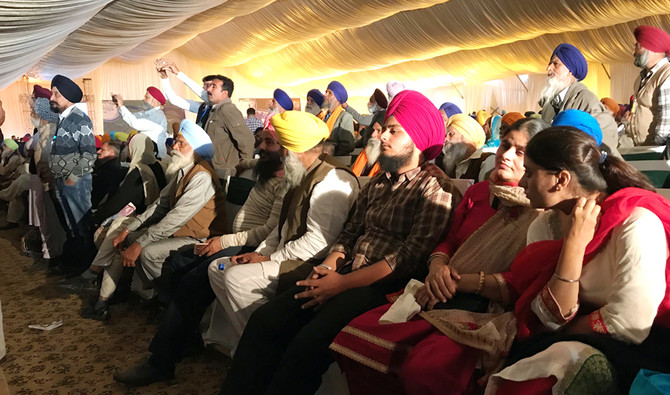
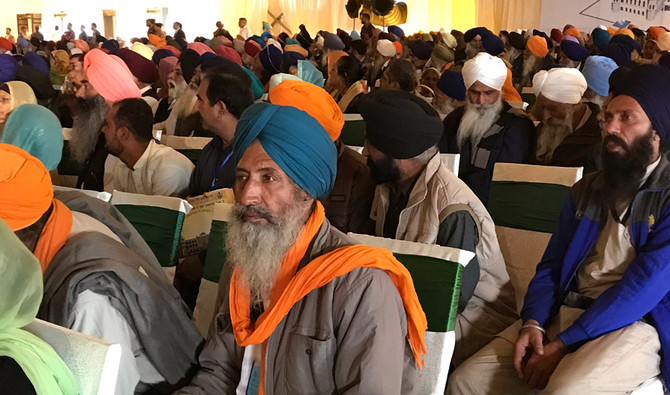
Sikh Pilgrims from India watching Imran Khan deliver speech for the ground breaking ceremony of Kartarpur Corridor in district Narowal in Punjab, a few kilometers from Indian border. (AN photo)
Updated 29 November 2018
Follow

We may have to wait for Sidhu to become PM – premier Khan says

  • Pakistan hopeful even as India slams the door on resumption of talks
  • New Delhi declines SAARC invite; Islamabad says “war not an option”

KARTARPUR, PAKISTAN: Shortly after Prime Minister Imran Khan delivered a powerful speech on Wednesday after laying the foundation stone for a border crossing between India and Pakistan and using the opportunity to renew his call to resume stalled talks between the two nuclear-armed nations, New Delhi struck back and told Islamabad not to mistake the construction of the Kartarpur corridor as a step towards resumption of dialogue. 

Indian External Affairs Minister, Sushma Swaraj said that “unless and until Pakistan stops terror activities in India, there will be no dialogue”, sending a clear message that Pakistan’s peace overtures are meaningless gestures until all issues are resolved.  

She also declined an invitation from Islamabad for Prime Minister Narendra Modi to attend the upcoming SAARC summit in the capital by categorically saying that “we will not participate in SAARC”. 

However, Pakistan Foreign Office spokesman Dr Muhammad Faisal told Arab News: “This is an initiative of Pakistan and certainly will not be the last (towards mending relations with India). We look to move forward even if there are hiccups and there is a lot of positivity in the air (after the corridor initiative) and we definitely want to build upon that.”  

India and Pakistan made some headway in improving their relations by announcing to jointly-construct a border crossing for millions of Indian Sikhs who have long desired to visit the shrine of Sikhism’s founder, Guru Nanak, which is nestled in Kartarpur, in the Narowal district of Punjab, nearly five kilometers away from Pakistan’s eastern border. 

Once ready, the crossing is expected to reduce the 100 km distance to less than five for the pilgrims. The surprise approval by the Indian cabinet to construct their side of the corridor -- decades after the matter had collected dust -- was widely interpreted as an icebreaker in bilateral relations. 

“It won’t change the environment overnight. There is too much bitterness and mistrust even now, but it is an important step because unless you start with a low-hanging fruit, a corridor of four kilometers (which) took 70 years -- benefitting the average Sikh pilgrim who has nothing to do with the larger issues concerning both countries – so it’s a helpful step and will show the enormous potential that exists in building people to people contact,” Rajdeep Sardesai, a notable Indian news anchor and author, told Arab News. 

He added that easing visa restrictions for journalists, traders, businessmen, and students will help in “taking the relationship forward”.         

Khan, flanked by some of his federal ministers at the historic ceremony, addressed a large audience – which included diplomats, Indian ministers, and Sikhs -- and stressed that “it would be insanity to think of a war between two countries with nuclear weapons. Both sides would lose everything. It would be foolish to think one could win a nuclear war”.  

“When war is not an option then the only path is friendship,” he said, sending a signal that Pakistan desires pleasant relations with its eastern neighbor. 

Lauding the peace efforts of former Indian cricket star, television celebrity, and provincial cabinet minister Navjot Singh Sidhu who was also part of the event, the prime minister questioned why India would choose to criticize a man who was trying to thaw frosty relations between the two countries. 

He said that the core issue of Jammu and Kashmir is a decades-old dispute which can only be resolved through the continuation of a dialogue. However, he added that “unless better sense prevailed in India, we may have to wait for Sidhu to become (India’s) Prime Minister”. 

He added that the government, opposition parties, army, and all state institutions were on the same page in terms of seeking to improve ties with India and that there is consensus to urgently enhance trade, religious tourism, and people to people contact for the benefit of both sides.

Sidhu, while praising his ex-cricketer friend Imran Khan, congratulated him on the initiative and said that both governments need to realize they can’t look back but move forward. He added that the Kartarpur corridor was the first step towards improving relations.    

“The Kartarpur spirit can make pilgrims of us all, venturing out on a journey that breaks the barriers of history and opens the borders of the heart and the mind. A journey that our people can walk together towards a future of shared peace and prosperity for India and Pakistan,” he said.


Bangladesh sets February date for first vote since 2024 mass uprising

Updated 5 sec ago
Follow

Bangladesh sets February date for first vote since 2024 mass uprising

  • At least 1,400 protesters were killed in violent crackdown under ex-PM Hasina’s rule
  • Interim government promises ‘all necessary support’ for upcoming elections

DHAKA: Bangladesh will hold national elections on Feb. 12, its chief election commissioner has announced, setting the timeline for the nation’s first vote since a student-led uprising that ousted long-serving Prime Minister Sheikh Hasina.

Hasina, whose Awami League party-led government was marred by allegations of human rights violations, rigged elections and corruption, was removed from office in August last year after 15 uninterrupted years in power.

Bangladesh has since been led by interim leader Muhammad Yunus, a Nobel Prize-winning economist, who took over governance after Hasina fled to India, where she is now in self-exile.

In a televised address on Thursday, chief election commissioner A.M.M. Nasir Uddin confirmed the voting date to elect 300 lawmakers and said a national referendum on political reforms would also be held on the same day.

“It’s a relief for the voters; it’s a relief for the country. It’s a relief for the investors, it’s a relief for the development partners and for the political parties and the people who did a massive job in July 2024 by sacrificing their lives and limbs to oust a tyranny,” said Prof. A.S.M. Amanullah, political analyst and vice chancellor of the National University in Dhaka.

Mass protests that broke out in 2024 began in early July as peaceful demonstrations, triggered by the reinstatement of a quota system for the allocation of civil service positions.

Two weeks later, they were met with a communications blackout and a violent crackdown by security forces.

A special tribunal in Dhaka found Hasina guilty of allowing lethal force to be used against the protesters, at least 1,400 people of whom died, according to estimates from the UN’s human rights office.

After a months-long trial, she was sentenced to death in November for crimes against humanity.

The February elections will take place in the aftermath of Hasina’s reign, with the Yunus-led administration banning all activities of Awami League, meaning the former ruling party would not be able to join the race next year.

Minor political tensions now revolve around the more than 40 million voters of the Awami League, as the public speculate “how they would move, in which party they would support or whether they would remain silent,” Amanullah said.

“(But) if you consider other than Awami League, if we consider the other political parties, I think the other political parties are sufficient, you know, to make the next poll participatory, and free and fair.”

Bangladesh last held elections in January 2024, which saw Hasina return to office for a fourth consecutive term. That vote was boycotted by the country’s main opposition parties, which accused her administration of rigging the polls.

“There is a growing demand within the society and in the community that they would cast their first vote after almost 15, 16 years. And that would be an (occasion) of big national celebration,” Amanullah said.

In February, more than 127.6 million Bangladeshis will be eligible to cast their vote. It will be Bangladesh’s 13th election since the country gained independence in 1971.

The long-awaited election process now begins with the filing of nominations from Dec. 12 to 29, which will then be reviewed over the following six days. The last date for withdrawing nominations is Jan. 20.

After the voting date was announced, Yunus pledged to “provide all necessary support” to encourage festivity, participation and fairness in the upcoming polls.

“After the historic mass uprising (last year), the country is now moving toward a new path,” he said in a statement. “This election and referendum will consolidate that trajectory, prioritize the will of the people and further strengthen the foundation of a new Bangladesh.”

For Malaika Nur, a 24-year-old Dhaka University student who took part in the 2024 protests, the elections are an opportunity for young people to formally take part in politics.

“Young people have been showing much interest in politics since July 2024. They showed us how the youth can reshape a country’s political condition. If they have a few seats in the parliament, it can be a game-changer for the future of politics in Bangladesh,” she said.

“I hope this election will be different from the last three elections held in the previous regime. There will be a festive mood, people will cast their valuable votes and will get to choose their representative … I hope the elected government will ensure safety and basic rights of every citizen, and will hold fair elections in the future and will not become another fascist.”