




KARTARPUR, PAKISTAN: Shortly after Prime Minister Imran Khan delivered a powerful speech on Wednesday after laying the foundation stone for a border crossing between India and Pakistan and using the opportunity to renew his call to resume stalled talks between the two nuclear-armed nations, New Delhi struck back and told Islamabad not to mistake the construction of the Kartarpur corridor as a step towards resumption of dialogue.
Indian External Affairs Minister, Sushma Swaraj said that “unless and until Pakistan stops terror activities in India, there will be no dialogue”, sending a clear message that Pakistan’s peace overtures are meaningless gestures until all issues are resolved.
She also declined an invitation from Islamabad for Prime Minister Narendra Modi to attend the upcoming SAARC summit in the capital by categorically saying that “we will not participate in SAARC”.
However, Pakistan Foreign Office spokesman Dr Muhammad Faisal told Arab News: “This is an initiative of Pakistan and certainly will not be the last (towards mending relations with India). We look to move forward even if there are hiccups and there is a lot of positivity in the air (after the corridor initiative) and we definitely want to build upon that.”
India and Pakistan made some headway in improving their relations by announcing to jointly-construct a border crossing for millions of Indian Sikhs who have long desired to visit the shrine of Sikhism’s founder, Guru Nanak, which is nestled in Kartarpur, in the Narowal district of Punjab, nearly five kilometers away from Pakistan’s eastern border.
Once ready, the crossing is expected to reduce the 100 km distance to less than five for the pilgrims. The surprise approval by the Indian cabinet to construct their side of the corridor -- decades after the matter had collected dust -- was widely interpreted as an icebreaker in bilateral relations.
“It won’t change the environment overnight. There is too much bitterness and mistrust even now, but it is an important step because unless you start with a low-hanging fruit, a corridor of four kilometers (which) took 70 years -- benefitting the average Sikh pilgrim who has nothing to do with the larger issues concerning both countries – so it’s a helpful step and will show the enormous potential that exists in building people to people contact,” Rajdeep Sardesai, a notable Indian news anchor and author, told Arab News.
He added that easing visa restrictions for journalists, traders, businessmen, and students will help in “taking the relationship forward”.
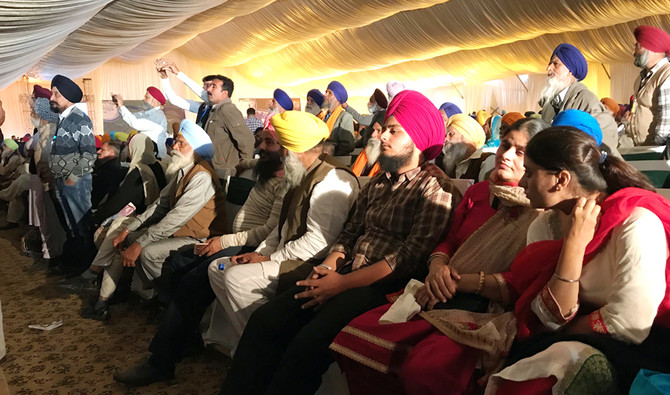
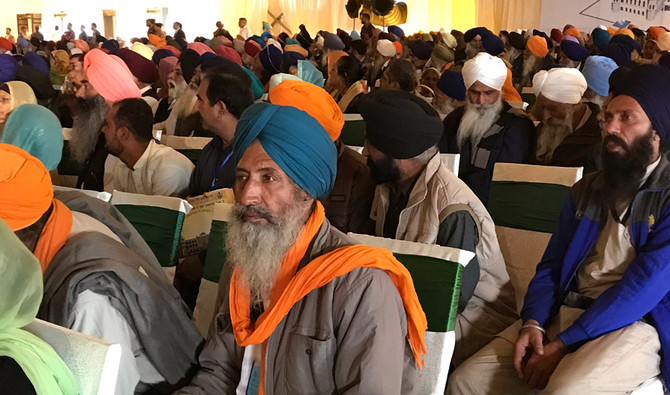
Khan, flanked by some of his federal ministers at the historic ceremony, addressed a large audience – which included diplomats, Indian ministers, and Sikhs -- and stressed that “it would be insanity to think of a war between two countries with nuclear weapons. Both sides would lose everything. It would be foolish to think one could win a nuclear war”.
“When war is not an option then the only path is friendship,” he said, sending a signal that Pakistan desires pleasant relations with its eastern neighbor.
Lauding the peace efforts of former Indian cricket star, television celebrity, and provincial cabinet minister Navjot Singh Sidhu who was also part of the event, the prime minister questioned why India would choose to criticize a man who was trying to thaw frosty relations between the two countries.
He said that the core issue of Jammu and Kashmir is a decades-old dispute which can only be resolved through the continuation of a dialogue. However, he added that “unless better sense prevailed in India, we may have to wait for Sidhu to become (India’s) Prime Minister”.
He added that the government, opposition parties, army, and all state institutions were on the same page in terms of seeking to improve ties with India and that there is consensus to urgently enhance trade, religious tourism, and people to people contact for the benefit of both sides.
Sidhu, while praising his ex-cricketer friend Imran Khan, congratulated him on the initiative and said that both governments need to realize they can’t look back but move forward. He added that the Kartarpur corridor was the first step towards improving relations.
“The Kartarpur spirit can make pilgrims of us all, venturing out on a journey that breaks the barriers of history and opens the borders of the heart and the mind. A journey that our people can walk together towards a future of shared peace and prosperity for India and Pakistan,” he said.


