

US to set up observation posts along Turkey-Syria border

Turkish and US troops began conducting joint patrols in the northern Syrian city of Manbij from Nov. 1. (File/Reuters)
Updated 22 November 2018
Follow

US to set up observation posts along Turkey-Syria border

  • Mattis announcement ‘will surely spark a new problem with Turkey,’ analyst tells Arab News
  • The US is consulting “closely” with the Turkish military, said Mattis

ANKARA: Wednesday’s announcement by Defense Secretary Jim Mattis that the US is set to install “observation posts” along parts of the Syrian-Turkish border has sparked debate about its possible security repercussions. 

The declared aim is to strengthen the focus on defeating Daesh in Syria. The posts will be manned by some of the 2,000 American troops already deployed in the country. 

Daesh still has a presence in eastern Syria, east of the Euphrates River near the border with Iraq.

The US is consulting “closely” with the Turkish military, said Mattis. 

But experts say his announcement will create further tensions between Washington and Ankara, as the latter will see this as benefitting the Syrian-Kurdish People’s Protection Units (YPG), which Turkey considers a terrorist group.

The announcement comes amid a recent rapprochement between Turkey and the US, whose troops began conducting joint patrols in the northern Syrian city of Manbij from Nov. 1. 
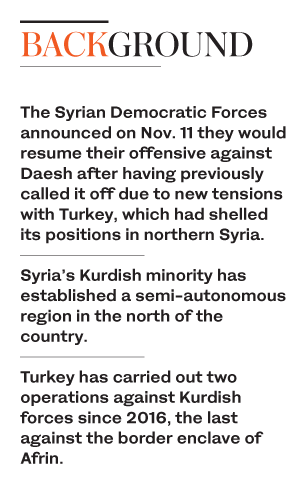
As part of a road map agreed in June by Washington and Ankara, the YPG is expected to withdraw from Manbij.

Sinan Hatahet, an expert on Syria at Al-Sharq Forum in Istanbul, told Arab News that the announcement by Mattis “will surely spark a new problem with Turkey, although it will have no impact on the ongoing cooperation in Manbij.”

The US is trying to strike a fine balance between maintaining its relationships with state actors in Syria and with its local partners on the ground, Hatahet said.

Sinan Ulgen, a former Turkish diplomat who chairs the Istanbul-based Center for Economics and Foreign Policy, said Ankara will likely react negatively to the announcement by Mattis, as it signals the continuation of US backing for the YPG. Turkish-US cooperation in Manbij could be damaged as a result, Ulgen added.

“Of interest will be whether Washington makes commitments in relation to these observation posts in terms of enhancing Turkey’s own border security,” he said.

Turkish Defense Minister Hulusi Akar recently criticized a photo of US soldiers having dinner with YPG members in Manbij.

“It is unacceptable for the US to provide arms and ammunition by plane and trucks to the YPG terrorist group even when Daesh has been neutralized to a large extent,” Akar said.

Oubai Shahbandar, a fellow at the New America think tank, said defeating Daesh requires a long-term sustainable solution.

“That means the US needs to… enhance its military cooperation with Turkey and with Sunni Arab forces on the ground to prevent the type of chaos that allows extremists like Daesh and the PKK (Kurdistan Workers’ Party) terror group to regain lost territory,” he told Arab News.

“The joint military patrols between American and Turkish forces in Manbij have so far been successful, and ought to serve as a model for what works for the rest of northeast Syria.”


Lebanon’s government approves a deal to transfer Syrian prisoners back to Syria

Updated 30 January 2026
Follow

Lebanon’s government approves a deal to transfer Syrian prisoners back to Syria

  • Lebanon and Syria have a complicated history with grievances on both sides
  • A key obstacle to warming relations has been the fate of about 2,000 Syrians in Lebanese prisons

BEIRUT: Lebanon’s Cabinet on Friday approved an agreement to transfer Syrian prisoners serving their sentences in Lebanon back to their home country.
The issue of prisoners has been a sore point as the neighboring countries seek to recalibrate their relations following the ouster of former Syrian President Bashar Assad in a lightning offensive by Islamist-led insurgents in December 2024. Former insurgent leader Ahmad Al-Sharaa is now Syria’s interim president.
Lebanon and Syria have a complicated history with grievances on both sides. Many Lebanese resent the decades-long occupation of their country by Syrian forces that ended in 2005. Many Syrians resent the role played by the Lebanese militant group Hezbollah when it entered Syria’s civil war in defense of Assad’s government.
A key obstacle to warming relations has been the fate of about 2,000 Syrians in Lebanese prisons, including some 800 held over attacks and shootings, many without trial. Damascus had asked Beirut to hand them over to continue their prison terms in Syria, but Lebanese judicial officials said Beirut would not release any attackers and that each must be studied and resolved separately.
The deal approved Friday appeared to resolve that tension. Lebanese Information Minister Paul Morcos said other issues remain to be resolved between the two countries, including the fate of Lebanese believed to have been disappeared into Syrian prisons during Assad’s rule and the demarcation of the border between the two countries.
Lebanon’s Deputy Prime Minister Tarek Mitri told reporters after the Cabinet meeting that about 300 prisoners would be transferred as a result of the agreement.
Protesters gathered in a square below the government palace in downtown Beirut ahead of the Cabinet vote to call for amnesty for Lebanese prisoners, including some who joined militant groups fighting against Assad in Syria. Some of the protesters called for the release of Sunni cleric Ahmad Al-Assir, imprisoned for his role in 2013 clashes that killed 18 Lebanese army soldiers.
“The state found solutions for the Syrian youth who are heroes and belong to the Syrian revolution who have been imprisoned for 12 years,” said protester Khaled Al- Bobbo. “But in the same files there are also Lebanese detainees. ... We demand that just as they found solutions for the Syrians, they must also find solutions for the people of this country.”