

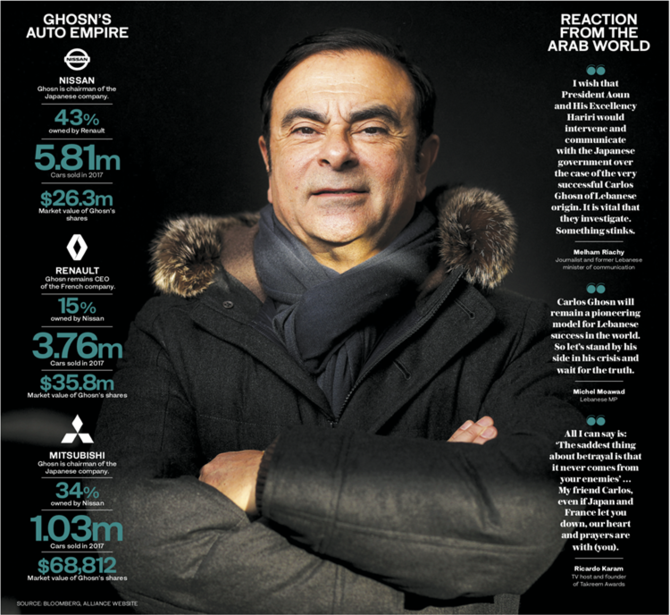

DUBAI: The Lebanese community at home and abroad has rallied around auto tycoon Carlos Ghosn, the Lebanese-Brazilian-French chairman of the Renault-Nissan-Mitsubishi Alliance, whose arrest on Monday by Japanese authorities following an internal investigation at Nissan over “significant acts of misconduct” sent shock waves through the industry.
While Ghosn was born in Brazil and divides his time between Paris and Tokyo, his grandfather was from Lebanon, and it is clear from the dismayed reaction this week that the community claims him as their own.
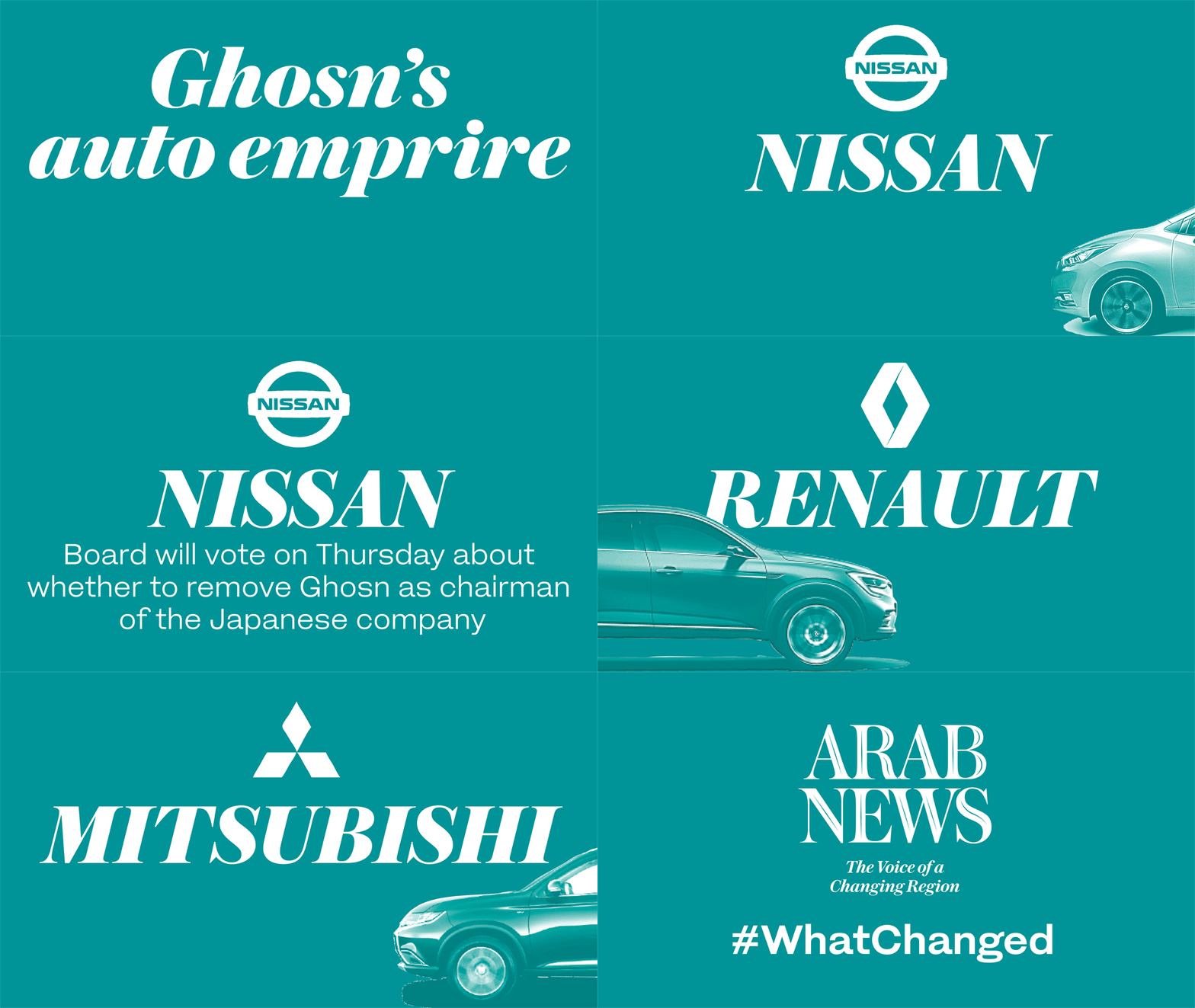
The results of an investigation into the alleged financial misconduct of the man credited with forging the world’s largest auto alliance are still pending, but many Lebanese referred to him as a role model and an ambassador for the country. And although Renault announced it would keep Ghosn as CEO, both Nissan and Mitsubishi said they would propose that their boards dismiss him.
“The news is shocking,” said Michel Hamam, partner at Kingpin Consultancy in Beirut. “What is more surprising is the behavior of Nissan and Mitsubishi’s officers and board, who emitted a judgment against him even before knowing the results of the authorities’ investigation. The content of the press conference given by the head of Nissan against the company’s chairman is unheard of, and you cannot but feel (there has been) an internal coup to oust him.”
Ghosn was indispensable when it came to reviving the company, Hamam said. “But now they believe they can do without him. He was always viewed in the Arab world, and worldwide, as a top-notch businessman and this will not change. His achievements speak for themselves.”
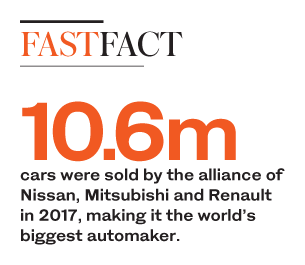
 The 64-year-old millionaire auto tycoon is one of the world’s most influential executives. In 2002, he was awarded Asia’s Businessman of the Year by Fortune magazine, followed by one of the top 10 most powerful people in business outside the US, in 2003.
Surveys by the Financial Times and PricewaterhouseCoopers also ranked him as the fourth most respected business leader in 2003, jumping one spot in both the following years. For many Lebanese, that reputation will remain.
“He was an ambassador carrying the name of Lebanon very high in the business sphere,” Hamam said. “While it is difficult to say if that will change since we have only heard one side of the story, there will be conflicting reactions to his arrest. Some will condemn him while others will ignore what happened — once the storm passes, he will still be highly regarded by Arab businessmen. After all, the reaction of Renault’s management is very important, confirming he is still the CEO of the company.”
For Robert Paoli, a Lebanese businessman in Beirut, the news came as a shock, with many questions unanswered. “I’m not sure a man like Carlos Ghosn, with such intelligence, can truly be that naive and make such mistakes, so we are really just waiting to find out the truth,” he said.
 “It was a massive shock for me. Having someone like Ghosn in the world was a sense of pride. He was much like our ambassador in business.”
Paoli cited a number of projects undertaken by Ghosn in Lebanon that raised his profile. “We saw so much in him and hoped that one day he would come back and work in Lebanese politics, potentially to manage the country’s finances,” he said.
“I don’t think anyone will change their opinion of him until after the results of the investigations.”
Many Lebanese in the Gulf echoed such sentiments, calling Ghosn a role model not only for Lebanese businessmen but also Arabs at large.
“Many people respected and admired him for what he brought to the automotive world,” said Jean-Pierre Mondalek, a Lebanese working in the UAE. “The news is disappointing, and I am keen to find out what comes out of this because being arrested does not necessarily equate to guilt, so he is technically innocent until proven guilty.
“As an enthusiast who works in the automotive industry and a Lebanese, I wonder, on a human level, how a man who was so impactful in the automotive world could get caught up in all this. So I’m interested to see how it all plays out.”
Samer Hamadeh, founder of Aegis Hospitality in Dubai, said the Ghosn case trumped any other business scandal.
“A giant is falling from grace and who knows who, or what, he will take down with him,” he said.
“Lebanon has seen its fair share of business villains, politically speaking, so Ghosn was the closest thing to a business hero. He represented a sense of pride the Lebanese don’t really get from their local businessmen,” Hamadeh said.
He believes public opinion of Ghosn was unlikely to change. “The region is used to business scandals, and this will end up like the rest of them — forgotten as soon as the next one comes along.”
Others agreed, saying that such cases had happened countless times in the business world, with its intricate rules and regulations.
“Ghosn is known to be one of the hardest-working men in the automobile industry,” said Walid Kanaan, a Lebanese businessman in the Gulf. “He adds great weight to the success of the Lebanese diaspora and was an example showing that Lebanese businessmen have attained the highest positions in the biggest companies in the world.”
 For Pierre Haddad, a Lebanese working in Abu Dhabi, Ghosn’s arrest was anything but a surprise, coming after years of Japanese efforts to replace him as head of one of the world’s largest car manufacturers.
“Just a few years back, an attempt to limit his power over Renault failed,” Haddad said. “For now, the arrest publicized in the media is one-sided, and wise men should wait for the defense’s counterattack.”
In the eyes of the Arab world, and especially the Lebanese, Ghosn was a hero. “No matter what they try, he will remain the leader, the driver, the innovator and visionary of modern times. His image will remain shining,” Haddad said. “The final judgment is the one that counts and, regretfully, several years may slip before (that arrives).”
However, at least one academic believes Ghosn’s arrest will raise questions in the minds of other business people around the world, including the Gulf.
“Ghosn is one of the best-known global business leaders,” said Andre Spicer, professor of organizational behavior at Cass Business School, part of City, University of London. “There will be questions about whether Ghosn continues to be able to speak for business globally and whether he is able to hold together the multinational alliance of Nissan, Mitsubishi and Renault.”
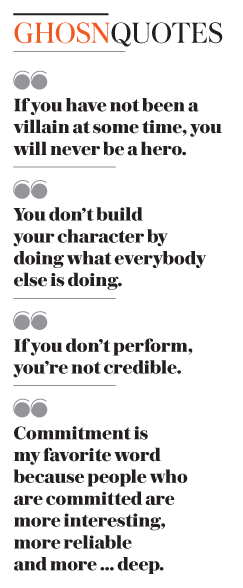
Spicer described Ghosn’s fall as a classic case of executive hubris. “Since being credited with turning around Nissan, he has been seen as a corporate demigod. He is featured in business books and has been the subject of case studies used to teach managers in training. In addition, he has become increasingly powerful in Nissan, Renault and Mitsubishi, all of which has fueled a sense he almost has superhuman abilities. When this happens, leaders start to think the normal rules don’t apply to them.”
Ghosn’s departure could be an existential threat for all three companies since he had built a complex alliance between three automakers that served as the centerpiece of the car maker’s strategy.
“The only thing holding it together was Ghosn,” Spicer added. “With him out of the picture, old differences between the companies could come to fore, the alliance could fall apart, and this would have profound implications for the direction of each company — particularly in an industry undergoing disruptive change.”


