
PESHAWAR: The keyboard is indeed mightier than the sword.
Following a story published by Arab News last week – which highlighted how children in Pakistan’s tribal areas were unable to acquire an education due to a lack of facilities and were thus forced to study under the open skies — the military in the South Waziristan region has swung into action.
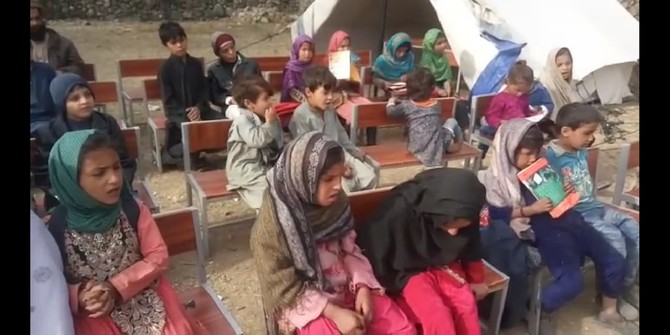
According to information received by Arab News, which was circulated on behalf of the military from the area: “A tent school has been established by the army in far-flung areas of Tehsil Makin as a temporary facility. Moreover, work on the construction of a permanent structure has also started which will be completed within a short span of time.”
Provisions have also been made for furniture, books, and stationery for children attending a school in Shereen Khel --- a small village on the outskirts of Makeen --- in the volatile region where a majority of the families were displaced during a crackdown by the military to rid the areas of militants.
At the moment, more than 52 students are benefitting from the facility in Shireen Khel.
Arab News had spoken to several top officials and tribal leaders who had said at the time that Prime Minister Imran Khan – staying true to his campaign and electoral promises — had ensured that the Federally Administered Tribal Areas (FATA) were eventually merged with the Khyber Pakhtunkhwa province.
When the bill finally became a law in May this year, it gave residents ample reasons to celebrate. However, today, nearly six months after the merger, several complained that children were being denied their basic right to education, which continues to remain a distant dream.
Tribesmen from the volatile region urged the government to prioritize the education sector, adding that hundreds of children had dropped out of school as they were forced to study under the open skies due to a lack of properly-constructed facilities in the South Waziristan, Bajaur and other tribal districts.
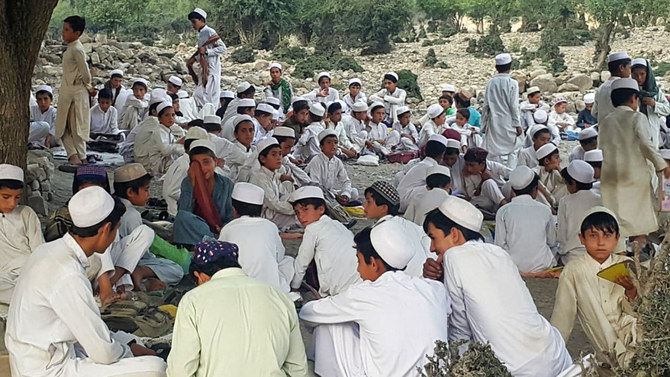
One such example was that of Shereen Khel where nearly 204 children were studying under a tree in Makeen --- a scenic valley once regarded as the epicenter of insurgency and the hometown of former Tehrik-e-Taliban Pakistan leader, Baitullah Mehsud.
Surrounded by jagged mountains, the Shereen Khel village boasts a population of roughly 2,000 but has no buildings for its school.
Mir Kalam, a tribesman from the area who teaches children voluntarily, said that because of this reason he has been teaching children for the past one year without getting any incentives for his services.
“I teach children voluntarily to create awareness among them and to make them responsible citizens of the country,” Kalam had said.
According to Shoaib Khan, a senior official at the FATA Education Directorate, roughly around 400,000 children are out of school in the tribal areas but plans are being implemented to enroll them.
When contacted Sikandar Hayat Mehsud, a local from the South Waziristan region said that the military in the area acted swiftly after getting wind of the report and ensured the provision of basic facilities for the school, a move which was widely lauded by the local residents.
“This is really extraordinary development when the media points out a problem and the authorities respond. The military move to shift basic facilities to the school which was functioning in open is a sigh of relief for the people who are busy building their lives from scratches because they have just been repatriated after spending years in displacement,” he said.
Mehsud added that he had shared the Arab News article in certain WhatsApp groups, prompting the authorities to get into action. “I’m sure the Arab News that article has great contributions to turn it into a formal educational institution,” Mehsud said.
THE COMPARISON
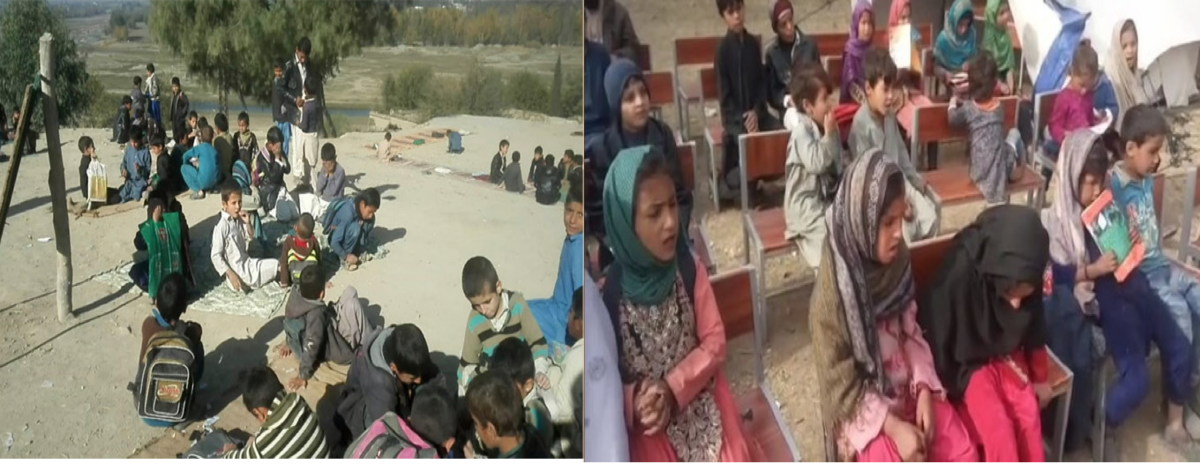
The condition of the school one week ago, left, and today. (AN photo)
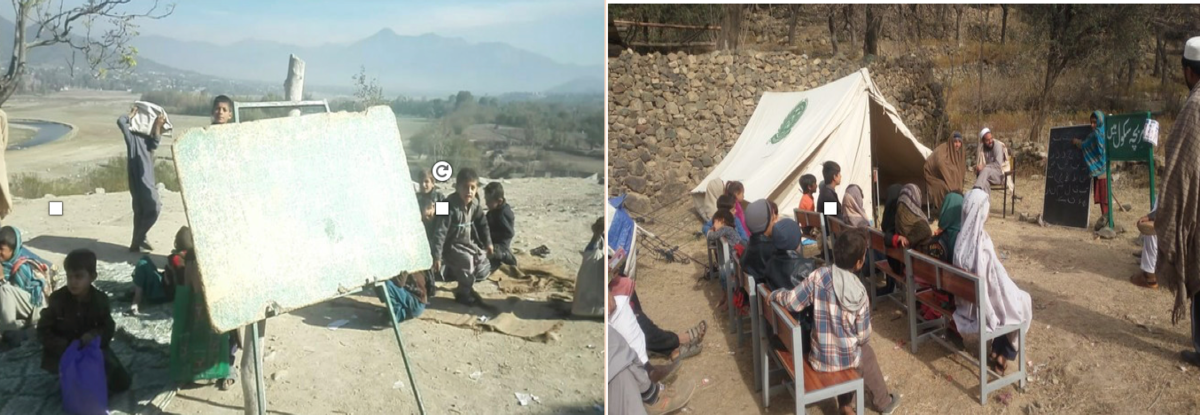
The condition of the school one week ago, left, and today. (AN photo)