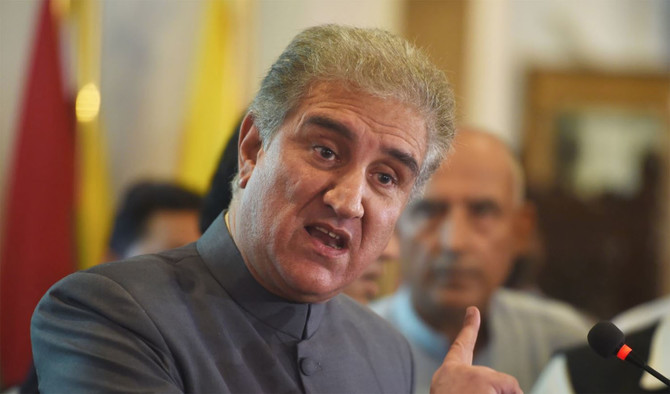
ISLAMABAD: In comments that could add more fuel to the diplomatic fire between Islamabad and Washington, Foreign Minister Shah Mehmood Qureshi termed US President Donald Trump as a “reckless man”, even as he urged both the countries to work toward “resetting ties”.
Qureshi is the latest leader to join the war of words between Trump and Prime Minister Imran Khan after the former alleged that Pakistan had not done a “damn thing” for the US in exchange for all the aid provided by Washington.
In an interview with a local television channel aired on Monday night, Qureshi said: “Blaming Pakistan for the US’ failures in Afghanistan is not fair.” He said the world knew Trump as a “reckless man”, adding that “resetting ties was a need for both countries”.
“The US is in dire need for a partner to help it in Afghanistan and do some face-saving for it. Therefore, if the US seeks Pakistan’s role in bringing peace and stability in Afghanistan, it should acknowledge Pakistan’s cooperation and support rendered thus far,” he said.
After Trump responded to Khan’s tweet claiming that Pakistan is among many countries that take from the US without giving anything in return, Khan, on Monday, fired back saying Trump’s false assertions only added insult to injury and that Pakistan would now do what was best for its own interests.
“Trump’s false assertions add insult to the injury Pakistan has suffered in the US War on Terror in terms of lives lost and destabilized economic costs. He needs to be informed about historical facts. Pakistan has suffered enough fighting US’s war. Now we will do what is best for our people and our interests,” Khan tweeted.
His comments follow other tweets posted on Monday where he sought to set the record straight by telling Trump to quit using Islamabad as a “scapegoat” in his “tirade” against the country.
In a four-point tweet, Khan explained why Trump’s comments were unjustified, reasoning that “No Pakistani was involved in 9/11 but Pakistan decided to participate in the US war on terror” nevertheless.
He added that while Pakistan suffered 75,000 casualties in the war and incurred losses of more than $123 billion to the economy, the aid provided by the US was “a minuscule $20 billion”.
Elaborating on the catastrophic effect that the war on terror had on Pakistan’s tribal region and on the lives of its ordinary citizens, he said: “Our tribal areas were devastated and millions of people uprooted from their homes. The war drastically impacted the lives of ordinary Pakistanis.”
In his concluding remarks PM Khan said that instead of making “Pakistan a scapegoat for their failures, the US should do a serious assessment of why, despite 1,40,000 NATO troops plus 250,000 Afghan troops and reportedly $1 trillion spent on the war in Afghanistan, the Taliban today are stronger than before.”
He ended his statement by asking Trump is he could “name another ally that gave such sacrifices”.
Trump then responded to Khan by saying that: “Of course we should have captured Osama Bin Laden long before we did. I pointed him out in my book just BEFORE the attack on the World Trade Center. President Clinton famously missed his shot. We paid Pakistan billions of dollars and they never told us he was living there. Fools!”
He further claimed that “we no longer pay Pakistan the $billions because they would take our money and do nothing for us, Bin Laden being a prime example, Afghanistan being another. They were just one of many countries that take from the United States without giving anything in return. That’s ENDING!”
In an interview with Fox News aired on Sunday, Trump justified the cancelation of $300 million in military aid to Pakistan by saying that “we’re supporting Pakistan, we’re giving them $1.3 billion a year — which we don’t give them any more, by the way, I ended it because they don’t do anything for us, they don’t do a damn thing for us.”
Talking about slain Al Qaeda leader Osama bin Laden who was found hiding in Pakistan, a short distance away from the country’s prestigious military academy, Trump added that “everybody in Pakistan knew he was there”.
Federal Minister for Human Rights, Dr. Shireen Mazari, issued a statement on Monday terming “Trump’s tirade against Pakistan” a lesson for all those Pakistani leaders “who kept appeasing the US especially after 9/11!”
She added that the “loss of Pakistani lives in the US war on terror, the free space for Raymond Davis and other operatives, the illegal killings by drone attacks — the list is endless…once again history shows appeasement does not work”.
“Whether China or Iran, the US policies of containment and isolation do not coincide with Pakistan’s strategic interests,” she said.
Former Senate Chairman, Raza Rabbani, termed Trump’s remarks “contrary to the facts” and reminded the US president that his “language regarding a sovereign state was aggressive”.
“He should be careful; Pakistan is not a state or colony of the US,” Rabbani said, further reminding Trump that “the US killed Pakistanis in unauthorized drone attacks, the US-sponsored terrorism in Kabul, and a drug industry was created on the Pak-Afghan border for the financial assistance of the US”.
“The Pakistani nation is paying the price of political and economic instability due to its alliance with the US,” he said.
Former Foreign Minister, Khawaja Asif, also took to Twitter to rebuff the US president’s remarks saying, “We continue to pay in blood for what we did for the USA.”
In a tweet which was later deleted, the Pakistan Tehreek-e-Insaf party claimed that the US government “is having an extremely hard time accepting the fact that the current Government of Pakistan being led by @ImranKhanPTI will not accept the terms and conditions they want to enforce on Pakistan; Wake up! #PMIKSaysNoMore”
The already strained relations between the US and Pakistan took a turn for the worse in January this year when Trump suspended security assistance to Islamabad over the alleged presence of Afghan militant groups in Pakistan’s tribal belt — a claim rejected by Islamabad.


![]()

Qureshi terms Trump “reckless”, says blame game unfair
Qureshi terms Trump “reckless”, says blame game unfair
- Foreign Minister reacts to unsavory comments posted by US president on social media
- Tweets forced PM Khan to hit back with an equal measure
Latest updates


© 2026 SAUDI RESEARCH & PUBLISHING COMPANY, All Rights Reserved And subject to Terms of Use Agreement.