Libya planning to extradite Manchester bomber’s brother

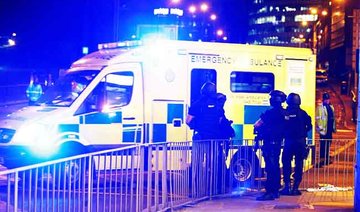
Britain last year submitted a request to extradite Hashem Abedi. (Ahmed Bin Salman, Special Deterrent Force via AP)
Updated 15 November 2018
Follow

Libya planning to extradite Manchester bomber’s brother

  • Abedi's brother, Salman, detonated the bomb, killing himself, outside one of the arena exits shortly after the end of a concert by pre-teen idol Ariana Grande

Libya is planning to extradite the brother of Manchester Arena bomber Salman Abedi to Britain by the end of the year, Libya’s UN-backed Prime Minister Fayez Al-Sarraj told the BBC in an interview.

Britain last year submitted a request to extradite Hashem Abedi after the bombing in May 2017 in which 22 people — many of them minors — were killed.

Abedi detonated the bomb, killing himself, outside one of the arena exits shortly after the end of a concert by pre-teen idol Ariana Grande.

Hashem Abedi is suspected of involvement and is wanted by Manchester police on charges of murder, attempted murder and conspiracy to cause explosions.
In an interview with the BBC on the sidelines of an international conference in Italy, Al-Sarraj said: “I think from here to the end of this year we will finish all the legal procedures in Libya.

“We are fully cooperating because we understand the suffering of the families of the victims of this terrorist attack.

“According to the general prosecutor we can extradite. After we complete the legal process in Libya it is only a matter of time.”

When Britain first made the extradition request in November 2017, the armed group holding him refused it.

The Manchester Arena bombing was Britain’s worst terror attack in more than a decade.

Salman Abedi was born in Manchester in 1994, to parents who had been granted asylum after fleeing Muammer Qaddafi’s regime.

He was in Libya just days before the attack.

AI reshaping the battle over the narrative of Maduro’s US capture

Updated 7 sec ago
Follow

AI reshaping the battle over the narrative of Maduro’s US capture

  • Since the US captured Venezuelan leader Nicolas Maduro in early January, pictures and videos chronicling the events have been crowded out by those generated with artificial intelligence
CARACAS: Since the US captured Venezuelan leader Nicolas Maduro in early January, pictures and videos chronicling the events have been crowded out by those generated with artificial intelligence, blurring the lines between fiction and reality.
The endless stream of content ranges from comedic memes to dramatic retellings.
In one, a courtroom illustration of Maduro in a New York courthouse springs to life and announces: “I consider myself a prisoner of war.”
In another, an AI-generated Maduro attempts to escape a US prison through an air duct, only to find himself in a courtroom with US President Donald Trump, where they dance with a judge and an FBI agent to a song by American rapper Ice Spice.
Maduro was captured alongside his wife Cilia Flores during US strikes in the Venezuelan capital of Caracas on January 3.
They have since been taken to a prison in New York where they are being held on drug trafficking charges.
While some have celebrated Maduro’s ouster, the “Chavismo” movement he leads — named after his predecessor Hugo Chavez — has worked to reframe what his fall means for Venezuela’s future.
- ‘ Confuse, combat, and silence’ -
Leon Hernandez, a researcher at Andres Bello Catholic University, told AFP that with AI’s rapid creation of content, we see development of “disinformation labs” that flood social media platforms.
“There were things that circulated that were not real during the capture (of Maduro), and things that circulated which were real that generated doubt,” Hernandez said.
“That was the idea: to create confusion and generate skepticism at the base level by distorting certain elements of real things.”
The goal, he added, is for the content to overwhelm audiences so they cannot follow it.
Even legacy media such as the Venezuelan VTV television channel are in on it, with the broadcaster playing an AI-animated video narrated by a child recounting Maduro’s capture.
“AI has become the new instrument of power for autocrats to confuse, combat, and silence dissent,” said Elena Block, a professor of political communication and strategy at the University of Queensland in Australia.
- ‘Greatest threat to democracy’ -
Block pointed out the use of cartoons, specifically, had been a medium of propaganda used in both authoritarian and democratic states.
Long before his arrest, Maduro was depicted as the illustrated superhero “Super Bigote” or “Super Mustache,” donning a Superman-like suit and fighting monsters like “extremists” and the “North American empire.”
The cartoon’s popularity spawned toys that have been carried by Maduro’s supporters during rallies advocating for his return.
And much like his predecessor, Maduro continued a practice of “media domination” to stave off traditional media outlets from airing criticism of Chavismo.
“With censorship and the disappearance or weakening of news media, social media has emerged as one of the only spaces for information,” Block said.
Maduro is not the only leader to use AI propaganda — Trump has frequently posted AI-generated pictures and videos of himself with “antagonistic, aggressive, and divisive language.”
“These digital and AI tools end up trivializing politics: you don’t explain it, you diminish it,” Block said. “AI today is the greatest threat to democracy.”