

Morocco inaugurates Africa’s fastest train

1 / 6
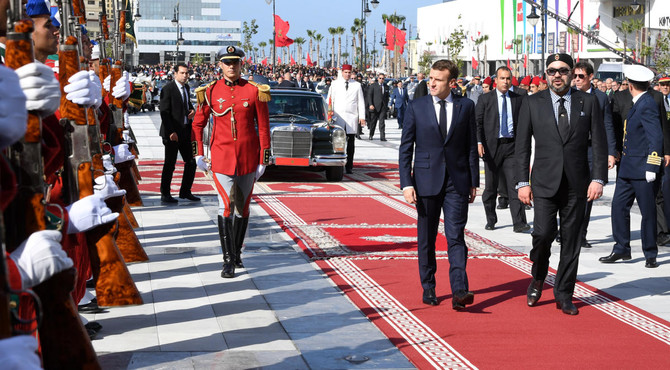
French President Emmanuel Macron and Moroccan King Mohammed VI review a honour guard after launching Africa's fastest train. (AFP)
2 / 6
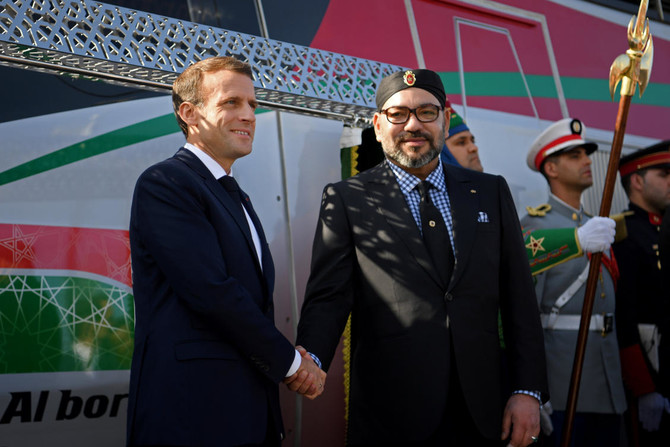
President Emmanuel Macron and King Mohammed VI shake hands as they inaugurate a high-speed line. (Reuters)
3 / 6
President Emmanuel Macron and King Mohammed VI arrive to inaugurate high-speed train. (Reuters)
4 / 6
Morocco inaugurates Africa’s fastest train. (AFP)
5 / 6
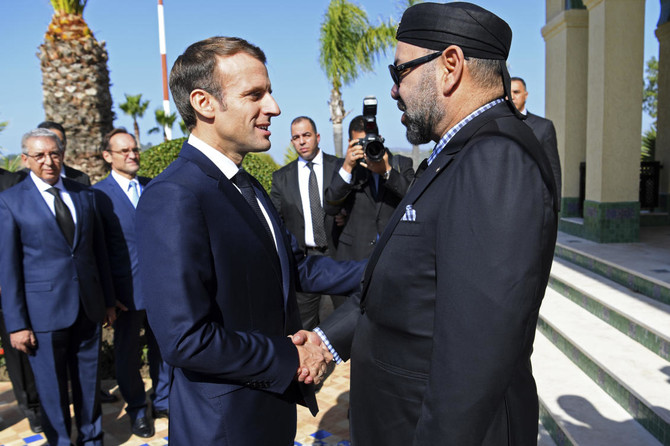
President Emmanuel Macron is welcomed by King Mohammed VI at Tangiers' airport, Morocco. (AP)
6 / 6
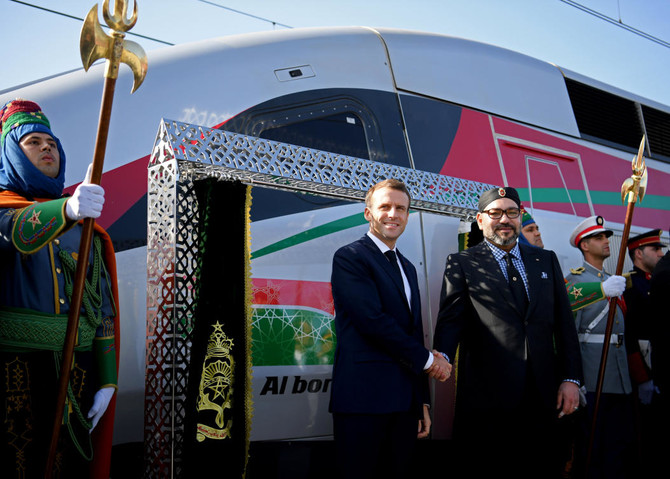
President Emmanuel Macron and King Mohammed VI pose for a photograph at Rabat train station. (Reuters)
Updated 15 November 2018
Follow

Morocco inaugurates Africa’s fastest train

  • King Mohammed VI and French President Emmanuel Macron boarded the train for the inaugural trip from Tangier to the capital Rabat
  • The high-speed line was completed at a total cost of 22.9 billion dirhams ($2.4 billion)

RABAT: Morocco inaugurated on Thursday Africa’s fastest train which will halve traveling time between the commercial and industrial hubs of Casablanca and Tangier.
After seven years of work on the high-speed railway line, King Mohammed VI and French President Emmanuel Macron boarded the train for the inaugural trip from Tangier to the capital Rabat.
The train, which was tested at a speed of 357 km (222 miles)per hour and is planned to run at 320 km (198 miles) per hour, will more than halve the 200 km (124 miles)Casablanca-Tangier journey to around two hours. It is about twice as fast as South Africa’s high-speed Gautrain linking Johannesburg’s international airport to the city’s financial district Sandton.

The high-speed line was completed at a total cost of 22.9 billion dirhams ($2.4 billion), according to state news agency MAP. Transport officials were not immediately available for comment. 51 percent of the project was financed by France, Morocco contributed 28 percent and the remaining 21 percent was provided by Saudi Arabia, Kuwait and the United Arab Emirates. 
Morocco bought 12 double-decker high-speed-trains from French group Alstom that will be operated by state-owned railway ONCF which expects six million passengers on the new train service annually.
The king named the first line Al Boraq after a mythical winged creature that transported the prophets to the heavens. While the Moroccan government and businesses praised the project as a key achievement in developing the country's infrastructure, the line has sparked controversy for its high cost. Critics say that Morocco should be investing in education and health instead.

Officials have said the project will boost growth in Tangier and help attract more investments to northern Morocco where one of Africa’s largest ports is located.
But critics perceive the project as symbolising a two-speed Morocco further accentuating disparities between territories as vast regions in the south and key cities such as Agadir remain without a basic train service.
A train derailment last month near Kenitra 15 km (10 miles) north of Rabat, which killed seven people and injured 125 others, triggered calls for a better allocation of resources by giving priority to improving safety and infrastructure as well as punctuality of basic railway services.


Trump says change of power in Iran would be ‘best thing’

Updated 14 February 2026
Follow

Trump says change of power in Iran would be ‘best thing’

  • Trump’s comments were his most overt call yet for the toppling of Iran’s clerical establishment
  • USS Gerald R. Ford — the world’s largest warship — would be “leaving very soon” for the Middle East

WASHINGTON: US President Donald Trump said Friday that a change of government in Iran would be the “best thing that could happen,” as he sent a second aircraft carrier to the Middle East to ratchet up military pressure on the Islamic republic.

Trump’s comments were his most overt call yet for the toppling of Iran’s clerical establishment, and came as he pushes on Washington’s arch-foe Tehran to make a deal to limit its nuclear program.

At the same time, the exiled son of the Iranian shah toppled in the 1979 Islamic revolution renewed his calls for international intervention following a bloody crackdown on protests by Tehran.

“Seems like that would be the best thing that could happen,” Trump told reporters at the Fort Bragg military base in North Carolina when a journalist asked if he wanted “regime change” in Iran.

Trump declined to say who he would want to take over in Iran from supreme leader Ayatollah Ali Khamenei, but he added that “there are people.”

He has previously backed off full-throated calls for a change of government in Iran, warning that it could cause chaos, although he has made threats toward Khamenei in the past.

Speaking earlier at the White House, Trump said that the USS Gerald R. Ford — the world’s largest warship — would be “leaving very soon” for the Middle East to up the pressure on Iran.

“In case we don’t make a deal, we’ll need it,” Trump said.

The giant vessel is currently in the Caribbean following the US overthrow of Venezuela’s Nicolas Maduro. Another carrier, the USS Abraham Lincoln, is one of 12 US ships already in the Middle East.

‘Terribly difficult’

When Iran began its crackdown on protests last month — which rights groups say killed thousands — Trump initially said that the United States was “locked and loaded” to help demonstrators.

But he has recently focused his military threats on Tehran’s nuclear program, which US forces struck last July during Israel’s unprecedented 12-day war with Iran.

The protests have subsided for now but US-based Reza Pahlavi, the son of Iran’s last shah, urged international intervention to support the Iranian people.

“We are asking for a humanitarian intervention to prevent more innocent lives being killed in the process,” he told the Munich Security Conference.

It followed a call by the opposition leader, who has not returned to his country since before the revolution, for Iranians at home and abroad to continue demonstrations this weekend.

Videos verified by AFP showed people in Iran this week chanting anti-government slogans as the clerical leadership celebrated the anniversary of the Islamic revolution.

Iran and the United States, who have had no diplomatic relations since shortly after the revolution, held talks on the nuclear issue last week in Oman. No dates have been set for new talks yet.

The West fears the program is aimed at making a bomb, which Tehran denies.

The head of the UN nuclear watchdog, Rafael Grossi, said Friday that reaching an accord with Iran on inspections of its processing facilities was possible but “terribly difficult.”

Reformists released

Trump said after talks with Israeli Prime Minister Benjamin Netanyahu earlier this week that he wanted to continue talks with Iran, defying pressure from his key ally for a tougher stance.

The Israeli prime minister himself expressed skepticism at the quality of any agreement if it didn’t also cover Iran’s ballistic missiles and support for regional proxies.

According to the US-based Human Rights Activists News Agency, 7,008 people, mostly protesters, were killed in the recent crackdown, although rights groups warn the toll is likely far higher.

More than 53,000 people have also been arrested, it added.

The Norway-based Iran Human Rights (IHR) NGO said “hundreds” of people were facing charges linked to the protests that could see them sentenced to death.

Figures working within the Iranian system have also been arrested, with three politicians detained this week from the so-called reformist wing of Iranian politics supportive of President Masoud Pezeshkian.

The three — Azar Mansouri, Javad Emam and Ebrahim Asgharzadeh — were released on bail Thursday and Friday, their lawyer Hojjat Kermani told the ISNA news agency.