

Libya rivals arrive for Italy summit after December election shelved
Libya rivals arrive for Italy summit after December election shelved/node/1403351/middle-east
Libya rivals arrive for Italy summit after December election shelved
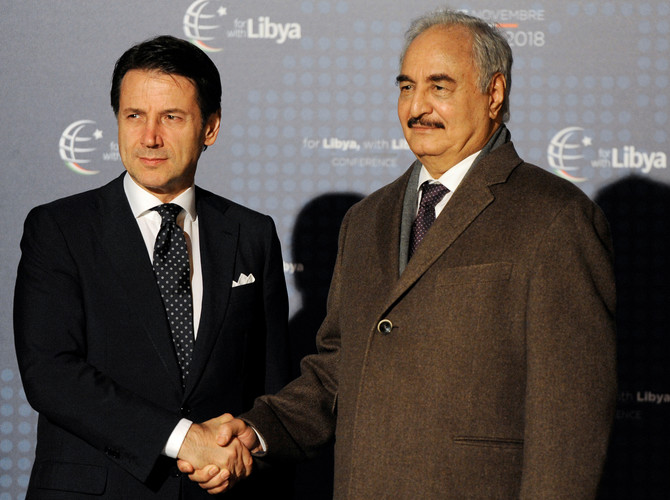
Italy's Prime Minister Giuseppe ConteÊwelcomes Libyan military commander Khalifa Haftar as he arrives at the venue of the international conference on Libya in Palermo, Italy, November 12, 2018. (Reuters)
Libya rivals arrive for Italy summit after December election shelved
Italian officials were scrambling at the weekend to secure Haftar’s attendance to the ongoing Palermo conference in Rome
If he shows up, it will be his first meeting with the Tripoli-based Prime Minister Fayez Al-Serraj since a Paris summit in May
Updated 12 November 2018
Reuters
PALERMO: The rulers of Libya’s rival east and west were gathering at a summit for the first time in more than five months on Monday, a week after the United Nations buried plans to hold an election next month.
Khalifa Haftar, the strongman ruling most of Libya’s east, arrived in the evening in the Italian city of Palermo for a two-day summit to discuss a UN peace plan to stabilize the North African country, in turmoil since 2011.
Libya’s prime minister Fayez Al-Serraj, who is based in the west and has limited authority, arrived earlier on Monday.
Italy hopes the conference will resurrect UN efforts to stage elections in Libya, after the United Nations announced last week that the OPEC member country could not hold a planned election on Dec. 10 because of violence and stalled talks.
The summit will assemble Libya’s main rivals for the first time since a similar event in Paris in May, where they had agreed to the plan to hold the December election.
It was not clear whether the Libyan participants would actually meet directly. Italian Prime Minister Giuseppe Conte will hold some bilateral meetings including with Haftar late on Monday, an official said.
Serraj’s western-based government is internationally recognized but has struggled to assert its authority in a country still mostly controlled by armed groups, eight years after NATO-backed rebels toppled former dictator Muammar Qaddafi in 2011.
A rival government is based in the east, where most towns and cities are under the control of Haftar.
Apart from Haftar, the heads of the two parliaments based in the east and west, Aguila Saleh and Khalid Al-Mishri, were also attending, officials said.
Italy, the former colonial power, has vast oil and gas interests in Libya and has been trying to shut down people-smuggling from the Libyan coast.
It has been eager to host a high-profile event, competing with France which staged the May conference.
Apart from Western, UN and Russian officials, Egyptian President Abdel Fattah El-Sisi was also attending.
UN Libya envoy Ghassan Salame told Reuters he hoped another attempt to hold an election will take place by June but Libyans should first hold a national conference in early 2019 to decide on the poll’s format.
“We want to ask at the national conference what type of election do you want: parliamentary or presidential, and what kind of law,” Salame said.
The envoy said the national conference should “preferably” take place on Libyan soil. Surveys had shown that 80 percent of Libyans want elections to end the stalemate between Libya’s rival administrations.
He hoped the Palermo conference would put pressure on the internationally recognized parliament, the House of Representatives (HOR), which has failed to pass an election law.
“The HOR has been sterile, has produced no law ... I think we need wider representation of the Libyans,” he said.
France has been courting Haftar, who is supported by Egypt and the United Arab Emirates, which see his forces as a bulwark against Islamists.
Italy is the main backer of Serraj and his weak Government of National Accord (GNA), and has worked with local groups in Libya to stop Europe-bound migrants from embarking by boat.
Epstein tried to build web of powerful ties across Middle East, documents show
Updated 8 sec ago
DUBAI: The departure of the chief executive of Dubai port giant DP World is the biggest fallout in the Middle East from US Department of Justice documents which show that disgraced financier Jeffrey Epstein tried to build a powerful network of political figures and business leaders across the region. DP World announced on Friday that Sultan Ahmed Bin Sulayem had resigned as chief executive and chair. The decision to act was taken after Bin Sulayem’s name appeared in the Epstein files, two sources with direct knowledge of the matter told Reuters, and as his relationship with the late convicted sex offender faced increasing scrutiny. In their correspondence, Bin Sulayem discussed sexual relationships with women with whom Epstein helped him connect. In an email dated November 9, 2007, Bin Sulayem told Epstein he had met one such woman in New York, whom he does not name and with whom he said he did not have sex. “Yes after several attempts for several months we managed to meet in NY,” he wrote, adding that there was a misunderstanding because “she wanted some BUSINESS! while i only wanted some PUSSYNESS!“ Dubai’s ruler on Friday also issued a decree appointing a new chairman for Dubai’s Ports, Customs and Free Zone Corporation, one of several roles Bin Sulayem held. Reuters was able to independently review only some of the Epstein files relating to Bin Sulayem and was unable to ascertain what specifically led to his departure from DP World although the sources said, without providing further details, that it was related to the files. Bin Sulayem did not respond to Reuters requests for comment on his departure. DP World declined to comment. COOKING TOGETHER In one email exchange, Epstein described Bin Sulayem as funny, trustworthy and a foodie. Epstein went on to say that Bin Sulayem, a Muslim, does not drink and prays five times a day. An undated photograph that appears in an email and is publicly available shows Epstein cooking with Bin Sulayem and the two of them looking relaxed together. The full name of the person it was sent to by Epstein is not provided. Bin Sulayem has not publicly commented on Epstein’s description or the emails about his relationship with him. Being named in the file is not evidence of criminal activity. But after members of the US Congress said Bin Sulayem’s name appeared in files released by the US Department of Justice (DOJ), he faced renewed questions from some of DP World’s financial backers over his past interactions. Bin Sulayem did not respond publicly to those concerns. The UK development finance agency, British International Investment, and Canada’s second-largest pension fund said last week they would suspend all new investment with DP World over Bin Sulayem’s alleged ties to Epstein. “We are shocked by the allegations emerging in the Epstein Files regarding Sultan Ahmed Bin Sulayem,” said a spokesperson for BII, without saying which allegations he was referring to. “In light of the allegations, we will not be making any new investments with DP World until the required actions have been taken by the company.” Canadian pension fund La Caisse said it was “pausing additional capital deployment alongside the company” until DP World clarified the situation and took “the necessary actions.” In a statement after Friday’s leadership changes at DP World, BII welcomed DP World’s decision and said it looked forward to continuing “our partnership to advance the development of key African trading ports.” La Caisse said “the company took the appropriate measures” and that it would “move quickly to work with DP World’s new leadership to continue our partnership on port projects around the world.” Bin Sulayem did not immediately respond when asked by Reuters to comment on the actions taken by BII and La Caisse. DP World declined comment. NETWORK OF CONTACTS The large cache of documents released by the DOJ, including text messages and emails, also shows the Middle East was no exception to Epstein’s efforts to use his wealth to build relationships with prominent people in politics, finance, academia and business around the world. Reuters was unable to ascertain how successful Epstein was in seeking to influence his contacts in the Middle East, and whether his advice was heeded. The DOJ documents reviewed by Reuters show Epstein tried to advise Qatari business leaders and political figures during the 2017-21 blockade of Qatar by Saudi Arabia, the United Arab Emirates, Bahrain and Egypt over accusations that Doha failed to curb ties with Iran and supported terrorism, which Qatar denied. In exchanges with a Qatari businessman and ruling family member Sheikh Jabor Yousuf Jassim Al Thani, Epstein urged Qatar to “stop kicking and arguing...let the heat come down a bit.” He said “the current Qatar team is very weak” and “FM is not experienced and it shows.” Qatar’s foreign minister at the time was Sheikh Mohammed bin Abdulrahman Al Thani, who now serves as both foreign minister and prime minister. Sheikh Mohammed has not commented publicly on Epstein’s portrayal of him. Asked about the exchange, Qatar’s International Media Office, which handles media requests for the prime minister, declined to comment. There was no response to a Reuters request for comment emailed to three companies in Qatar that Sheikh Jabor is listed as chairman of, or to a text message sent to an individual who, according to the files released by the DOJ, works in Sheikh Jabor’s office. Epstein urged Doha to forge links with Israel to stay in the good graces of Donald Trump, who was then in his first term as US president. He suggested the Gulf state either move toward recognizing Israel or pledge $1 billion to a fund for terrorism victims. Ultimately, Qatar stuck to its independent course. In 2021, the blockading countries restored ties with Doha, and ties between the Trump administration and Qatar are now strong. DISCUSSION OF SAUDI ARAMCO IPO Epstein discussed Saudi Aramco’s initial public offering in dozens of email exchanges. In one exchange dated September 10, 2016, with a person named as Aziza Alahmadi, and with former Norwegian diplomat Terje Roed-Larson copied in, Epstein warned that Aramco going public could expose Saudi Arabia to lawsuits and asset seizures. Saudi Aramco declined to comment on these emails. Alahmadi could not be reached for comment and Reuters was unable to establish her role, if any, in Epstein’s activities. In an email dated October 16, 2017, and also sent to Alahmadi, Epstein suggested selling China an option to buy a $100-billion stake in Aramco rather than pursuing a traditional IPO, saying it would provide liquidity while limiting exposure to public markets. Saudi Aramco declined to comment to Reuters on the emails. Roed-Larsen did not immediately respond to a request for comment sent by email via his lawyer. Epstein’s reach also extended to Egypt, the documents released by the DOJ show. Some emails show a request from a family member of Hosni Mubarak — the wife of his son Gamal Mubarak — that was passed on to Epstein asking for help in 2011, following the former president’s ouster and subsequent legal troubles. They did not say what kind of assistance was sought and Reuters was unable to establish whether Epstein had tried to intercede on the family’s behalf. Reuters emailed a request for comment to one lawyer and sent a text message to another, both of whom represented Gamal Mubarak. There was no immediate response.