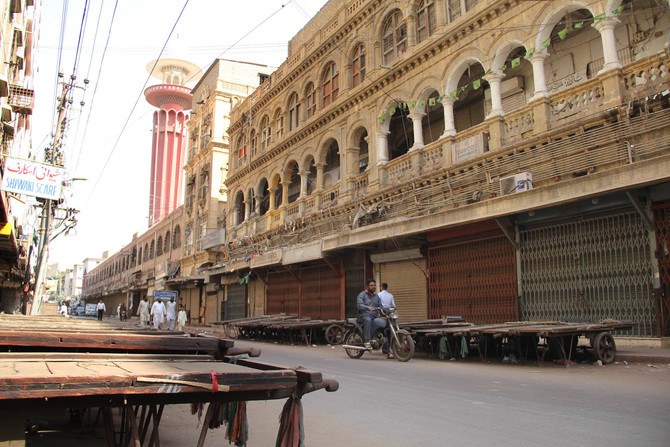
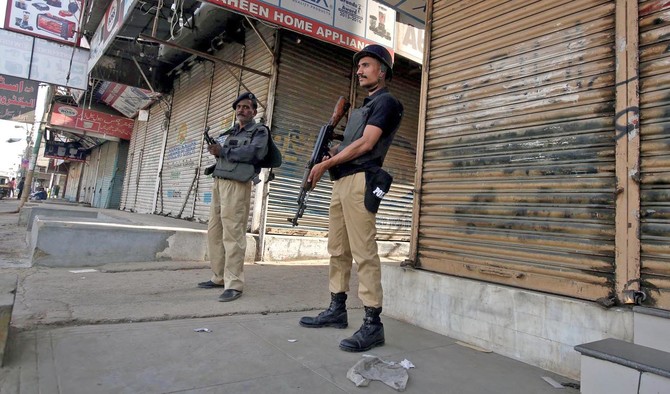
KARACHI: Pakistan’s economy suffered a loss of Rs100 to Rs120 billion following the three-day countrywide protests called by religious parties rallying against the Supreme Court’s decision to acquit a Christian woman accused of blasphemy, traders and industrialists told Arab News on Saturday.
Life limped back to normalcy after an agreement was signed between the leaders of the Tehreek-i-Labbaik Pakistan (TLP), a far-right political party, and the government ending 72 hours of violent demonstrations that had paralyzed business activities across the country.
“The country’s daily business activities are worth Rs30-40 billion, which means it lost that much amount everyday during the protests which paralyzed industrial activities for three days,” Muhammad Danish Khan, President of Korangi Association of Trade and Industry (KATI), which represents one of the largest industrial estates of Pakistan, told Arab News.
He added that Korangi industrial, which was forced to cease its activities for the past few days on account of the nationwide protests, is host to nearly 4,000 small and large industries, including a refinery, and contributes Rs400 million every day to the national exchequer.
Highlighting the impact of the ill-timed protests, especially with Prime Minister Imran Khan visiting China to secure financial assistance and investment, Syed Mazhar Ali Nasir, Senior Vice-President, Federation of Pakistan Chambers of Commerce and Industry (FPCCI), said: “The cost of the country’s image and the exports is much higher from the economic numbers, especially at a time when the country’s prime minister is in another country to secure financial assistance and investment.”
Though no official figures detailing the actual loss to the economy have been released, industrialists and traders estimate it to be in billions, with the port city of Karachi impacted the worst, sending disturbing signals to the rest of the country about its economic health.
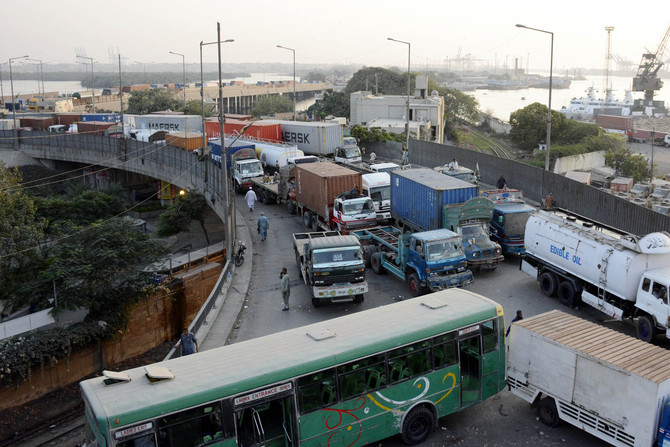
“Nearly 85 to 92 percent of cross border trade, particularly exports of Pakistan, are transshipped from Karachi. Approximately Rs7 billion of exports are lost during a one-day strike in Karachi. Similarly Rs17 billion worth of imports are disturbed due to this reason,” the FPCCI said.
As the industrial activities came to a grinding halt three days ago, the trading community also suffered losses due to a lack of sales. “We estimated that during the last three days our trading community has suffered around Rs100 billion losses. Small shopkeepers were mostly impacted by the events,” Khalid Pervaiz, President of All Pakistan Traders’ Association, said, while Atiq Mir, Chairman of Karachi Tajir Itehad, added that traders “incurred losses worth Rs15 billion in Karachi alone”.
“More than three million daily wagers turn up every day in the markets to earn their livelihood, with means of their livelihood blocked by this kind of protests,” Mir said.
Pakistan’s Karachi Port Trust (KPT) handles an average of 80,000 tons of cargo per day. “The shipping activities at the harbor during the protests remained normal but due to the non-availability of transport, movement of export and import goods remained suspended,” Shariq Amin, spokesman of KPT, said.
Pakistan’s industrialists and traders called for a comprehensive policy to tackle sensitive issues and violent protests. “Businessmen are the first victims of such violent actions. In such conditions who will place order from outside of Pakistan,” Nasir questioned.
“It is the responsibility of the state to stop violence and protect the life and properties of citizens,” Pervaiz said, adding that the government should take the business community into confidence and consult with them “because it’s the economy which guarantees the security and existence of the state”.
“All sensitive issues concerning politics and religion must be resolved at the table rather than on streets,” Nasir said, reasoning that negotiations should be the first and violence could be the last option. “Unfortunately in Pakistan, the last option is exercised in the first place,” he added.0


Businessmen pay Rs120bn as price for three-day protests
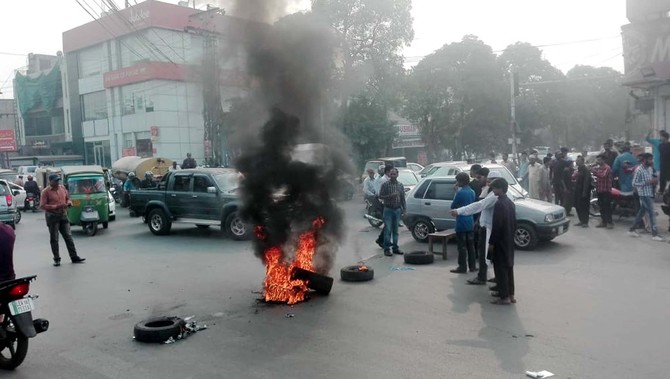
Businessmen pay Rs120bn as price for three-day protests
- Pakistan’s industries and markets remained shut following protests against SC verdict
- Country generates nearly Rs30-40bn revenue every day, traders say


Pakistan’s Zardari to begin five-day Iraq visit tomorrow to discuss trade, investment and energy
- Trade between the two countries remains limited despite potential flagged by officials and business groups
- Recent high-level contacts between the two sides have centered on pilgrim facilitation, security cooperation
ISLAMABAD: President Asif Ali Zardari is scheduled to begin a five-day official visit to Iraq from Saturday to discuss a wide range of issues, including greater trade, investment and energy cooperation, the foreign office said in a statement on Friday.
Pakistan and Iraq established diplomatic relations in 1947 and have maintained cordial ties, though economic engagement between the two countries has remained limited. Trade volumes are small, with Iraq not ranking among Pakistan’s major export or import partners, despite officials and business groups identifying potential in sectors such as construction services, pharmaceuticals, and rice and other agricultural exports. Security concerns, weak banking channels and limited connectivity have continued to constrain commercial growth.
The two countries have stepped up high-level official exchanges in recent months, reflecting efforts to broaden and deepen bilateral relations and explore new areas of cooperation across economic, political and people-to-people domains.
“At the invitation of H.E. Dr. Abdul Latif Jamal Rashid, President of the Republic of Iraq, the President of Pakistan, Mr. Asif Ali Zardari, will undertake an official visit to the Republic of Iraq from 20 to 24 December 2025,” the foreign office announced in a statement.
“During the visit, the President will hold high-level meetings with the Iraqi leadership to review the full spectrum of bilateral relations and explore ways to further strengthen cooperation across key areas of mutual interest, including trade and investment, energy, reconstruction, manpower, technology, education, and people-to-people exchanges,” it added. “Discussions will also cover regional and international developments, as well as cooperation at multilateral fora.”
The foreign office said the visit was expected to reinforce traditionally warm ties between the two countries, identify new avenues of partnership and enhance people-to-people linkages, including religious tourism and economic collaboration.
People-to-people ties are strongest in the religious sphere, as Iraq holds significant importance for Pakistani Shia community who travel to holy sites in Najaf and Karbala.
Earlier this month, Interior Minister Mohsin Naqvi held talks with his Iraqi counterpart, General Abdul Ameer Al-Shammari, on the sidelines of meetings in Brussels, where both officials agreed to deepen cooperation on security and the facilitation of Pakistani pilgrims traveling to Iraq, including measures to ensure smooth travel and compliance with visa rules.