Maulana Sami-ul-Haq killed by unknown assailants

Maulana Sami-ul-Haq. (AFP/File)
Updated 02 November 2018
Follow

Maulana Sami-ul-Haq killed by unknown assailants

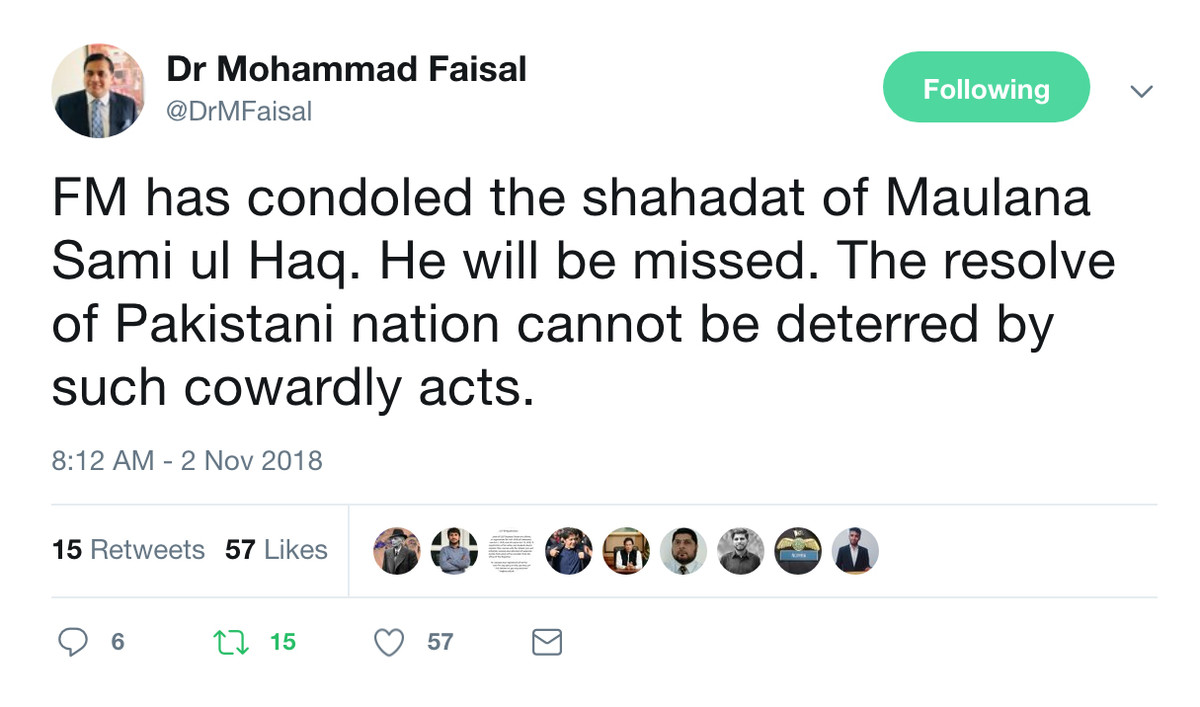
  • He ran a high-profile seminary where some of the top Afghan Taliban leaders were educated
  • He was frequently described as the “father of Taliban”

ISLAMABAD: Maulana Sami-ul-Haq, chief of his own faction of Jamiat Ulema-e-Islam (JUI-S), was killed in a knife attack at his residence in Rawalpindi, said local media reported on Friday.
“The Maulana has been martyred,” his close aide and deputy chief of JUI-S, Yousaf Shah, confirmed while talking to Arab News. “All I can tell you at the moment is that he is no more with us.”
“Maulana Sami-ul-Haq has been assassinated,” Muhammad Hamza Shafqaat, Deputy Commissioner Islamabad, tweeted as well. “Small protests have erupted in Aabpara chowk. Everyone is advised to please stay at home for a while. We will take control of the situation in a while.”
Maulana Sami-ul-Haq ran a high-profile religious seminary, Darul Uloom Akora Khattak.
Notable deceased Afghan Taliban leaders, Mullah Muhammad Omar and Jalaluddin Haqqani, were among its alumni.
It was not just Haq’s influence with the Afghan Taliban but also his sway over Pakistan’s politics that led the Pakistani Taliban ask him to help negotiate a truce with the country’s government years back before Qatar allowed the Taliban to open an office in Doha.
A former senator, Haq spoke fluent Arabic, Urdu and Pashto.
His seminary was unofficially dubbed as “the university of jihad,” and he was frequently described as the “father of Taliban.” He was also widely viewed as a key to any peace deal to be negotiated between militant factions and the United States and Pakistan.


Imran Khan not a ‘national security threat,’ ex-PM’s party responds to Pakistan military

Updated 06 December 2025
Follow

Imran Khan not a ‘national security threat,’ ex-PM’s party responds to Pakistan military

  • Pakistan’s military spokesperson on Friday described Khan’s anti-army narrative as a “national security threat”
  • PTI Chairman Gohar Ali Khan says words used by military spokesperson for Khan were “not appropriate”

ISLAMABAD: Former prime minister Imran Khan’s Pakistan Tehreek-e-Insaf (PTI) party on Saturday responded to allegations by Pakistan military spokesperson Lt. Gen. Ahmed Sharif Chaudhry from a day earlier, saying that he was not a “national security threat.”

Chaudhry, who heads the military’s media wing as director general of the Inter-Services Public Relations (ISPR), spoke to journalists on Friday, in which he referred to Khan as a “mentally ill” person several times during the press interaction. Chaudhry described Khan’s anti-army narrative as a “national security threat.”

The military spokesperson was responding to Khan’s social media post this week in which he accused Chief of Defense Forces Field Marshal Asim Munir of being responsible for “the complete collapse of the constitution and rule of law in Pakistan.” 

“The people of Pakistan stand with Imran Khan, they stand with PTI,” the party’s secretary-general, Salman Akram Raja, told reporters during a news conference. 

“Imran Khan is not a national security threat. Imran Khan has kept the people of this country united.”

Raja said there were several narratives in the country, including those that created tensions along ethnic and sectarian lines, but Khan had rejected all of them and stood with one that the people of Pakistan supported. 

PTI Chairman Gohar Ali Khan, flanked by Raja, criticized the military spokesperson as well, saying his press talk on Thursday had “severely disappointed” him. 

“The words that were used [by the military spokesperson] were not appropriate,” Gohar said. “Those words were wrong.”

NATURAL OUTCOME’

Speaking to reporters earlier on Saturday, Pakistan’s Defense Minister Khawaja Asif defended the military spokesperson’s remarks against Khan.

“When this kind of language is used for individuals as well as for institutions, then a reaction is a natural outcome,” he said. 

“The same thing is happening on the Twitter accounts being run in his [Khan’s] name. If the DG ISPR has given any reaction to it, then I believe it was a very measured reaction.”

Khan, who was ousted after a parliamentary vote of confidence in April 2022, blames the country’s powerful military for removing him from power by colluding with his political opponents. Both deny the allegations. 

The former prime minister, who has been in prison since August 2023 on a slew of charges he says are politically motivated, also alleges his party was denied victory by the army and his political rivals in the 2024 general election through rigging. 

The army and the government both deny his allegations.