



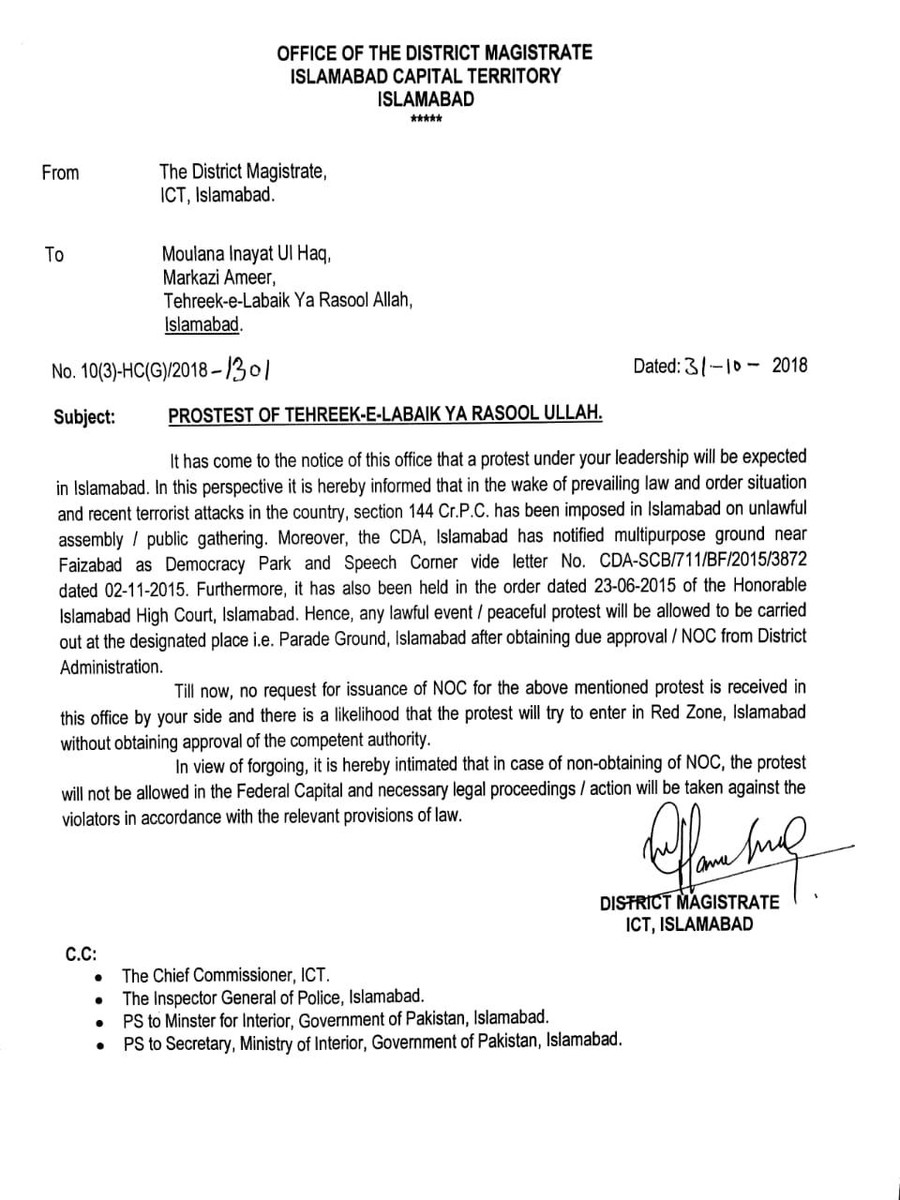
ISLAMABAD: Demonstrations called by far-right Islamist groups entered their third day on Friday as party workers and supporters continued to organize sit-ins across major cities of Pakistan, protesting against the Supreme Court’s decision to acquit a Christian woman, accused of blasphemy.
Several major highways and key roads were barricaded by protestors, who are demanding that the top court reverse its decision to free Aasia Bibi who was on death row for eight years.
Khadim Hussain Rizvi, the leader of Tehreek-e-Labaik Pakistan (TLP), the Islamist political party leading the protests, tweeted late on Thursday night that negotiations with the government had failed, as the representatives had threatened to obliterate them, adding that the Inter-Services Intelligence’s (ISI) General Faiz was one of the members representing the government in the talks.
Director General ISPR, Major General Asif Ghafoor, said that the top court’s judgment was a legal matter and dragging the Pakistan Army into it is regrettable. Talking to Pakistan Television (PTV) this morning, he said that the government is currently engaged with the protestors and was seeking to peacefully resolve the matter. However, he made it clear that Pakistan Army would play its constitutional role if requested by the government.
Earlier, the Pakistan Tehreek-e-Insaaf (PTI) government had said that they had decided not to use force against the protestors and wanted to resolve the matter amicably. On Wednesday, however, Prime Minister Imran Khan in a televised address to the nation warned the protesters that the state stands ready to fulfill its responsibility in ensuring law and order in the country and would deal with miscreants with an iron hand.
On Friday, several other religious parties, including the Milli Yakjehti Council (MYC), an alliance of 15 religious groups, representing numerous schools of thoughts – which includes mainstream Jamaat-e-Islami Pakistan (JIP), Jamiat-Ulema-e-Islam Fazal (JUIF), Jamiat Ulema-e-Pakistan (JUP), and Hafiz Saeed’s Jamaat-ud-Dawa (JuD) – were expected to join the protests.
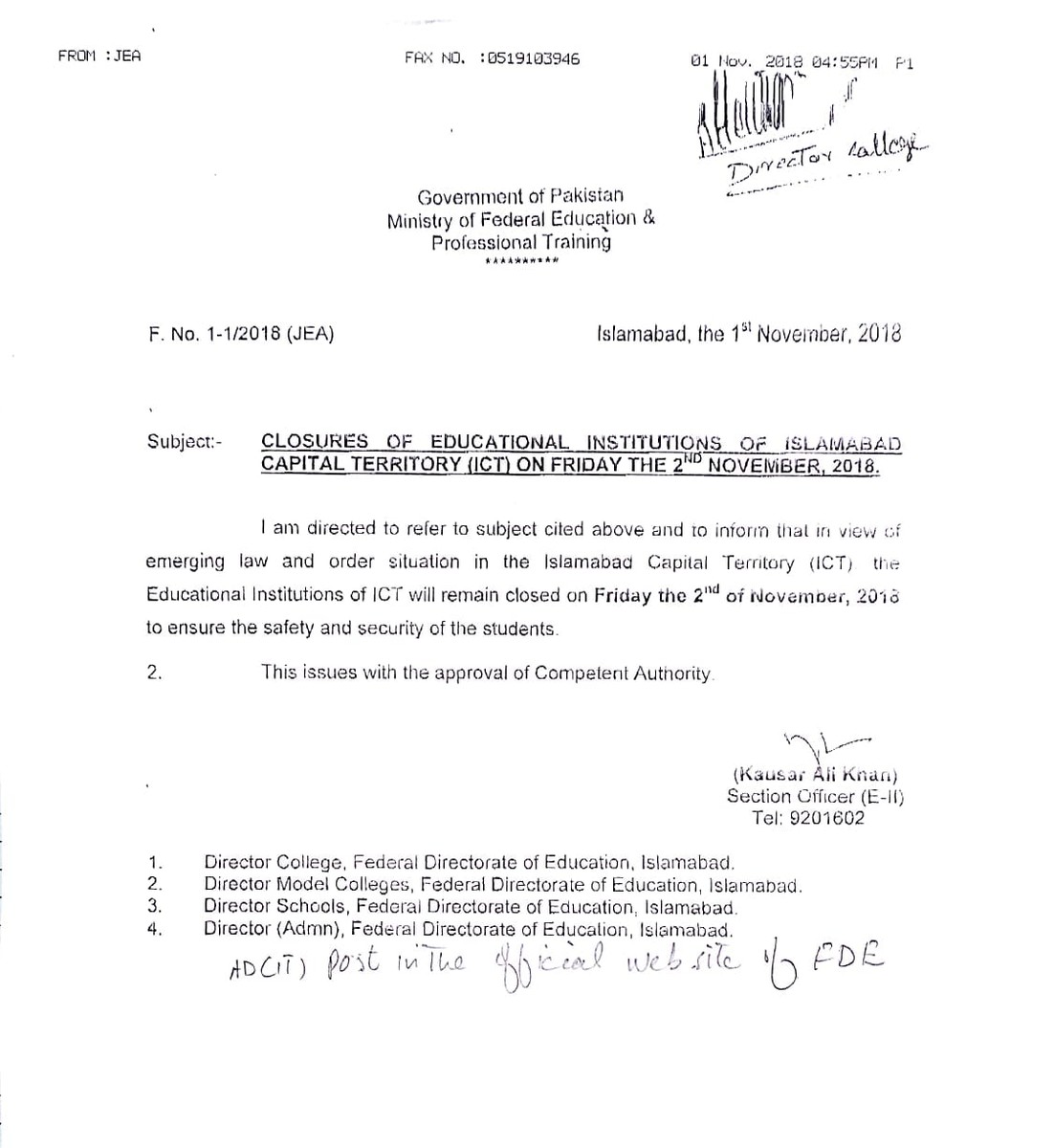
Meanwhile, authorities blocked the mobile phone services in Islamabad, Lahore, Rawalpindi and Gujranwala on Friday morning, with schools and businesses across the country asked to remain closed too.
Who is Aasia Bibi?
At the core of the issue is the case of Bibi, a 51-year-old woman and mother of five who was accused of blasphemy in 2009, when two of the women farmers she was working with complained to the village prayer leader that she had made derogatory comments about Prophet Muhammad (PBUH), following an altercation.
Her family, however, denied the allegations, adding that the case was a result of an internal feud between the women. A session’s court judge found Bibi guilty of the crime and sentenced her to death a year after. The High Court upheld the verdict, making Bibi the first Pakistani woman to be charged for blasphemy. However, the Supreme Court – citing a lack of evidence -- overturned the verdict, acquitting her of all charges and asking for her immediate release.
Bibi is currently housed at an undisclosed location, awaiting release, even as her brother, James Masih, fears for her life, adding that his sister would not be safe in Pakistan. “She has no other option and she will leave the country soon,” he said.
On Thursday evening, a review petition against the decision was filed in the Lahore registry of the Supreme Court. In Lahore, Rizvi is leading the protests outside Punjab Assembly, while law enforcement agencies have cordoned off about half a kilometer of the area.
Similarly, in Karachi, security has been beefed up and commandos of Special Security Unit (SSU) deployed outside the apex court’s Karachi registry and other important government offices. “We have taken strict measures to maintain the law and order situation,” city police Chief, Dr Amir Sheikh, told Arab News.
“We are off the road for three days now and will decide later in the evening if we need to bring vehicles on the road after assessing the situation,” Karachi Transport Ittehad President, Irshad Bukhari, told Arab News.
According to Islamabad police, all roads have been cleared in the federal capital except along the Faizabad interchange -- the main artery which connects Islamabad with Rawalpindi. However, our correspondent reporting from Islamabad said that the capital wore a deserted look early this morning as businesses and schools remain closed.


