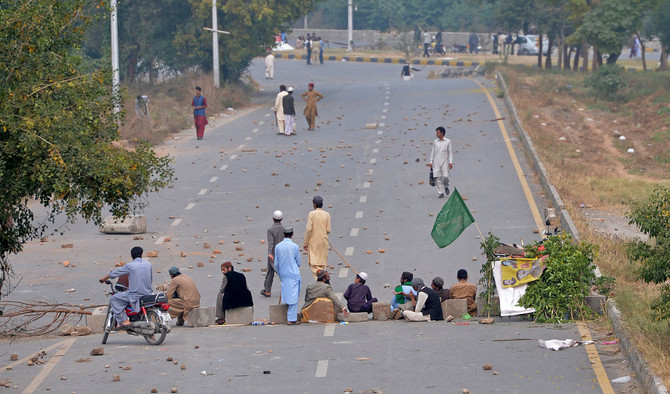
KARACHI: Islamist protesters blocked roads in Pakistan's major cities for a second day on Thursday, opposing a Supreme Court decision the previous day to acquit a Christian woman on death row for blasphemy allegations, media said.
Knots of protesters from an ultra-Islamist party blocked roughly 10 key roads in the southern city of Karachi and others in eastern Lahore, Geo TV and other channels said. Private schools in both cities were shut, as well as in the capital.
Groups of about 200 protesters from the Tehreek-e-Labaik (TLP) party sat under large tents, listening to speeches on two blocked roads in Karachi, a Reuters witness said.
In one speech, a TLP speaker exhorted supporters to light new fires if the police managed to douse burning tyres and other objects they had already set ablaze.
The demonstrators were protesting against the court's decision to free Aasia Bibi, a mother of four, who had been living on death row since 2010, as the first woman sentenced to death by hanging under Pakistan's tough blasphemy laws.
Bibi was accused of making derogatory remarks about Islam after neighbors objected to her drinking water from their glass because she was not Muslim.
But a three-judge panel set up to hear the appeal, headed by Chief Justice Saqib Nisar, ruled the evidence was insufficient.
The case has divided Pakistan, where two politicians who sought to help Bibi were assassinated, and outraged Christians worldwide, with Pope Francis saying he personally prayed for Bibi.
In a televised national broadcast late on Wednesday, Prime Minister Imran Khan warned the protesters the government would act against any prolonged blockade.
"We will not allow any damages. We will not allow traffic to be blocked," Khan said. "I appeal to you, do not push the state to the extent that it is forced to take action."
Khan's broadcast followed comments by a senior leader of the Islamist TLP group, calling for Chief Justice Nisar and the other two judges to be killed.
"They all three deserve to be killed," TLP co-founder Muhammad Afzal Qadri told a protest in Lahore. "Either their security, their driver, or their cook should kill them."
He also called for the ouster of Khan's new government and urged army officers to rise up against powerful military chief General Qamar Javed Bajwa.
Hafiz Saeed, an influential Islamist whom the US accuses of being the mastermind of attacks in Mumbai in 2008 that killed 166, has called for protests after Friday afternoon prayers.
Another Islamist group, the Milli Yakjehti Council, is also meeting on Thursday to discuss Bibi's case and may launch protests.
The whereabouts of Bibi and her family are unclear, and speculation is growing that she will leave Pakistan with her family, who have been in hiding for much of the past eight years.


Protests continue in Pakistan on second day after Aasia Bibi's acquittal


Protests continue in Pakistan on second day after Aasia Bibi's acquittal
- Bibi was accused of making derogatory remarks about Islam after neighbors objected to her drinking water from their glass because she was not Muslim
- Prime Minister Imran Khan warned the protesters the government would act against any prolonged blockade


Pakistan announces national Islamic scholarship competition focused on youth
- Contest invites books, essays, poetry in multiple languages, with awards for men and women
- Best entries to be published digitally and in print, submissions due by March 31
ISLAMABAD: Pakistan’s Ministry of Religious Affairs on Wednesday announced a nationwide competition for books, poetry and academic papers focused on Islamic scholarship, as part of efforts to promote religious discourse addressing modern social challenges, particularly among younger generations.
The annual competition will cover works on Seerat — the biography and teachings of the Prophet Muhammad (pbuh) — as well as Na’at, a traditional form of devotional poetry praising the Prophet, alongside broader Islamic research and literary contributions published in Pakistan and abroad.
“Ministry of Religious Affairs ... remains committed to addressing contemporary challenges through the guidance of the Seerat-e-Tayyaba (the life of the Prophet Muhammad), describing the national competition as an important step toward promoting Islamic teachings in society,” the ministry said in a statement.
“The initiative serves as an effective platform to encourage writers and researchers working on Seerat and Islamic subjects.”
For 2026, the ministry has set the central theme for Seerat research papers as “Protection, development and character-building of the younger generation in the light of the life of the Prophet Muhammad (peace be upon him).”
Officials said the focus aims to encourage scholarly engagement with issues such as ethics, social responsibility and education in a rapidly changing society.
The competition will award separate cash prizes and certificates to male and female writers at national and provincial levels, while selected research papers will be published in both digital and printed formats, the statement said.
According to the ministry, works published in national, regional and foreign languages will be eligible, with eight dedicated categories covering Seerat authors and Na’at poets. Separate categories have also been introduced for women writers, journals and magazines, expanding participation beyond individual book authors.
The ministry said the competition is intended to strengthen Islamic literary traditions while encouraging new voices to engage with religious subjects in a contemporary context.
The deadline for submission of books and research papers is March 31, 2026, it added.


