Aasia Bibi to finally walk free

Pakistani police officers stand guard outside the Supreme Court in Islamabad on Wednesday. Pakistan’s top court on Wednesday overturned a death sentence for blasphemy handed down to a Christian woman, acquitting her of all charges and ordering her immediate release. (AP)
Updated 31 October 2018
Follow

Aasia Bibi to finally walk free

  • Pakistan Supreme Court acquits Christian woman on death row after eight years in jail
  • Case had gained international attention after she was convicted for blasphemy

ISLAMABAD: Pakistan’s top court on Wednesday overturned a death sentence for blasphemy handed down to a Christian woman, acquitting her of all charges and ordering her immediate release.
The ruling brings to an end a long-delayed, landmark decision involving Aasia Bibi, 51, after she was convicted by the Lahore High Court (LHC) in 2010, making her the first woman to be sentenced to death under Pakistan’s blasphemy law.
She had been in jail ever since.
The apex court announced the verdict on a 2014 appeal filed by Bibi challenging the LHC’s decision. Chief Justice Saqib Nisar, while reading out the judgment, ordered for Bibi’s immediate release if she was not wanted in any other case. “The judgment of the high court and that of the trial court is reversed. Her conviction is set aside and she is to be relieved forthwith if not required in other charges,” the ruling said.
Earlier, a special three-judge bench — comprising and headed by Chief Justice Saqib Nisar, Justice Asif Saeed Khosa and Justice Mazhar Alam Khan Miankhel — reserved its verdict on October 8 after hearing the final appeal against Bibi’s execution.
The appeal had challenged the LHC’s October 2014 verdict which upheld a trial court’s decision in November 2010 sentencing Bibi to death for committing blasphemy.
Bibi was accused of making “defamatory and sarcastic” comments about Prophet Muhammad (PBUH) in 2009 during an argument with three Muslim women, while working in a field, in Sheikhupura.
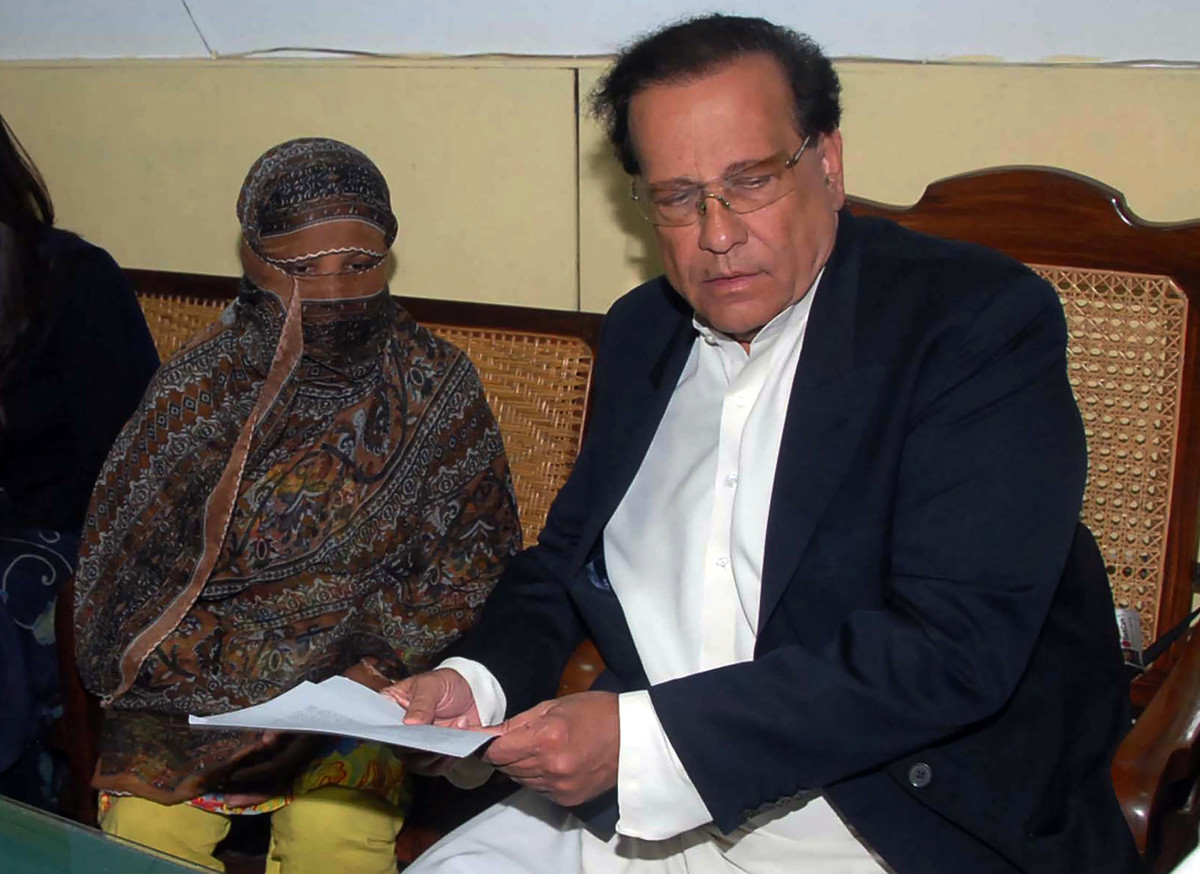


This file photo shows Aasia Bibi, left, with the slain Governor of Punjab Salman Taseer at the Central Jail in Sheikhupura on Nov. 20, 2010. (AFP)

According to details of the case, she had been asked to fetch water to which the Muslim women objected saying that as a non-Muslim she was unfit to touch the water bowl. The women later complained to a local prayer leader, accusing Bibi of blasphemy.
During the last hearing, Bibi’s lawyer, Saiful Mulook, had told the bench that the incident had taken place on June 14, 2009 and a case was registered on June 19 by the prayer leader or imam in Katanwala village. The imam alleged that Bibi had confessed to committing blasphemy, the lawyer said.
The counsel further informed the bench that the imam himself was not a witness to the incident. “From your statements we have gathered that the imam himself did not witness the incident as it happened and no blasphemous words were said in his presence,” Justice Khosa said, to which Justice Nisar added: “As per the prayer leader’s statement, a panchayat [village court] was held in a house and 1,000 people had gathered for it.”
The Supreme Court, after reserving the verdict, restrained both electronic and print media from discussing or commenting on the matter until the final judgment was passed.
Islamabad was placed on high alert prior to the announcement of the verdict after a far-right group’s leader, Tehrik-e-Labaik’s Khadim Rizvi, called for protests in case Bibi was released. Additional police and paramilitary rangers were deployed in several areas of the capital to guard the Diplomatic Enclave and other sensitive buildings.
Bibi’s case outraged Christians worldwide and had been a source of division within Pakistan. The incident gained international spotlight after the-then Punjab governor Salman Taseer intervened and called for an amendment in blasphemy laws. The governor was later killed in broad daylight in Islamabad by one of his own bodyguards. His assassin, Mumtaz Qadri, was executed in 2016 after the apex court found him guilty of murder and his appeal for clemency was rejected by the president.
Pakistan’s blasphemy law (295-C) carries the mandatory death penalty and activists claim that it is often used to target non-Muslim minorities in the country.

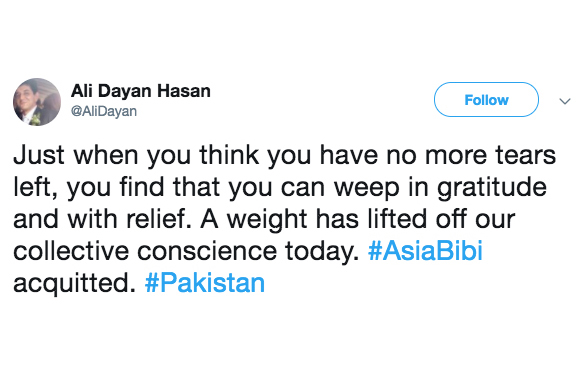
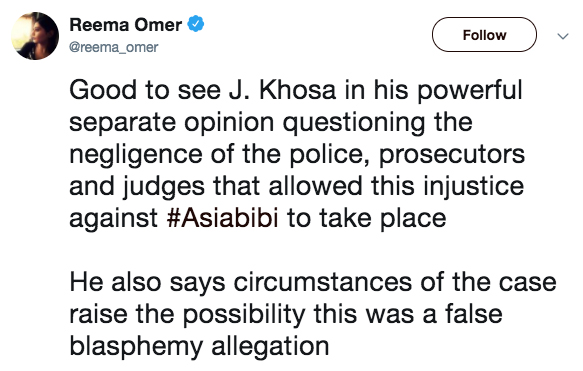
REACTIONS

Cross-border clash breaks out between Pakistan and Afghanistan amid rising tensions

Updated 55 min 2 sec ago
Follow

Cross-border clash breaks out between Pakistan and Afghanistan amid rising tensions

  • Border residents say exchange of fire in the Chaman border sector lasted nearly two hours
  • Both governments issue competing statements blaming the other for initiating the violence

ISLAMABAD: Pakistan and Afghanistan witnessed yet another border clash, according to officials in both countries who spoke in the early hours of Saturday, with each side accusing the other of launching “unprovoked” attacks.

Fighting erupted in Pakistan’s southwestern Chaman border sector, with an AFP report saying that residents on the Afghan side of the frontier reported the exchange of fire began at around 10:30 p.m. (1800 GMT) and continued for roughly two hours.

The incident underscored how tensions remain high between the neighbors, who have seen deadly clashes in recent months despite several rounds of negotiations mediated by Qatar and Türkiye that resulted in a tenuous truce in October.

“There has been unprovoked firing by Afghan Taliban elements in the Chaman Sector which is a reckless act that undermines border stability and regional peace,” said a Pakistani security official on condition of anonymity.

“Pakistani troops responded with precision, reinforcing that any violation of our territorial integrity will be met with immediate and decisive action,” he continued.

The official described Pakistan’s response as “proportionate and calibrated” that showed “professionalism even in the face of aggression.”

“The Chaman Sector exchange once again highlights the need for Kabul to rein in undisciplined border elements whose actions are destabilizing Afghanistan’s own international standing,” he added.

Relations between Pakistan and Afghanistan have grown increasingly bitter since the Taliban seized power in Kabul following the withdrawal of international forces in August 2021.

Islamabad accuses the Taliban administration of sheltering anti-Pakistan militant groups such as the Baloch Liberation Army (BLA) and Tehreek-e-Taliban Pakistan (TTP), which have carried out deadly attacks in its western provinces bordering Afghanistan, targeting civilians and security forces.

The Taliban deny the charge, saying Pakistan’s internal security challenges are its own responsibility.

The Pakistani security official said his country remained “committed to peaceful coexistence, but peace cannot be one-sided.”

“Attempts to pressure Pakistan through kinetic adventurism have repeatedly failed and will continue to fail,” he said. “The Chaman response has reaffirmed that message unmistakably.”

He added that Pakistan’s security forces were fully vigilant and that responsibility for any escalation “would solely rest with those who initiated unprovoked fire.”

Mosharraf Zaidi, spokesman for Pakistan’s prime minister, also commented on the clashes in a social media post, saying the Afghan Taliban had “resorted to unprovoked firing along the border.”

“An immediate, befitting and intense response has been given by our armed forces,” he wrote.

Afghan authorities, however, blamed Pakistan for the hostilities.

“Unfortunately, tonight, the Pakistani side started attacking Afghanistan in Kandahar, Spin Boldak district, and the forces of the Islamic Emirate were forced to respond,” Taliban spokesman Zabihullah Mujahid said on X.

Border clashes that began in October have killed dozens of people on both sides.

The latest incident comes amid reports of back-channel discussions between the two governments, although neither has publicly acknowledged such talks.