

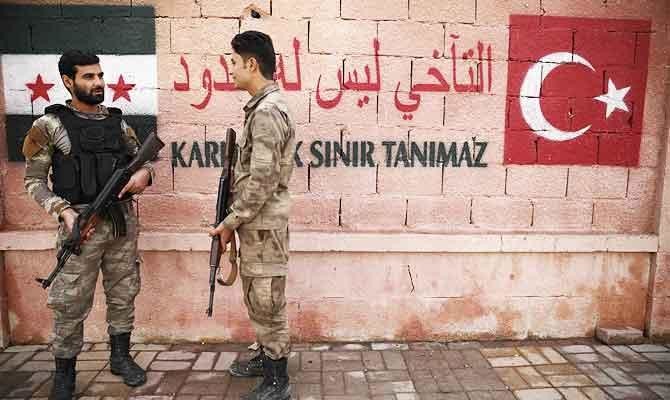

AZAZ: “Brotherhood has no limits.” The phrase is painted in Arabic and Turkish on a wall in Azaz, the town at the heart of Turkey’s de facto protectorate in northern Syria. From Turkish-language classes for Syrian children to the state-owned Turk Telekom company erecting its first cell towers on Syrian soil, Ankara’s role in the opposition-controlled region around Azaz has been expanding.
“All the support we receive is Turkish — education, services, and so on,” said Mohammed Hamdan Keno, 64, head of the Azaz Local Council (ALC), which governs the town.
“Everything here is from our Turkish brothers.”
Like the rest of his hometown, his desk in the ALC’s headquarters is adorned with both the three-star flag of the Syrian uprising and Ankara’s red-and-white crescent emblem.
Turkey began providing humanitarian, political and military backing to Syria’s opposition soon after anti-regime protests began in 2011, and it has remained a steady ally ever since.
But its influence became more explicit in 2016, when Turkish troops and allied Syrian fighters launched a military operation against both the Daesh group and Kurdish fighters.
They cleared the extremists from the towns of Jarabulus, Al-Rai and other areas, and this year overran the adjacent Kurdish-controlled enclave of Afrin.
Ankara keeps Turkish troops and intelligence forces in the area, and still backs the local police forces.
But Turkish state institutions and private companies have also put down roots in this relatively stable pocket, becoming an integral part of everyday life.
Electricity grid
Walls of the main hospital in Jarabulus are now adorned with portraits of Turkish President Recep Tayyip Erdogan, and the town is lit by an electricity grid set up by Ankara.
A similar deal is in its first stages in Azaz, Keno said.
“A private Turkish company will implement an electricity project in Azaz, and Turkey is the guarantor,” he said.
The town’s main market and several neighborhoods have already been linked to the grid over the past week under an initial $3-million deal with AK Energy, he added.
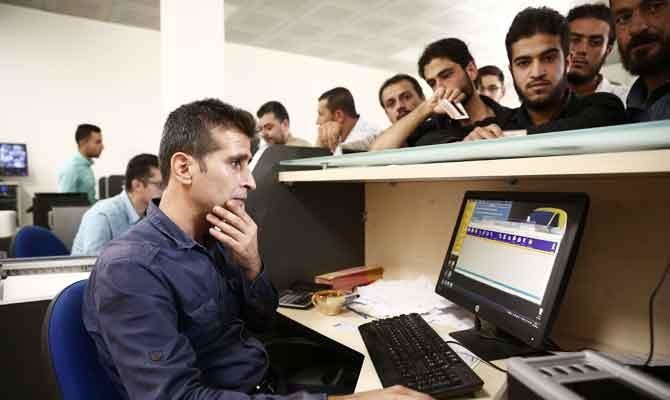
The firm opened an Azaz satellite office in a former Syrian regime building.
Keno said Turkey has also helped the council pave roads, renovate mosques and repair classrooms damaged by fighting.
“They fixed up the schools, gave us desks, books, schoolbags, computers and printers,” he listed off.
As class started up again this year, the council decided to introduce something new for the area’s estimated 18,000 students: Turkish courses.
“We used to have two foreign languages in our curriculum: English and French. Because of the rapprochement between us and Turkey, all the teachers and administrators decided to switch” from French to Turkish, said Keno.
“Since Turkey is this area’s state sponsor, of course learning the Turkish language guarantees a Syrian child’s future.”
Most of the signs around Azaz itself are already bilingual, and to phone each other and surf the web, residents have replaced their Syrian SIM cards with Turkish ones.
“The demand is remarkable,” said Ahmad Hadbeh, Turk Telekom’s 24-year-old representative in Syria.
“We put up towers in Al-Bab, Azaz and Jarabulus. The signal became stronger than before, and made up for a lot of the Syrian network coverage.”
The Turk Telekom store is set up in the center of Azaz’s market, teeming with people shopping for sweets, rice, clothes and even cleaning supplies imported from Turkey.
Salim Horani, a 37-year-old trader in Azaz, ships everything from fabric and shoes to industrial equipment from Turkey.
“Turkey’s markets are huge — we can import from Istanbul, Meric, Gaziantep and Mersin,” he said.
It’s cheaper for shoppers in opposition territory to buy Turkish-imported goods than products from regime-held zones in Syria, he said.
“Prices in Turkey are more affordable by a really huge margin compared to regime areas.”
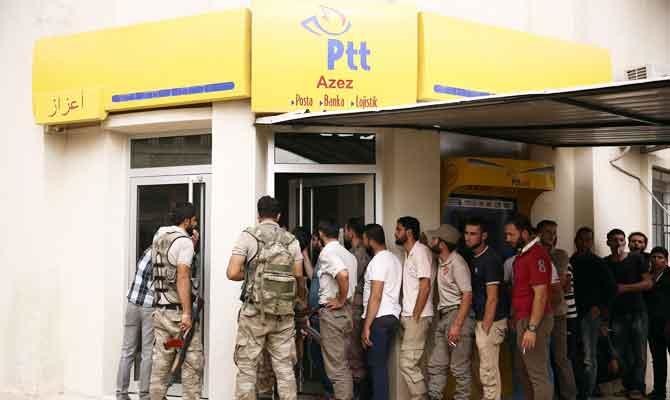
Some Syrians even get clothes and other products shipped directly from Turkish cities into Azaz through the PTT, Turkey’s state-owned postal service.
At PTT’s Azaz branch, Turkish and Syrian employees only accept the Turkish lira, whose value plummeted to record lows in August.
Turkey’s President Erdogan has repeatedly threatened to launch another offensive east of Azaz on swathes of Syrian territory held by US-backed Kurdish forces it views as “terrorists.”
On Sunday, the Turkish military fired artillery shells at “shelters” of the Kurdish People’s Protection Units (YPG) in the Kobani region.
Around Azaz, Turkey appears to be putting down roots for the long term, said Ahmet Yayla, assistant professor at DeSales University in the US.
“All those administrations in those cities are directed by Turkey. It’s a kind of mandate,” he said.
“The areas will not be part of Turkey officially, but Turkey will de facto keep ruling over those areas.”


