


Pakistan’s Shinwari tribe wants visa-free movement across Torkham border

1 / 4
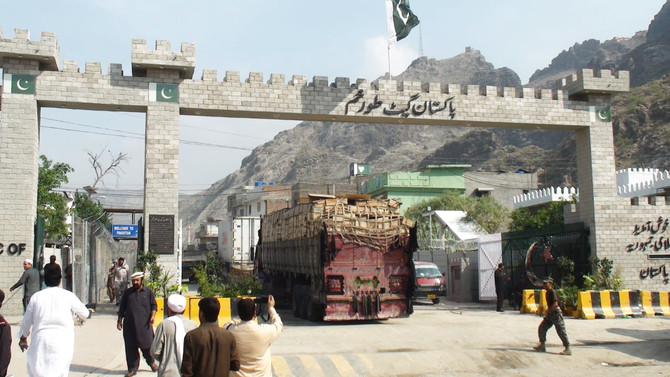
A loaded truck passes through the Torkham border. (AN photo)
2 / 4
Security officials and bystanders look on as a loaded truck passes through Torkham border. (AN photo)
3 / 4
Hundreds of Shinwari tribesmen march in Landi Kotal, a town in Khyber tribal region, demanding visa-free movement on Torkham border to Afghanistan and other incentives. (AN photo)
4 / 4
Shinwari tribesmen visit a congested bazaar at Landi Kotal, a town in Khyber tribal district, in connection of their demands. (AN photo)
Updated 28 October 2018
Follow

Pakistan’s Shinwari tribe wants visa-free movement across Torkham border

  • Members of the Shinwari tribe were allowed to use special cards for their cross-border movement before 2016
  • They have threatened to go on an indefinite hunger strike if their demand is not met

PESHAWAR: Thousands of Pakistani tribesmen belonging to the Shinwari clan, which straddles the Pak-Afghan frontier, protested in Landi Kotal on Sunday, demanding visa-free movement across the Torkham border.

“We’re not being allowed to visit the other side of the border in Afghanistan, even though we have our businesses, shops, and properties there,” Zarqeeb Shinwari, president of the Custom Clearing Association at the Torkham border, told Arab News. “We cannot even visit our relatives on the other side.”

The Shinwaris were allowed to use special rahdari (passage) cards before 2016 that facilitated their cross-border movement. In the past couple of months, however, Pakistani authorities have started asking them for travel documents to cross into Afghanistan, he added.

Shakil-ur-Rehman, a senior government official at the Torkham border, claimed that the local administration had already taken notice of the protest by tribesmen, adding it would hold a meeting with the Shinwaris to tackle the issue in the next few days.

“We’re going to have a meeting tomorrow, or the day after, and hopefully resolve their legitimate problems,” Rehman told Arab News, without elaborating on why these restrictions were placed on the movement of the local tribe.

However, Merajuddin Shinwari, another tribesman, claimed that things were not streamlined at the Torkham border and there was “total chaos and maladministration” that adversely affected the businesses of tribesmen, even though these commercial ventures constituted their sole source of income.

Zarqeeb said at least half a million members of the Shinwari tribe who lived on the Pakistani side had their relatives, properties and businesses in Afghanistan. He pointed out that all these individuals should be allowed a relaxation from visa formalities and other such restrictions.

Pakistani authorities had promised to facilitate people in this way who lived within the 15-kilometer range of the Torkham town, a pledge which, he noted, should be fulfilled in its letter and spirit.

Afghan authorities had no problem when these tribesmen visited the other side of the border, he added.

Zarqeeb also warned that his tribe was planning to hold a similar protest next Sunday. “After that, we will go on an indefinite hunger strike until our legitimate demands are met,” he said.

Officials confirmed that members of the Shinwari tribe living on both sides of the border were exempt from using formal travel documents since they were issued temporary cards by the administration of Khyber tribal district.


Pakistan warns against landslides, avalanches next week amid rain and snowfall prediction

Updated 28 December 2025
Follow

Pakistan warns against landslides, avalanches next week amid rain and snowfall prediction

  • Westerly wave likely to approach western areas from Dec. 29, persist till Jan. 2, says Met Office
  • Pakistan advises tourists to exercise caution while traveling in northern areas during the period

ISLAMABAD: Pakistan’s Meteorological Department on Sunday warned against the possibility of landslides and avalanches in the country’s northern areas next week, as it forecast heavy rains and snowfall in hilly regions. 

The Met Office predicted that a westerly wave is likely to approach Pakistan’s western areas from Dec. 29 and strengthen from Dec. 30 onwards. This wave is expected to grip most upper and central parts of the country on Dec. 31 and persist in the upper areas till Jan. 2, the PMD said. 
 
“Possibility of landslides/avalanches in hilly areas of upper Khyber Pakhtunkhwa, Gilgit-Baltistan and Kashmir during the period,” the PMD warned. 

“Tourists are advised to remain extra cautious and avoid unnecessary traveling during the period.”

The advisory warned that rainfall with wind and thunderstorm and snowfall is likely in Punjab’s Murree and the Galliyat region from Dec. 30 to Jan. 2 with occasional gaps. It also warned of rain with wind, thunderstorms and moderate snowfall in the northern Gilgit-Baltistan and Kashmir regions during the same period.

The PMD warned of rain with wind and thunderstorms, with moderate to heavy snowfall in upper areas from Dec. 30 to Jan. 1 in the northwestern Khyber Pakhtunkhwa province. 

For Sindh and Balochistan provinces, the PMD warned that rain with wind and thunderstorms with snowfall were expected over hilly areas from Dec. 29-31. 

The PMD warned snowfall may cause road closures or slippery conditions in the northern areas of Naran, Kaghan, Dir, Swat, Kohistan, Mansehra, Abbottabad, Shangla, Astore, Hunza, Skardu, Murree, Galliyat and Neelum Valley from Dec. 30 to Jan. 2. 

“Fog condition is likely to subside in central/southern parts of Punjab and upper Sindh during the wet spell,” it said. 

“Daytime temperatures are likely to drop further in the coming week, particularly after the spell.”

Authorities in the past have urged people to avoid northern areas or exercise caution in travel when weather conditions are expected to deteriorate during the winter season. 

At least 21 people, including nine children, died in freezing temperatures after being stuck in their vehicles in the Pakistani hill station of Murree in January 2022 when roads became impassable due to heavy snow.