CAIRO: One of the world’s most important collections of Egyptian antiquities is on show in the Fine Arts Museum (Kunsthistorisches Museum) in Vienna.
The museum holds more than 17,000 objects that date from a period of almost 4,000 years, from the Egyptian Predynastic and Early Dynastic periods (ca. 3500 BC) to the early Christian era.
Geographically their origins range from Egypt, Nubia, the eastern Mediterranean and Mesopotamia to the Arabian Peninsula. The Egyptian collection contains about 6,000 pieces, traced back to the Pharos, Ptolemaic and Greek-Roman Periods.
The collection has a history extending back to around 1560. The Egyptian antiquities already in the ruling Habsburg family’s possession were held in the coin collection and cabinet of antiquities.
The museum said: “The holdings of Egyptian artefacts were considerably expanded by various gifts and acquisitions, most importantly by the objects purchased in Egypt in 1821 by the physician Ernst August Burghart, and the Austrian general consul in Alexandria from 1824 to 1849, Anton Ritter von Laurin.”
Other pieces were provided by Crown Prince Rudolf, the son of Emperor Franz Joseph, who acquired numerous Egyptian artefacts during his travels to Egypt in 1881, the museum explained.
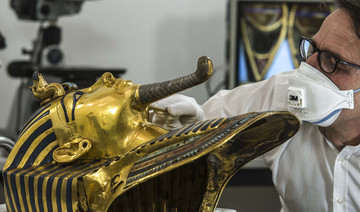
Most of the additions in the first half of the 20th century were the result of archaeological excavations in Egypt and Nubia financed by the Austrian Academy of Sciences. Among them are the famous Reserve Head, numerous tomb statues, inscribed architectural components such as false doors and architraves, coffins of stone and wood, jars, jewelry and vessels made from various materials.
“These masterpieces are the treasures of my ancestors,” said Samah Hussien, an Egyptian citizen based in Vienna, who was admiring the treasures in the museum.
“I am so proud to see Egyptian pieces in one of the most famous museums in the world but it is painful to see them here, and not in my country,” he added.
The rooms holding the Egyptian and Near Eastern Collection are magnificently decorated with an ancient Egyptian design. Three Egyptian monolithic columns more than six meters in height support the ceilings. The columns, which were excavated in Alexandria, were a gift to Emperor Franz Joseph in 1869, the fine arts museum said.
The monumental museum buildings, built as part of the Emperor Franz Joseph’s expansion of the city in 1858, was intended to appropriately represent the artistic treasures that had been collected by the Habsburgs over the centuries.
The museum was ceremoniously opened in 1891.


![]()

Egyptian and Arab antiquities take pride of place in Vienna museum
Egyptian and Arab antiquities take pride of place in Vienna museum
- Most of the additions in the first half of the 20th century were the result of archaeological excavations in Egypt and Nubia financed by the Austrian Academy of Sciences
- Three Egyptian monolithic columns more than six meters in height support the ceilings

Latest updates



© 2026 SAUDI RESEARCH & PUBLISHING COMPANY, All Rights Reserved And subject to Terms of Use Agreement.