


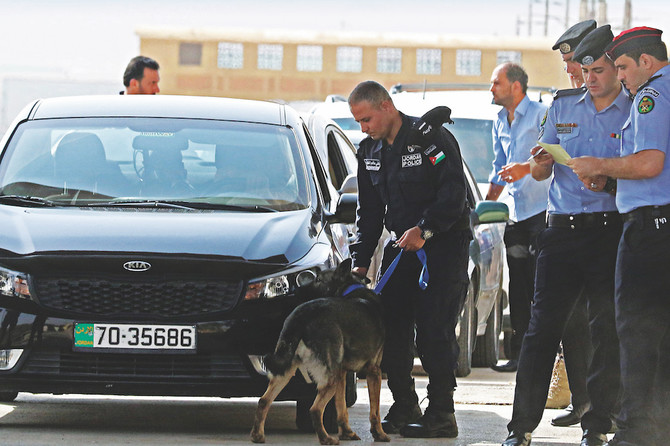
BEIRUT: By reopening a key land crossing with Jordan this month, the Syrian regime is inching toward a return to trade with the wider region as it looks to boost its war-ravaged economy.
The government of President Bashar Assad took back control of the Nassib border post in July from rebels as part of a military offensive that reclaimed swathes of the south of the country.
Syria’s international trade has plummeted during the seven-year civil war, and its foreign reserves have been almost depleted.
The reopening of Nassib after a three-year hiatus, on Oct. 15, is a political victory for the Damascus regime, said Sam Heller of the International Crisis Group.
It is “a step toward reintegrating with Syria’s surroundings economically and recapturing the country’s traditional role as a conduit for regional trade,” he said.
The Nassib crossing reopens a direct land route between Syria and Jordan, but also a passage via its southern neighbor to Iraq to the east, and the Gulf to the south.
“For the Syrian government, reopening Nassib is a step toward normalization with Jordan and the broader region, and a blow to US-led attempts to isolate Damascus,” Heller said.
International pressure and numerous rounds of peace talks have failed to stem the fighting in Syria, and seven years in the regime has gained the military upper hand in the conflict.
Assad’s forces now control nearly two-thirds of the country, after a series of Russia-backed offensives against rebels.
Syria faces a mammoth task to revive its battered economy.
The country’s exports plummeted by more than 90 percent in the first four years of the conflict alone, from $7.9 billion to $631 million, according to a World Bank report last year.
The Syria Report, an economic weekly, said Nassib’s reopening would reconnect Syria with an “important market” in the Gulf.
But, it warned, “it is unlikely Syrian exports will recover anywhere close to the 2011 levels in the short and medium terms because the country’s production capacity has been largely destroyed.”
For now, at least, Nassib’s reopening is good news for Syrian tradesmen forced into costlier, lengthier maritime shipping since 2015.
Among them, Syrian businessman Farouk Joud was looking forward to being able to finally import goods from Jordan and the UAE via land.
Before 2015, “it would take a maximum of three days for us to receive goods, but via the sea it takes a whole month,” he told AFP.
Importing goods until recently has involved a circuitous maritime route from the Jordanian port of Aqaba via the Suez Canal, and up to a regime-held port in the northwest of the country.
“It costs twice as much as land transport via Nassib,” Joud said.
Syrian parliament member Hadi Sharaf was equally enthusiastic about fresh opportunities for Syrian exports.
“Exporting (fruit and) vegetables will have a positive economic impact, especially for much-demanded citrus fruit to Iraq,” he told AFP.
Before Syria’s war broke out in 2011, neighboring Iraq was the first destination of Syria’s non-oil exports.
The parliamentarian also hoped the revived trade route on Syria’s southern border would swell state coffers with much-needed dollars.
Before the conflict, the Nassib crossing raked in $2 million in customs fees, Sharaf said.
Last month, Syria’s Prime Minister Imad Khamis said fees at Nassib for a four-ton truck had been increased from $10 to $62.
Syria’s foreign reserves have been almost depleted due to the drop in oil exports, loss of tourism revenues and sanctions, the World Bank said.
And the local currency has lost around 90 percent of its value since the start of the war.
Lebanese businessmen are also delighted, as they can now reach other countries in the region by sending lorries through Syria and its southern border crossing.
Lebanon’s farmers “used to export more than 70 percent of their produce to Arab countries via this strategic crossing,” said Bechara Al-Asmar, head of Lebanon’s labor union.
Despite recent victories, Damascus still controls only half of the 19 crossings along Syria’s lengthy borders with Lebanon, Jordan, Iraq and Turkey.
Damascus and Baghdad have said the Albukamal crossing with Iraq in eastern Syria will open soon, but did not give a specific date.
Beyond trade, there is even hope that the Nassib crossing reopening might bring some tourists back to Syria.
A Jordanian travel agency recently posted on Facebook that it was organizing daily trips to the Syrian capital by “safe and air-conditioned” bus from Monday.
“Who among us doesn’t miss the good old days in Syria?” it said.


