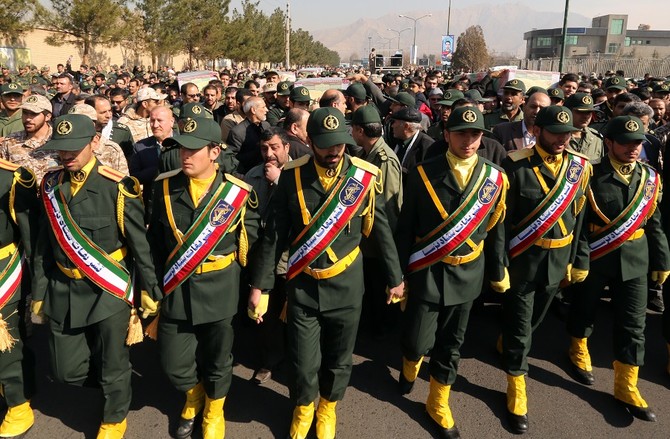
Militants abduct 14 Iranian border guards on border with Pakistan

Fourteen Iranian border guards were kidnapped on the border with Pakistan on Tuesday. (File/AFP)
Updated 16 October 2018
Follow

Militants abduct 14 Iranian border guards on border with Pakistan

  • The official said the kidnappers were members of a terrorist group, but gave no more details
  • Lulakdan is in Sistan and Baluchestan Province

TEHRAN: Militants in Iran abducted 14 members of a border security force near the Pakistan border on Tuesday, Iranian media reported, in the latest blow to the country’s powerful Revolutionary Guard.
The reports quoted an unnamed but informed source as saying two of the abducted are members of the powerful Revolutionary Guard’s intelligence department. The rest include seven members of the Basij force, a volunteer wing of the Guard, as well as regular Iranian border guards.
The abduction took place under the cover of darkness, before dawn, near the Loukdan border crossing point in southeastern Sistan and Baluchistan province. The area, which lies on a major opium trafficking route, has seen occasional clashes between Iranian forces and Baluch separatists, as well as drug traffickers.
There was no immediate claim of responsibility.
The Guard confirmed the abductions in a statement on its website, saying the attack was the work of “treason committed by infiltrators.”
The statement further blamed the abductions on a “terrorist group guided and supported by foreign intelligence services” and added that the Iranian security will “seriously pursue the bandits, terrorists and infiltrators.”
The Guard also asked Pakistan to take action to secure its side of the border.
“It is expected from the Pakistan government to take a serious attitude toward bandits and terrorists that have taken shelter near the border,” the Guard said, repeating calls for Islamabad to “quickly release and repatriate kidnapped Iranian border guards” — a reference to Iranian troops abducted in earlier incidents and taken into Pakistan.
The statement claimed the perpetrators were “hired by some evil, reactionary and terrorist- training regional countries,” a reference to Iran’s regional rival Saudi Arabia and its Gulf Arab allies.
Later Tuesday, Gen. Mohammad Pakpour, commander of the Guard’s ground forces, called for a joint Iran-Pakistan operation against those behind the abductions.
He said Pakistani side needs “to assume more responsibility in this regard” while Iranian state TV said the site of the attack was close to a Pakistani border guard station.
Tuesday’s abductions were the second major blow in as many months to the paramilitary Guard, which answers directly to Iran’s Supreme Leader Ayatollah Ali Khamenei.
In September, militants disguised as soldiers opened fire on a military parade in Iran’s oil-rich southwestern city of Ahvaz, killing 24 people and wounding over 60. 
Arab separatists in the region, who say the Persian-dominated government is discriminating against Iran’s Arab minority, claimed responsibility for the Ahvaz attack and Iranian officials blamed them for the assault. But Daesh also claimed responsibility, initially offering incorrect information about it and later publishing a video of three men it identified as the attackers. The men in the video, however, did not pledge allegiance or otherwise identify themselves as Daesh followers.


Saad Hariri pledges to contest May election

Updated 15 sec ago
Follow

Saad Hariri pledges to contest May election

  • Beirut rally draws large crowds on anniversary of his father’s assassination

BEIRUT: Lebanon’s former Prime Minister Saad Hariri announced on Saturday that his movement, which represents the majority of Lebanon’s Sunni community, would take part in upcoming parliamentary elections scheduled for May.

The Future Movement had suspended its political activities in 2022.

Hariri was addressing a large gathering of Future Movement supporters as Lebanon marked the 21st anniversary of the assassination of his father and former Prime Minister Rafik Hariri, at Martyrs’ Square in front of his tomb.

He said his movement remained committed to the approach of “moderation.”

A minute’s silence was observed by the crowd in Martyrs’ Square at the exact time when, in 2005, a suicide truck carrying about 1,000 kg of explosives detonated along Beirut’s seaside road as Rafik Hariri’s motorcade passed, killing him along with 21 others, including members of his security guards and civilians, and injuring 200 people.

Four members of Hezbollah were accused of carrying out the assassination and were tried in absentia by the Special Tribunal for Lebanon.

The crowd waved Lebanese flags and banners of the Future Movement as they awaited Saad Hariri, who had returned to Beirut from the UAE, where he resides, specifically to commemorate the anniversary, as has been an annual tradition.

Hariri said that “after 21 years, the supporters of Hariri’s approach are still many,” denouncing the “rumors and intimidation” directed at him.

He added: “Moderation is not hesitation … and patience is not weakness. Rafik Hariri’s project is not a dream that will fade. He was the model of a statesman who believed, until martyrdom, that ‘no one is greater than their country.’ The proof is his enduring place in the minds, hearts and consciences of the Lebanese people.”

Hariri said he chose to withdraw from political life after “it became required that we cover up failure and compromise the state, so we said no and chose to step aside — because politics at the expense of the country’s dignity and the project of the state has no meaning.”

He said: “The Lebanese are weary, and after years of wars, divisions, alignments and armed bastions, they deserve a normal country with one constitution, one army, and one legitimate authority over weapons — because Lebanon is one and will remain one. Notions of division have collapsed in the face of reality, history and geography, and the illusions of annexation and hegemony have fallen with those who pursued them, who ultimately fled.”

Hariri said the Future Movement’s project is “One Lebanon, Lebanon first — a Lebanon that will neither slide back into sectarian strife or internal fighting, nor be allowed to do so.”

He added that the Taif Agreement is “the solution and must be implemented in full,” arguing that “political factions have treated it selectively by demanding only what suits them — leaving the agreement unfulfilled and the country’s crises unresolved.”

He said: “When we call for the full implementation of the Taif Agreement, we mean: weapons exclusively in the hands of the state, administrative decentralization, the abolition of political sectarianism, the establishment of a senate and full implementation of the truce agreement. All of this must be implemented — fully and immediately — so we can overcome our chronic problems and crises together.

“Harirism will continue to support any Arab rapprochement, and reject any Arab discord. Those who seek to sow discord between the Gulf and Arab countries will harm only themselves and their reputation.

“We want to maintain the best possible relations with all Arab countries, starting with our closest neighbor, Syria — the new Syria, the free Syria that has rid itself of the criminal and tyrannical regime that devastated it and Lebanon, and spread its poison in the Arab world.”

Hariri said he saluted “the efforts of unification, stabilization and reconstruction led by Syrian President Ahmad Al-Sharaa.”

When asked about the Future Movement’s participation in parliamentary elections following his withdrawal from politics, he said: “Tell me when parliamentary elections will be held, and I will tell you what the Future Movement will do. I promise you that, when the elections take place, they will hear our voices, and they will count our votes.”

The US Embassy in Lebanon shared a post announcing that Ambassador Michel Issa laid a wreath at the grave of Rafik Hariri.

Hariri’s legacy “to forge peace and prosperity continues to resonate years later with renewed significance,” the embassy said.