RAQA, Syria: Shattered ultrasound machines and prosthetic limbs litter the hallways of Raqqa’s main hospital, still gutted a year after Daesh made its infamous last stand in its Syrian heartland.
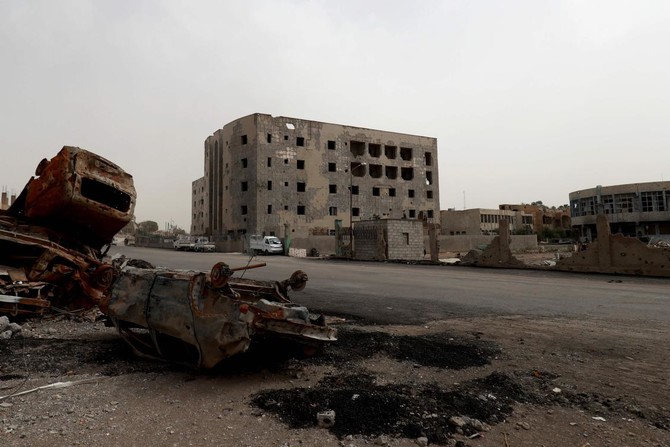
The bullet-riddled complex looms large among the sea of destroyed buildings in the northern city, once the de facto Syrian capital of Daesh’s ill-fated “caliphate.”
On October 17 last year, US-backed forces overran the city’s final two militant holdouts — the National Hospital and nearby stadium — sealing the end of Daesh’s bloody three-year reign over Raqqa.
But a year later, as other parts of the city are being slowly rebuilt, the massive hospital remains in ruins, almost haunted.
The road leading up to the entrance has been cleared of the burned corpses lying there last October, but twisted car wrecks still make for an uncomfortable welcome.
Torn-up gurneys, filthy sky-blue hospital sheets and rusted gas canisters have been dumped in the courtyard.
Bullet-riddled doors are graffitied with the phrase “CLEAR, November 9, 2017,” apparently marking the day those rooms were checked for mines or lingering militants.
Inside, hospital rooms are charred black from fires after air strikes.
Paint is peeling off the ceiling and the walls are lined with sand bags piled by Daesh fighters defending their final bastion.
Making his way slowly through the abandoned medical ward was Mohammad Hussein, 37, in navy trousers and a striped shirt.
Hussein is now a member of the health commission of Raqqa Civil Council (RCC), the body governing the city since Daesh’s ouster, but he was once a nurse in the hospital.
“You don’t feel like you’re walking into a hospital. You feel like you’re walking into a mound of rubble,” he muttered.
The Raqqa native began working in the hospital in 2003 at the age of 22, and stayed on when Daesh captured the city 11 years later.
Hussein recalls Daesh members shoring up the hospital’s defenses last year, digging tunnels and setting up blast walls as the US-backed Syrian Democratic Forces (SDF) closed in.
“They stockpiled medical supplies in huge amounts — serums, blood, water, power generators,” he said.
After days of besieging the hospital and stadium, the SDF made a successful, lightning-fast push for both.
Since then, tens of thousands of people have returned to Raqqa, but life is still dangerous in the city.
Daesh planted a sea of mines across the city that have maimed and killed returning residents, and guerrilla-style attacks against SDF positions indicate militant sleeper cells remain a threat.
“No one lost as much as Raqqa’s people when it comes to the destruction of this hospital, which used to serve hundreds of people on a daily basis,” said Hussein.
Khaled Abbud Al-Hassan was one of them.
One day last year, as artillery and air strikes pounded areas near his home, a piece of shrapnel tore into his building.
“It killed my four-year-old daughter and cut my hand, so I went to get treated at the hospital,” said Hassan, 60.
Inside were doctors from Azerbaijan, he recalled. Most of the Syrian staff was from Aleppo, west of Raqqa.
“They treated each other and us as well. I was there for about a week before the hospital was bombed and they told us to get out,” Hassan said.
After a recent visit to Raqqa, Amnesty International said the level of destruction was “shocking,” with schools, homes, and medical infrastructure still ravaged.
It has slammed the US-led coalition’s bombing of the city and said it should help rebuild Raqqa.
The coalition has removed rubble from main streets and demined some areas, but a rehabilitation of the hospital has still not been sponsored, said RCC co-chair Laila Mustafa.
“It needs huge funds to be restored, more than three billion Syrian pounds (almost $6 million). This excludes medical equipment, which would be high-quality and exorbitantly expensive,” Mustafa said.
She told AFP that the RCC was in talks with a foreign backer over funds to partially rehabilitate one hospital ward.
The stadium, whose underground locker rooms Daesh had transformed into a prison, has fared better.
The field was partly restored after the SDF’s takeover, hosting its first football match in April.
Now, laborers are building a platform and stadium seats have been painted white, with a crimson-red trim.
“We’re coordinating with the RCC and the Syrian Democratic Council to rehabilitate the national stadium,” said Imad Al-Himad, a contractor.
It has so far cost around 100,000 Syrian pounds.
“This was the ‘black stadium,’ and since it was repainted white, it’ll be known as the White Stadium,” said Himad.


![]()
![]()
![]()
![]()

Year after Daesh lost Syria’s Raqqa, holdout hospital awaits recovery


Year after Daesh lost Syria’s Raqqa, holdout hospital awaits recovery
- The bullet-riddled complex looms large among the sea of destroyed buildings in the northern city
- Inside, hospital rooms are charred black from fires after air strikes


Latest updates


© 2026 SAUDI RESEARCH & PUBLISHING COMPANY, All Rights Reserved And subject to Terms of Use Agreement.