SAO PAULO: Brazil’s far-right presidential candidate Jair Bolsonaro is “fomenting violence” and is a danger to democracy, his leftist rival Fernando Haddad told AFP on Saturday.
Haddad, trailing in the polls ahead of an October 28 runoff, argued against Bolsonaro’s pledge to ease gun laws for citizens to combat rampant insecurity and highlighted contentious remarks Bolsonaro has made.
“My adversary foments violence, including a culture of rape,” Haddad said, recalling an episode when Bolsonaro told a congresswoman she didn’t “deserve” to be raped by him.
He stressed he believed Brazil was seeing the biggest peril since returning to democracy three decades ago, saying: “In my opinion, the big threat to the continent is Bolsonaro.”
The charges were made as violent incidents linked to the election occurred in various parts of Brazil. Early this week, a man was stabbed to death in a bar for reportedly yelling support for Haddad’s Workers Party. A transgender woman also said she was beaten by Bolsonaro supporters in the street.
Haddad, a former mayor of Sao Paulo, is fighting to close a big gap between him and Bolsonaro, who admires US President Donald Trump and is nostalgic for Brazil’s 1964-1985 military dictatorship.
Haddad is pushing for televised debates that his rival has so far avoided, initially because of a wound Bolsonaro suffered when a lone assailant stabbed him while campaigning last month.
In the first round of the election last Sunday, Bolsonaro easily dominated, winning 46 percent of the vote to Haddad’s 29 percent.
A subsequent Datafolha survey suggested Bolsonaro, a former paratrooper running on an anti-crime, anti-corruption platform, had 58 percent voter support going into the run-off, against 42 percent for Haddad.
In his interview with AFP in Sao Paulo, Haddad homed in on the frontrunner’s message that has resonated most with Brazilians: Bolsonaro’s law-and-order pledges that include making it easier for citizens to defend themselves with firearms, boosting the police force, and lowering the age of criminal responsibility to 16.
“Arming the population will resolve nothing. It’s the state that has to implement public safety,” he said.
He added that the outgoing government had fallen short in this area, especially in combating organized crime.
Bolsonaro was singularly unsuited to fighting violence, Haddad said, pointing to a campaign moment when the far-right candidate feigned shooting up the Workers Party.
“How can a person preaching intolerance offer security to anyone?” he asked.
Haddad also pushed back against a public perception highlighted by Bolsonaro that the Workers Party, in power from 2003 to 2016, was corrupt — a view confirmed by the incarceration of its icon, former president Luiz Inacio Lula da Silva, for corruption.
His party had made “errors,” he admitted.
“Our government didn’t brush anything under the carpet. Obviously, what people saw outside the carpet wasn’t pretty but that was combated with legislation we approved and... all organs of the state will be strengthened in our new government,” Haddad said.
“I share the same view as society that corruption is something intolerable.”
But he also pointed to Bolsonaro’s very thin record of being involved in passing laws despite nearly three decades in Congress, saying: “He rails against things. But what he proposes has no consistency whatsoever.”
Haddad declared: “That person is leader in the polls, but he will lose.”
Lula, he said, was “very happy” at Haddad’s performance so far in the elections, especially as he had been a late replacement for the ex-president in September, after a court ruled Lula to be ineligible to run again.
Haddad also tackled attempts by Bolsonaro’s campaign to claim the Workers Party was the same as the Socialist regime running neighboring Venezuela, in crisis under President Nicolas Maduro.
The Workers Party’s run in government in Brazil “didn’t look anything like what is happening in Venezuela,” he said, adding that his party “was born in the challenge to all authoritarian regimes on the left and right — unlike Bolsonaro whose roots are in the military dictatorship.”


![]()
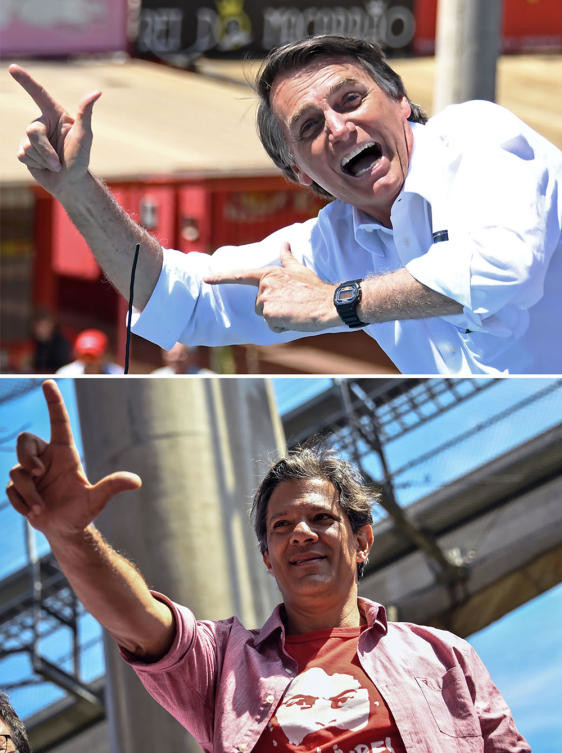
Brazil’s presidential candidate Haddad accuses far-right rival of ‘fomenting violence’
Brazil’s presidential candidate Haddad accuses far-right rival of ‘fomenting violence’
- Haddad argued against Bolsonaro’s pledge to ease gun laws for citizens to combat rampant insecurity and highlighted contentious remarks Bolsonaro has made
- In the first round of the election last Sunday, Bolsonaro easily dominated, winning 46 percent of the vote to Haddad’s 29 percent


Latest updates


© 2026 SAUDI RESEARCH & PUBLISHING COMPANY, All Rights Reserved And subject to Terms of Use Agreement.