

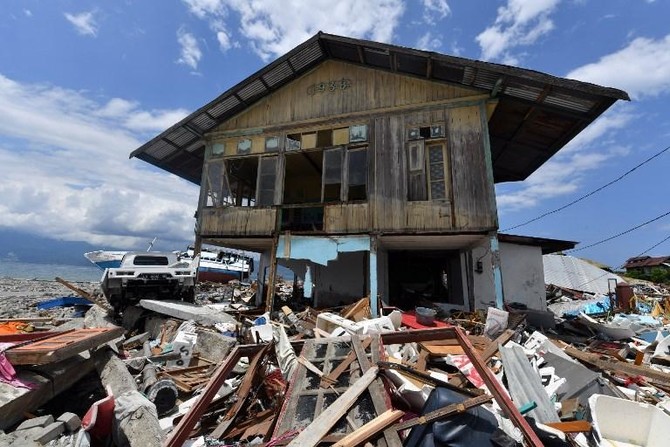
Indonesia ends grim search for dead in quake-tsunami

1 / 2
The United Nations has sought $50.5 million for immediate relief to help the quake-tsunami victims. (AFP)
2 / 2
Members of the Indonesian special operations Mobile Brigade Corps patrol the Petobo neighborhood hit by the earthquake and liquefaction in Palu, Central Sulawesi, Indonesia, on Thursday. (Reuters )
Updated 12 October 2018
Follow

Indonesia ends grim search for dead in quake-tsunami

  • The magnitude 7.5-quake and a subsequent tsunami razed swathes of the city of Palu on Sulawesi island on September 28
  • Indonesia initially refused international help, saying the military had the situation in hand

JAKARTA: The Indonesian government has extended by two weeks the emergency phase in earthquake-stricken areas of Sulawesi island in central Indonesia. Initially due to end today it will continue until Oct. 26, the National Disaster Management Agency (BNPB) revealed.

The government also decided to continue search efforts into today to recover bodies of victims of the 7.4-magnitude earthquake and the ensuing tsunami and landslides. The original plan was to end searches yesterday, worried that decomposing bodies could trigger diseases after two weeks buried under rubble.

“There were people who requested for the search and evacuation efforts to be extended for another day. But it will really have to end on Friday,” BNPB spokesman Sutopo Purwo Nugroho said.

He added that the joint national search and rescue team will still be looking for bodies of victims in full force throughout the day but will officially end its work by sundown.

The search efforts will be reduced to a smaller effort with Palu’s search and rescue agency handling the work in case there more bodies are retrieved.

The number of those confirmed dead in the two weeks since the Sept. 28 quake rose to 2,073. As many as 1,663 were from Palu while the rest were from neighboring districts of Donggala, Sigi, Parigi Moutong and West Sulawesi’s Pasangkayu district. All those confirmed dead have been buried, Nugroho said.

Palu, the provincial capital with a population of 367,000, was been greatly affected by the triple disaster, with 65,773 houses on its coastline swept away by the tsunami. Further inland residential areas have been reduced to rubble.

Nugroho said the number of people still unaccounted for remains in the hundreds with the official figure given as 652 in Palu out of the overall total of 680. It is estimated, however, that thousands will eventually be classified as missing.

Central Sulawesi Governor Longki Djanggola revealed that the government will turn the devastated Balaroa, Petobo and Jono Oge housing areas into open green spaces to serve as a memorial park for those killed.

As Indonesia recovered from the Palu quake, a powerful undersea quake with 6.3 magnitude shook Situbondo in East Java province at 01:57 a.m. yesterday, according to the Meteorology, Climatology and Geophysics Agency.

The quake killed three people, with falling debris injuring a further eight, Nugroho said.

The jolt was felt in some parts of neighboring island of Bali, where global leaders and thousands of world’s top financiers, economists, and bankers are gathered in southeast of the island for annual meetings of International Money Fund and World Bank.

UN Secretary General Antonio Guterres and Malaysian Prime Minister Mahathir Mohammad are scheduled to take some time off their schedule in Bali to visit Palu this week.

“The quakes in Situbondo and Palu are not connected to each other because the faults that triggered them are different,” Nugroho said.

The Indonesian archipelago sits along on the Pacific Ring of Fire where tectonic plates meet and subduct, meaning it is a disaster-prone area with frequent earthquakes and volcanic eruptions.


Mexico fears more violence after army kills leader of powerful Jalisco cartel

Updated 1 sec ago
Follow

Mexico fears more violence after army kills leader of powerful Jalisco cartel

GUADALAJARA: School was canceled in several Mexican states and local and foreign governments alike warned their citizens to stay inside, as widespread violence erupted following the army’s killing of the powerful leader of the Jalisco New Generation Cartel.
Nemesio Rubén Oseguera Cervantes, known as “El Mencho” was the boss of one of the fastest-growing criminal networks in Mexico, notorious for trafficking fentanyl, methamphetamine and cocaine to the United States and staging brazen attacks against government officials who challenged it.
He was killed during a shoot-out in his home state of Jalisco as the Mexican military attempted to capture him. Cartel members responded with violence across the country, blocking roads and setting fire to vehicles.
President Claudia Sheinbaum urged calm and authorities announced late Sunday they had cleared most of the more than 250 cartel roadblocks across 20 states. The White House confirmed that the US provided intelligence support to the operation to capture the cartel leader and applauded Mexico’s army for taking down a man who was one of the most wanted criminals in both countries.
Mexico hoped the death of the world’s biggest fentanyl traffickers would ease Trump administration pressure to do more against the cartels, but many remained hunkered down and on edge as they waited to see the powerful cartel’s reaction.
Many fear more violence
Guadalajara, the capital of Jalisco state and Mexico’s second-largest city, was almost completely shut down on Sunday as fearful residents stayed home.
Passengers arriving to the city’s international airport Sunday night were told it was operating with limited personnel because of the burst of violence.
Jacinta Murcia, a 64-year-old nutrition products vendor, was among those nervously walking late Sunday night through the airport, where earlier in the day travelers sprinted and ducked behind chairs fearing violence. Most flights into the city were suspended on Sunday.
Murcia anxiously scrolled through news stories on social media showing the face of “El Mencho” and sent messages to her children, who were tracking her location as she tried to travel across the city to her house after dark.
“My plan today leaving the airport is to see if there are any taxis, but I’m scared of everything. That there are blockades, that there’s a curfew, that something could happen,” she said. “I’m all alone.”
Authorities in Jalisco, Michoacan and Guanajuato reported at least 14 other people killed Sunday, including seven National Guard troops.
Videos circulating on social media showed tourists in Puerto Vallarta walking on the beach with smoke rising in the distance.
In another part of the airport a group of elderly Mexicans gathered, discussing how to get home.
“We better all go together,” one said. “Go with God.”
A blow against a cartel could be a diplomatic coup
David Mora, Mexico analyst for International Crisis Group, said the capture and outburst of violence marks a point of inflection in Sheinbaum’s push to crack down on cartels and relieve US pressures.
US President Donald Trump has demanded Mexico do more to fight the smuggling of the often-deadly drug fentanyl, threatening to impose more tariffs or take unilateral military action if the country does not show results.
There were early signs that Mexico’s efforts were well received by the United States.
US Amb. Ron Johnson recognized the success of the Mexican armed forces and their sacrifice in a statement late Sunday. He added that “under the leadership of President Trump and President Sheinbaum, bilateral cooperation has reached unprecedented levels.”
But it may also pave the way for more violence as rival criminal groups take advantage of the blow dealt to the CJNG, Mora said.
“This might be a moment in which those other groups see that the cartel is weakened and want to seize the opportunity for them to expand control and to gain control over Cartel Jalisco in those states,” he said.
“Ever since President Sheinbaum has been in power, the army has been way more confrontational, combative against criminal groups in Mexico,” Mora said. “This is signaling to the US that if we keep cooperating, sharing intelligence, Mexico can do it, we don’t need US troops on Mexican soil.”
‘El Mencho’ was a major target
Oseguera Cervantes, who was wounded in the operation to capture him Sunday in Tapalpa, Jalisco, about a two-hour drive southwest of Guadalajara, died while being flown to Mexico City, the Defense Department said in a statement.
During the operation, troops came under fire and killed four people at the location. Three more people, including Oseguera Cervantes, were wounded and later died, the statement said.
White House Press Secretary Karoline Leavitt said via X that the US government provided intelligence support for the operation. “‘El Mencho’ was a top target for the Mexican and United States government as one of the top traffickers of fentanyl into our homeland,” she wrote. She commended Mexico’s military for its work.
The US State Department had offered a reward of up to $15 million for information leading to the arrest of El Mencho. The Jalisco New Generation Cartel is one of the most powerful and fastest growing criminal organizations in Mexico and began operating around 2009.
In February 2025, the Trump administration designated the cartel as a foreign terrorist organization.
Sheinbaum has criticized the “kingpin” strategy of previous administrations that took out cartel leaders, only to trigger explosions of violence as cartels fractured. While she has remained popular in Mexico, security is a persistent concern and since US President Donald Trump took office a year ago, she has been under tremendous pressure to show results against drug trafficking.
The Jalisco cartel has been one of the most aggressive cartels in its attacks on the military — including on helicopters — and is a pioneer in launching explosives from drones and installing mines. In 2020, it carried out a spectacular assassination attempt with grenades and high-powered rifles in the heart of Mexico City against the then head of the capital’s police force and now federal security secretary.