Over 1,000 militants leave demilitarized zone in Syria’s Idlib

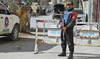
In this July 19, 2018 file photo, a Syrian army soldier holds his AK-47 rifle with stickers showing President Bashar Assad and Arabic that reads, "Heroes of Assad's Syria," at a check point at the Hamadiyah market, in the Old City of Damascus, Syria. (AP)
Updated 10 October 2018
Follow

Over 1,000 militants leave demilitarized zone in Syria’s Idlib

  • Deadline arrives after Russia and Turkey agreed to enforce a new buffer zone
  • Syrian Observatory for Human Rights, said no heavy weapons were visible in the buffer

MOSCOW: More than 1,000 militants have left a demilitarized zone in Syria’s rebel-held region of Idlib, Russian Foreign Ministry spokeswoman Maria Zakharova told reporters on Wednesday.
Russia and Turkey agreed to enforce a new demilitarised zone in Idlib from which “radical” rebels were required to withdraw by Oct. 15.

The demilitarized zone ringing the Idlib region is the result of a deal reached last month between rebel backer Turkey and government ally Russia to stave off a regime assault on Syria's last major rebel stronghold.
The accord called for a complete withdrawal of all heavy weapons from the planned buffer by Wednesday, and rebels and jihadists appeared to have met that deadline.
"The pullout of heavy weapons from the de-militarized zone was completed on October 10," the Turkish defence ministry said.
Rami Abdel Rahman, who heads the Syrian Observatory for Human Rights, said no heavy weapons were visible in the buffer already from Tuesday.
He was unable to confirm any pullout from a part of the planned zone that falls inside Latakia province but said any such weaponry was not out in the open.
"They could have been moved to trenches or secret locations," he said.
The Turkey-backed National Liberation Front (NLF) rebel alliance said it had pulled out all heavy arms by Monday, and the Observatory said jihadists quietly followed suit.
Despite the relatively speedy implementation of the accord's first deadline, observers say a thornier task lies ahead.
Under the deal, the zone must be free by October 15 of all jihadists, including those of Hayat Tahrir al-Sham (HTS), the region's dominant force led by former Al-Qaeda fighters.
With five days to go, HTS and other jihadist fighters remained inside the planned buffer area and showed no sign of leaving.
HTS, which controls more than two-thirds of the planned zone, has not officially responded to the Turkey-Russia deal.
Haid Haid, an associate fellow at the Chatham House think-tank, said HTS had made the "pragmatic" move of pulling out its heavy weapons.
"Of course implementing the heavy weapons point is easier," he said. "The harder point is withdrawing forces from the area."
Syrian Foreign Minister Walid Muallem had expressed confidence in Turkey's ability to fulfil its side of the deal "because of its knowledge of factions" on the ground.
HTS, jihadists from the Turkestan Islamic Party (TIP) and current Al-Qaeda outfit Hurras al-Deen control more than two-thirds of the planned buffer zone.
Many of HTS's fighters have battled for years in Syria under various groups and are keen to keep their influence in the war-ravaged country's largest remaining rebel bastion.
"HTS is playing the long game in Idlib," said Nicholas Heras of the Center for a New American Security.
"It is making the assessment that Turkey will allow it to continue to operate in northwest Syria, so long as HTS keeps a low profile," he added.
"As long as HTS stays on Turkey's good side, it has a golden opportunity to set permanent roots in Idlib," Heras said.
In recent weeks, Turkey has dispatched convoys of troops to monitoring posts in the region and its soldiers are expected to patrol any future buffer zone.
Forces loyal to President Bashar Al-Assad have retaken large parts of Syria from opposition fighters and jihadists since Russia intervened in September 2015.
After a series of victories near Damascus and in the south of the country earlier this year, a similar Moscow-backed assault had been expected against Idlib before the Russia-Turkey deal was announced.
Despite progress in implementing the accord, Assad insisted on Sunday it was a "temporary measure" and that Idlib would eventually return to state control.
Heras said Damascus and Moscow could use the grace period to focus on reconstructing Syria's war-ravaged infrastructure.
"The Russians want to freeze the war in western Syria and get on with the business of rebuilding Assad's zone of control," he said.
"Assad might want to reconquer Idlib, but for now he does not have a better option than this deal," he said.
The Syrian war has killed more than 360,000 people since it erupted in 2011 with the brutal repression of anti-government protests.

Meanwhile, the UN on Wednesday urged warring parties in Syria to allow basic health service deliveries to tens of thousands of increasingly desperate Syrians trapped in the desert near the Jordanian border.
The global body's fund for children, UNICEF, said two babies without access to hospitals had died in the past 48 hours near the Rukban border crossing.
"Once again, UNICEF appeals to all parties to the conflict in Syria and those who have influence over them, to allow and facilitate access to basic services including health for children and families," said the agency's Middle East and North Africa director, Geert Cappelaere.
"This is the very minimum for human dignity."


Sudan defense minister dismisses ‘intelligence document’ as fabrication after convoy strike

Updated 12 February 2026
Follow

Sudan defense minister dismisses ‘intelligence document’ as fabrication after convoy strike

  • Gen. Hassan Kabroun tells Arab News claims that army hid weapons in aid convoy are “completely false”

RIYADH: Sudan’s defense minister has firmly denied reports attributed to Sudanese intelligence alleging that a convoy targeted in North Kordofan was secretly transporting weapons under the cover of humanitarian aid.

Gen. Hassan Kabroun described the claims as “false” and an attempt to distract from what he called a militia crime.

The controversy erupted after news reports emerged that a document attributed to Sudan’s General Intelligence Service claimed the convoy struck in Al-Rahad on Friday was not a purely humanitarian mission, but was instead carrying “high-quality weapons and ammunition” destined for Sudanese Armed Forces units operating in the state.

The report further alleged that the convoy had been outwardly classified as humanitarian in order to secure safe passage through conflict zones, and that the Rapid Support Forces had destroyed it after gathering intelligence on its route and cargo.

Kabroun categorically rejected the narrative.

“First of all, we would like to stress the fact that this news is false,” he told Arab News. “Even the headline that talks about the security of the regions, such as Al-Dabbah, is not a headline the army would use.”

He described the document as fabricated and politically motivated, saying it was designed to “cover up the heinous crime they committed.”

The minister affirmed that the area targeted by drones is under full control of the Sudanese Armed Forces and does not require any covert military transport.

“Second, we confirm that the region that was targeted by drones is controlled by the army and very safe,” Kabroun said. “It does not require transporting any military equipment using aid convoys as decoys because it is a safe area controlled by the army, which has significant capabilities to transport humanitarian aid.”

According to the minister, the Sudanese military has both the logistical capacity and secure routes necessary to move equipment openly when needed.

“The army is professional and does not need to deliver anything to Kadugli or Dalang on board aid convoys,” he said. “The road between Dalang and Kadugli is open. The Sudanese forces used that road to enter and take control of the region. The road is open and whenever military trucks need to deliver anything, they can do so without resorting to any form of camouflage.”

Kabroun further rejected any suggestion that the military uses humanitarian operations as cover.

“Aid is transported by dedicated relief vehicles to the areas in need of this assistance,” he said. “Aid is not transported by the army. The army and security apparatus do not interfere with relief efforts at all, and do not even accompany the convoys.”

He stressed that the Sudanese Armed Forces maintains a clear institutional separation between military operations and humanitarian work, particularly amid the country’s crisis.

“These are false claims,” he said. “This fake news wanted to cover up the heinous crime they committed.”

Sudan has been gripped by conflict since April 2023, when fighting broke out between the Sudanese Armed Forces and the Rapid Support Forces, plunging the country into what the United Nations has described as one of the world’s worst humanitarian disasters.

The latest dispute over the convoy comes amid intensified fighting in South Kordofan, a strategically sensitive region linking central Sudan with the contested areas of Darfur and Blue Nile.

The false report suggested that intelligence monitoring had enabled the RSF to strike what it described as a military convoy disguised as humanitarian aid. But Kabroun dismissed that version outright.

“The intelligence agency is well aware of its duties,” he said. “The Sudanese Army has enough weapons and equipment to use in the areas of operations. These claims are completely false.”

He argued that the narrative being circulated seeks to shift blame for attacks on civilian infrastructure and humanitarian movements.

“This shows that they are trying to cover up the atrocities,” he added, referring to the militia.

Kabroun maintained that the army has regained momentum on multiple fronts and remains fully capable of sustaining its operations without resorting to deception.

“The region is secure, the roads are open, and the army does not need camouflage,” he said. “We are operating professionally and transparently.”

“These claims are completely false,” Kabroun said. “The Sudanese Army does not use humanitarian convoys for military purposes.”