

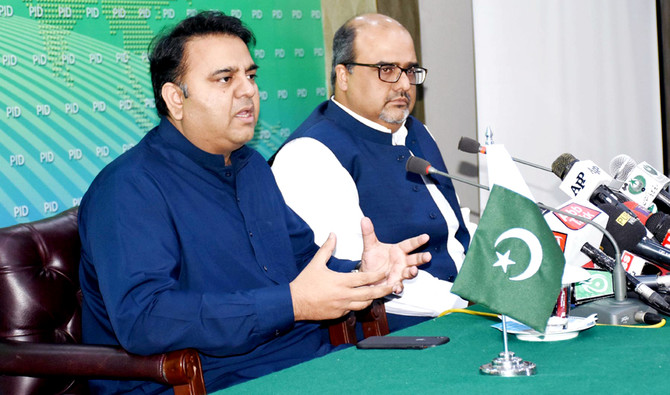
ISLAMABAD: A newly established multiagency “Assets Recovery Unit” in Pakistan started its operation this week, Special Assistant to the Prime Minister on Accountability Mirza Shahzad Akbar told reporters in Islamabad on Friday.
Akbar, who also heads the special unit, said the authorities had received the details of more than 10,000 properties in Dubai and England belonging to Pakistani nationals, and the unit is now investigating and gathering more details about these assets.
The aim of the unit is to investigate assets acquired using wealth accumulated in Pakistan illegally and then laundered abroad.
Akbar said in a news conference that the government was also working to ratify treaty with Switzerland to get information about Pakistani nationals’ bank accounts in Switzerland.
Imran Khan’s Pakistan Tehreek-i-Insaf (PTI) has often claimed that it intends to bring looted wealth back to Pakistan, and has campaigned on this message extensively.
The PTI also said in a tweet: “The law is being made for the exchange of information with the United States, China and UAE.”
It added that anti money-laundering legislation is being changed.
Last month, Prime Minister Imran Khan’s cabinet formed a “Assets Recovery Unit” to trace assets of Pakistani nationals who have taken money outside the country or are retaining money unlawfully.
After the cabinet decision, in an interview with Arab News, the head of the Assets Recovery Unit, Mirza Shahzad Akbar, said that representatives of National Accountability Bureau (NAB), Federal Investigation Agency (FIA), Federal Board of Revenue (FBR) and State Bank of Pakistan (SBP) are part of this multiagency unit.
Mirza Shahzad Akbar had admitted that at this point the special unit does not have information on the exact amount that needed to be retrieved but ex-finance minister Ishaq Dar had put the figure at $200 billion, in 2013.
Other than to ascertain the exact amount to be retrieved the major challenge for government in foreign countries would be to establish that the money was transferred through unlawful means from Pakistan.
Analysts believe that to bring “looted money” the Pakistani Government not only needs to modify laws at home but also to sign conventions and treaties with the other countries, where the government believes Pakistani nationals have transferred money unlawfully or purchased assets.
Dr. Vaqar Ahmed, joint executive director at the Sustainable Development Policy Institute, told Arab News that bringing back “looted money” will be “very difficult given the past experience. They (the government) would need to prove (criminal activities) in foreign courts.”
However, he maintained that “the Asset Recovery Unit has been established which is a step in the right direction but also points toward the deficits of those organizations which were mandated to do this job and couldn’t deliver. Only time will tell how this unit can better coordinate across the FIA, NAB, FBR and SBP.”
Though it is difficult to establish the “looted money” trail, especially in European countries, it is not without precedent. In August this year, in one such example, the United Kingdom repatriated £70 million stolen by an unnamed Nigerian citizen, who was convicted in an Italian court but the identity of the Nigerian involved in the offense was not made public.
After decrying the corrupt political elite for nearly 22 years of his political life, Imran Khan finally rose to power by securing an election win in July this year.
Ever since then, his government has been grappling with the decades-old problem of illegally acquired cash, also known as black money, stashed outside the country by rich and influential Pakistanis.


