

Indonesia receives foreign aid a week after powerful earthquake

1 / 3
Indonesian military personnel unload relief aid from a Singapore Air Force cargo plane at the Mutiara Sis Al-Jufri airport in Palu, Central Sulawesi, on Oct. 4, 2018. (AP Photo/Tatan Syuflana)
2 / 3
Indonesian military personnel distribute relief aid at the Mutiara Sis Al-Jufri airport to evacuate the earthquake and tsunami-damaged city of Palu, Central Sulawesi island, on Oct. 4, 2018. (AP Photo/Tatan Syuflana)
3 / 3
Indonesian military personnel unload relief aid from a Singapore Air Force cargo plane at the Mutiara Sis Al-Jufri airport in Palu, Central Sulawesi, on Oct. 4, 2018. (AP Photo/Tatan Syuflana)
Updated 06 October 2018
Follow

Indonesia receives foreign aid a week after powerful earthquake

JAKARTA: Foreign aid began pouring in on Friday to areas devastated by the 7.4 magnitude earthquake and the tsunami a week earlier in Indonesia’s Central Sulawesi province on the island of Sulawesi.

Indonesian officials have said that among the items they need most to distribute humanitarian aid to Palu — the provincial capital — and surrounding districts, is an aircraft that can land at Mutiara Sis Al Jufri airport where only 2,000 meters of runway remain intact.

Other items that Indonesia needs are water and sanitation, tents, power generators, field hospital and medical assistance.

The spokesman for the disaster mitigation agency said in a press conference that at least 10 Hercules aircraft from Singapore, Malaysia, Australia, India and New Zealand had taken part in deploying aid to Palu.

“There will be 12 planes from the US, Malaysia, China, South Korea, Japan and Thailand arriving soon,” Sutopo Purwo Nugroho said, adding that all foreign aid is arriving first in Balikpapan, the main city in East Kalimantan province across the Makassar Strait, before they are distributed to the disaster areas.

The Embassy of Japan said in a statement on Friday that a C-130 Hercules and 51 personnel of Japan’s disaster relief unit had arrived in Balikpapan and planned to begin air transport from Balikpapan to Palu on Saturday.
The Japan International Cooperation Agency (JICA) has donated relief goods such as 500 tents, generators, water purifiers and flocculants with a total value of 3 billion Indonesian rupiah, which have arrived in Balikpapan and will be distributed in the affected areas immediately.

Rescuers have managed to pull out bodies and survivors from the eight-story Roa Roa Hotel in Palu, which had a high occupancy rate at the time of the quake.

Nugroho said on Thursday that rescuers had managed to extract eight bodies from the ruins of the hotel, including a South Korean who had been participating in a paragliding competition. The competition had completed by the time the quake struck at 6.02 p.m. local time and it was held as part of the Pesona Palu Nomoni Festival to celebrate Palu’s 40th anniversary.

Wahyu Yudha, head of FASI (Federasi Aero Sport Indonesia), confirmed the paraglider’s death in a statement and said that the body of Dong Jin Lee, who was based in Bali, was found under the hotel’s rubble at 2.45 p.m. on Thursday and had been identified by his family. Another paraglider from East Java and a member of the Indonesian Air Force, Fahmi Ruddo, was also found dead in the debris.

Tagor Siagian, spokesman for the Indonesia Paragliding & Hanggliding Association (FASI), said that there were 32 paragliders, including those from Palu who participated in the competition, but most of those who were not from Palu were able to leave the city a day after the quake.

“There were seven paragliders who had been staying at the Roa-Roa Hotel. Four of them had been found dead earlier on Monday and Tuesday,” Siagian told Arab News.
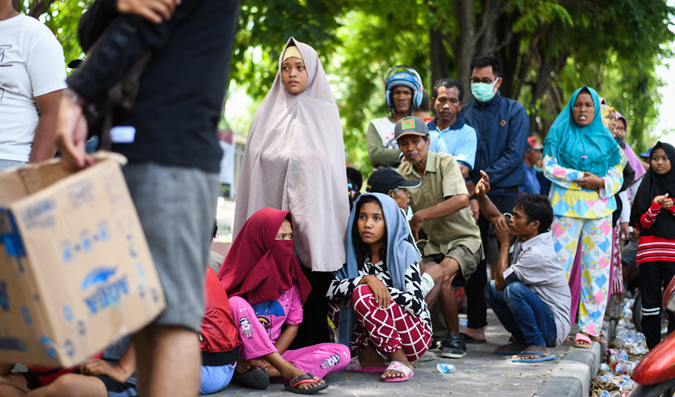


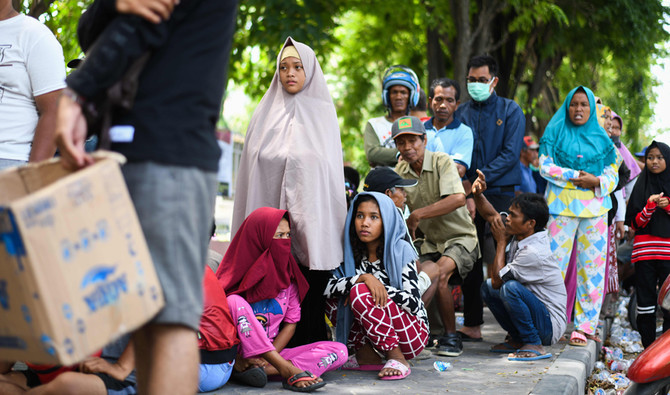
Earthquake-affected Indonesian residents queue outside a government building to get relief aid in Palu, Sulawesi island, on Oct.4, 2018. (AFP)

The confirmed death toll has soared to 1,571 with 1,352 from Palu and the rest from the neighboring districts of Parigi Moutong, Donggala, Pasangkayu and Sigi.

“Rescuers will continue to look for more bodies and survivors seven days since the earthquake and tsunami hit, with the possibility to extending it to another week,” Nugroho said.

At least 1,510 bodies have been buried, while the number of those badly injured is now 2,549, while 70,821 people have been displaced.

With the possibility of casualties continuing to rise, Nugroho said that those who couldn’t be found by the end of the emergency phase would be classified as missing instead of confirmed dead.

It is very likely the number of people missing could reach thousands from the current 113, given the scale of devastation caused by the second quake - triggered calamity that hit Palu — soil liquefaction, or when the soil becomes saturated and loses its density.

As many as 66,238 houses are damaged, with 1,700 houses in Balaroa residential complex badly damaged by the liquefaction that followed the quake. In Petobo, an entire village of 744 houses collapsed and was swallowed by the liquefying soil.  

Indonesia sits on the Pacific Ring of Fire, where active volcanoes are concentrated and tectonic plates meet and subduct, making it a disaster-prone area with frequent earthquakes. There are 127 active volcanoes that dot the Indonesian archipelago.

“So far, there have been 437 aftershocks, with decreasing intensity since the 7.4 magnitude quake. It will continue to happen as the faults are finding a balance,” Nugroho said.


Russia-ally Touadera seeks third term in Central African Republic

Updated 1 sec ago
Follow

Russia-ally Touadera seeks third term in Central African Republic

BANGUI: Central African Republic President Faustin-Archange Touadera is seeking a third term in an election on Sunday, campaigning on security gains after signing deals with rebel groups and enlisting support from Russian mercenaries and Rwandan ​forces.
He faces six opposition candidates including Anicet-Georges Dologuele, a former prime minister and runner-up in the 2020 election, but is likely to win in part due to his control over state institutions, analysts say.
Such a result would likely further the interests of Russia, which has traded security assistance for access to resources including gold and diamonds. Touadera is also offering access to the country’s lithium and uranium reserves to anyone interested.
The 68-year-old mathematician took power in 2016 after the worst crisis in the chronically unstable country’s history, when three years of intercommunal strife forced a fifth of the population to flee their homes, either internally or abroad.
Touadera has signed peace deals this year with several rebel groups, while ‌others have been ‌weakened in the face of Russian mercenaries and troops from Rwanda deployed to ‌shore ⁠up Touadera’s ​government as ‌well as UN peacekeepers.
“During the 10 years that we have been working together, you yourselves have seen that peace is beginning to return, starting from all our borders and reaching the capital,” Touadera told a rally at a stadium in the capital Bangui this month.
His opponents, meanwhile, have denounced a constitutional referendum in 2023 that scrapped the presidential term limit, saying it was proof Touadera wants to be president for life.
They have also accused him of failing to make significant progress toward lifting the 5.5 million population out of poverty.
“The administrative infrastructure has been destroyed and, as you know, the roads are in a ⁠very poor state of repair,” Dologuele told a recent press conference.
“In short, the Central African economy is in ruins.”
SECURITY THREATS REMAIN DESPITE PEACE DEALS
The presidential ‌contest is taking place alongside legislative, regional and municipal elections, with provisional results ‍expected to be announced by January 5.
If no ‍candidate gets more than 50 percent of the vote, a presidential runoff will take place on February 15, while legislative ‍runoffs will take place on April 5.
A smooth voting process could reinforce Touadera’s claim that stability is returning, which was buttressed last year with the UN Security Council’s lifting of an arms embargo and the lifting of a separate embargo on diamond exports.
“The fact that these measures were lifted, it shows that we’re gradually getting back to normal. Or at least that’s the narrative,” said Romain ​Esmenjaud, associate researcher at the Institut Francais de Geopolitique.
The peace deals are credited with a decline in violence in some areas and an expected boost in economic growth projections to 3 percent this ⁠year, according to the International Monetary Fund. US President Donald Trump’s administration has said the UN should hand security back to the government soon.
But serious security threats remain. Rebels have not fully disarmed, reintegration is incomplete, and incursions by combatants from neighboring Sudan fuel insecurity in the east.
Pangea-Risk, a consultancy, wrote in a note to clients that the risk of unrest after the election was high as opponents were likely to challenge Touadera’s expected victory.
“The election will take place in an atmosphere marked by heightened grievances over political marginalization, increasing repression, and allegations of electoral fraud,” said chief executive Robert Besseling.
Dologuele alleged fraud after he was recorded as winning 21.6 percent of the vote in 2020, when rebel groups still threatened the capital and prevented voting at 800 polling stations across the country, or 14 percent of the total. A court upheld Touadera’s win.
Paul-Crescent Beninga, a political analyst, said voters will be closely scrutinizing the voting and counting processes.
“If they do not go well, it gives those ‌who promote violence an excuse to mobilize violence and sow panic among the population of the Central African Republic. So that is why we must ensure that the elections take place in relatively acceptable conditions,” he said.