


BEIRUT: The families of Druze hostages held by Daesh rallied for a third day on Friday to demand action by the Syrian regime to free them, witnesses said.
The terrorists abducted around 30 people — mostly women and children — from the southwestern province of Sweida in late July during the deadliest attack on Syria’s Druze community of the seven-year civil war.
On Friday, a handful of people gathered for a sit-in at the regime’s provincial headquarters in Sweida, said a reporter in the city.
The protests began on Wednesday, a day after families learned that Daesh had executed a 25-year-old female captive, said Nour Radwan, the head of news website Sweida24.
They began protesting to “demand that the government intervene immediately to free the hostages,” he said.
A protester said he was not related to the Druze hostages but had joined the sit-in to show support.
“Those who are related to them are always here, and there are large numbers that come in solidarity,” he said, though adding that the numbers were lower on Friday.
“We’re demanding the return of the hostages. That’s not a tall order,” he said.
Negotiations between the regime’s Russian ally and the terrorists for the release of the Druze captives had stalled, but Radwan said they resumed on the first day of the sit-in.
Footage of the protest on Thursday published online by Sweida24 showed a few dozen men and women in front of the provincial headquarters.
They gathered on the building’s front steps around neatly lined up photographs of the missing, and a sign that said: “We demand the hostages be returned alive.”
Regime forces have battled Daesh in the volcanic plateau of Tulul Al-Safa in the east of the province since the July attack.
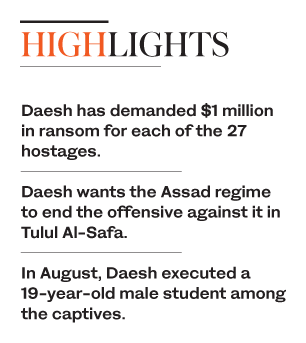
Radwan said the terrorists had demanded $1 million in ransom for each of the 27 hostages, as well as an end to the regime’s offensive against them in Tulul Al-Safa and the release of 48 wives of Daesh terrorists from regime custody.
In the July 25 attack, Daesh killed more than 250 people, most of them civilians, in a wave of suicide bombings, shootings and stabbings across Sweida province.
 They kidnapped around 30 people — mostly women and children — at the same time.
In August, Daesh executed a 19-year-old male student among the captives.
A 65-year-old Syrian woman among the hostages also died, with her Daesh captors telling negotiators she had died of an illness.
Daesh swept across large parts of Syria and Iraq in 2014, declaring a “caliphate” in territory it controlled.
But its self-declared state has since crumbled, and in Syria the terrorists have seen their presence dwindle to parts of the vast desert that stretches from the capital to the Iraqi border and a small pocket in the Euphrates Valley.
Kurdish-led forces are battling to expel the terrorists from that pocket around the town of Hajjin in the province of Deir Ezzor. The families of Druze hostages held by Daesh rallied for a third day on Friday to demand action by the Syrian regime to free them, witnesses said.
The terrorists abducted around 30 people — mostly women and children — from the southwestern province of Sweida in late July during the deadliest attack on Syria’s Druze community of the seven-year civil war.
On Friday, a handful of people gathered for a sit-in at the regime’s provincial headquarters in Sweida, said a reporter in the city.
The protests began on Wednesday, a day after families learned that Daesh had executed a 25-year-old female captive, said Nour Radwan, the head of news website Sweida24.
They began protesting to “demand that the government intervene immediately to free the hostages,” he said.
A protester said he was not related to the Druze hostages but had joined the sit-in to show support.
“Those who are related to them are always here, and there are large numbers that come in solidarity,” he said, though adding that the numbers were lower on Friday.
“We’re demanding the return of the hostages. That’s not a tall order,” he said.
Negotiations between the regime’s Russian ally and the terrorists for the release of the Druze captives had stalled, but Radwan said they resumed on the first day of the sit-in.
Footage of the protest on Thursday published online by Sweida24 showed a few dozen men and women in front of the provincial headquarters.
They gathered on the building’s front steps around neatly lined up photographs of the missing, and a sign that said: “We demand the hostages be returned alive.”
Regime forces have battled Daesh in the volcanic plateau of Tulul Al-Safa in the east of the province since the July attack.
Radwan said the terrorists had demanded $1 million in ransom for each of the 27 hostages, as well as an end to the regime’s offensive against them in Tulul Al-Safa and the release of 48 wives of Daesh terrorists from regime custody.
In the July 25 attack, Daesh killed more than 250 people, most of them civilians, in a wave of suicide bombings, shootings and stabbings across Sweida province.
They kidnapped around 30 people — mostly women and children — at the same time.
In August, Daesh executed a 19-year-old male student among the captives.
A 65-year-old Syrian woman among the hostages also died, with her Daesh captors telling negotiators she had died of an illness.
Daesh swept across large parts of Syria and Iraq in 2014, declaring a “caliphate” in territory it controlled.
But its self-declared state has since crumbled, and in Syria the terrorists have seen their presence dwindle to parts of the vast desert that stretches from the capital to the Iraqi border and a small pocket in the Euphrates Valley.
Kurdish-led forces are battling to expel the terrorists from that pocket around the town of Hajjin in the province of Deir Ezzor.


