

Enforcing Austria’s burqa ban a delicate matter in Alpine resort

1 / 2
A woman wearing a headscarf sits on a bench in a park in Zell am See in Austria. (AFP)
2 / 2
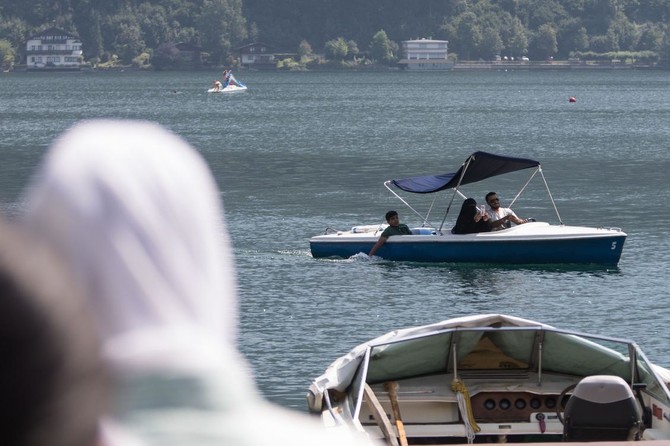
A woman wearing a niqab sits in a boat in Zell am See in Austria. (AFP)
Updated 05 October 2018
Follow

Enforcing Austria’s burqa ban a delicate matter in Alpine resort

  • The picturesque little town south of Salzburg draws tens of thousands of visitors from Saudi Arabia, the UAE or Oman every year
  • They make up more than a quarter of all annual visitors and holiday brochures are readily available in Arabic

ZELL AM SEE, Austria: With its pristine waters, snow-covered mountains and breathtaking Alpine views, the Austrian lakeside town of Zell am See is one of the top European destinations for visitors from the Gulf region.
And it aims to remain so, even though Austria introduced a ban on face-covering burqa or niqab veils a year ago.
The picturesque little town south of Salzburg with a population of 10,000 is regularly described as “paradise” in Arabic-language reviews online. It draws tens of thousands of visitors from Saudi Arabia, the United Arab Emirates or Oman every year.
They make up more than a quarter of all annual visitors and holiday brochures are readily available in Arabic.
So, when Austria banned the wearing of burqas or niqabs in all public spaces in October 2017 — under pain of fines of up to €150 ($170) — the town’s authorities knew that enforcing the rule could be a delicate matter.
The aim of the ban, according to the government, is to further integration among Austrian Muslims at a time when fears about immigration and radical Islamists are sharply dividing society.
But in resorts such as Zell am See, police are having to enforce it against tourists, fueling fears that the high-spending Arab guests, and the valuable revenue they represent, might be scared off.
“I’ve heard some people say they don’t want to come back now,” said one restaurant worker who asked not to be named, even if he said hadn’t particularly noticed a drop in business this year.
Local police chief Kurt Moeschl said more than 200 fines had been handed out between June and September alone. But his officers were always at pains to remain respectful.
“We have been trying to implement the law with as much tact and sense of proportion as possible,” he said.

Austrian embassies and missions abroad had been working to raise awareness of the new law, Moeschl said. And the police chief himself had hosted the Saudi ambassador in Zell am See to discuss the issue.
Moeschl estimated that in around 90 percent of cases, the women had agreed to remove their veil after police officers explained the new law to them.
Walking along the lakeside, one couple from Saudi Arabia — who did not wish to be named — said they had been approached by police during their stay.
“Yes, the police did talk to us about the niqab law. But we are leaving tomorrow,” the husband said, as his wife, still wearing the veil, stood beside him.
A little farther along the shore, Barbara Scheicher, who operates a boat-rental business, said the law had not had a noticeable impact.
“I haven’t noticed any difference, either in the number [of people] coming, or in how many of them are veiled,” she said.
“I asked one woman whether she knew it was illegal, but she reacted so badly that since then I haven’t. I’ve seen the same reaction when the police have tried to tell people,” Scheicher said.
Police chief Moeschl said his officers had also encountered locals and even other holidaymakers who insisted that women’s veils be forcibly removed.
One Norwegian tourist, for example, went so far as to send the police photos of niqab-wearing women at various locations around the town, complete with the times they were taken, and the message: “Do your job.”
Moeschl insisted that most interactions passed off without incident and that his officers followed interior ministry guidelines.
And he is optimistic that, over time, the situation will become easier.
“I expect that in a few years from now, this won’t be an issue.”


Fourth pair of Filipino conjoined twins to undergo separation surgery in Riyadh

Updated 5 sec ago
Follow

Fourth pair of Filipino conjoined twins to undergo separation surgery in Riyadh

  • The Manuel twins and their parents met with the Saudi ambassador to Manila
  • Kingdom’s flagship program for conjoined twins has separated over 140 children 

MANILA: Conjoined twins Olivia and Gianna Manuel will travel to Riyadh for separation surgery, becoming the fourth pair of Filipino twins to be treated under the Saudi Conjoined Twins Program, the Kingdom’s Embassy in Manila said on Tuesday. 

The 20-month-old girls from the town of Talavera in the central Philippine province of Nueva Ecija were born in April 2024. They are joined from the chest to the abdomen, a condition known as omphalopagus. 

Saudi Ambassador Faisal Ibrahim Al-Ghamdi received them on Monday, “ahead of their departure to the Kingdom,” the embassy said in a statement. 

“The family of the twins conveyed their profound gratitude and appreciation to the Government of the Kingdom of Saudi Arabia for this generous gesture and the medical and humanitarian care extended to their daughters.”

Olivia and Gianna’s mother first learned about the Saudi Conjoined Twins Program last year when she was still in the hospital with the girls, closely monitored by doctors for three months after they were born. 

“From the time I gave birth to the twins, I already started searching about conjoined twins,” Ginalyn Manuel told Arab News.

In the beginning, she followed updates on Akhizah and Ayeesha Yusoph, the second pair of Filipino twins to be selected for separation surgery under the program. 

But at the time, she could not find anyone who was able to help connect her to the King Salman Humanitarian Aid and Relief Center, which runs the conjoined twins initiative. 

“Then in May, I saw the Misa twins. The mother posted that they were about to fly and she was thanking Saudi Arabia and the embassy,” Manuel said. 

Maurice Ann and Klea Misa are the third pair of conjoined twins from Lubang, a municipality on the Philippine island of Mindoro, who flew to Riyadh earlier this year in May for a separation surgery.

Through their social media posts, Manuel tried again to make online connections, eventually finding the right people to link her up with KSrelief. 

“Then in July, (KSrelief) sent us an email asking for the medical records of my twins, and that started the whole process,” she said. 

Conjoined twins are a rare phenomenon, estimated to occur once in every 50,000 to 60,000 births. 

Saudi Arabia is known as a pioneer in the field of separation surgery. KSrelief was established by King Salman in 2015 and is headed by Dr. Abdullah Al-Rabeeah, one of the world’s most renowned pediatric surgeons.

Since 1990, he and his team have separated more than 140 children from 27 countries who were born sharing internal organs with their twins.

The Misa twins, who are joined at the head, are currently being prepared for their surgery in Riyadh. 

The first pair of Filipino conjoined twins, Ann and Mae Manzo, were separated under the program in March 2004. They were joined at the abdomen, pelvis and perineum. 

They were followed by the Yusoph twins, who were joined at the lower chest and abdomen and shared one liver. Their successful separation surgery was conducted in September 2024.