- Out of the 50 million Gujarati-speaking people in the world, around 3.5 million live in Karachi and these include top industrialists, businessmen and owners of big media houses
- Karachi’s Gujarati-speaking youth has launched The Education Sanstha (TES) as part of the #SaveGujarati initiative to keep their language from dying
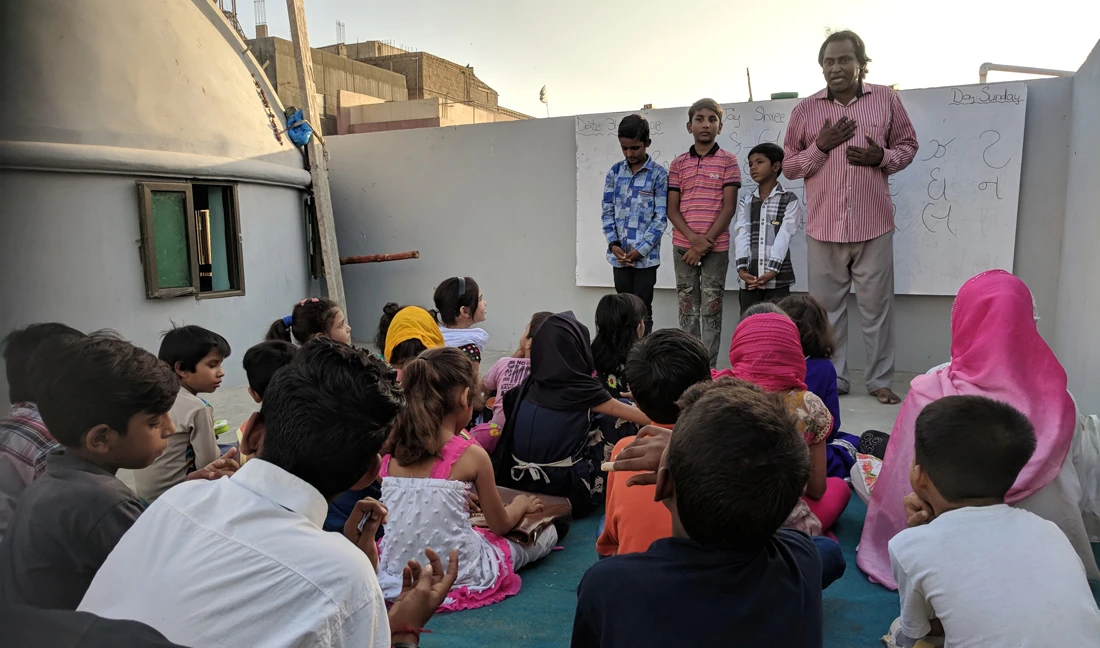
KARACHI: Amit Kumar, a 37-year-old dweller of the Soldier Bazaar locality of Karachi, works as a peon in private firms during the day. After little rest in the evening, he takes his four children to the rooftop of a three-story Shri Ramdev Pir temple. At the top of this Hindu temple, however, there are no prayers. These are classes for Karachiites of Gujarati decent, who are fast forgetting their native language.
“Although I could speak my mother tongue, it would always bother me that I was not able to write and read Gujarati,” Kumar says. His children, Simren, 10, Nena, 6, and Gaurav, 4, are sitting by his side as he talks to Arab News.
This informal school is open from Monday to Saturday from 9 to 10 p.m.
“When I came to know that The Education Sanstha (TES) had started offering free Gujarati language classes, I took no time to get myself and my children registered,” he said. They would never be able to read and write Gujarati language had he not come across this opportunity, said Kumar.
Meenakshi Solanki, a nurse at a local hospital, was the first girl to join these free lessons. There are now 125 students and 53 of them are girls who took inspiration from Solanki to join this informal language school. “It was a boys-only class but when I joined the girls started coming,” she told Arab News.
According to Solanki, she is also the first member of her family who will be able to write and read Gujarati. “We deserve to be educated in our mother tongue but since it’s not part of the curriculum, TES has provided this golden opportunity to us,” she said, expressing her gratitude to a group of youngsters who launched this initiative.
Another student, 12-year-old Vivek Premji, said most of his family were still attached to the language. “Had these classes not been arranged, I would have been the first of my family to forget my mother tongue. My mother knew Gujarati but I didn’t. I was super-excited when I first heard about the classes,” Premji, who has been raised by a single mother, told Arab News.
Chander Kant Jethwa, an office-bearer of the TES, said his group of volunteers will help dropouts from the community to get back to schools. “We will also arrange special Urdu and English language classes for the dropouts to make them literate,” he told Arab News, adding that it was at one point that TES conceived the idea of beginning the Gujarati language classes.
Manoj Solanki, another group member, said his group kicked off classes on July 9, 2018 and, after getting an enormous response, they decided to expand the language program to other areas. “On September 26, we started classes in Keemari [area] and will soon take this #SaveGujarati initiative to different areas of the city,” he said.
Pandit Vital Das, one of the three teachers at this informal school, says Guajarati was part of the curriculum till 1975. For the next six years, the community continued to teach the language in different temples in the city. “In 1981, the education, however, completely stopped. Now, after 29 years, the city is having the first classes where students are being taught their mother language,” Das told Arab News.
These are not lower or lower-middle class areas where this important language is endangered.
Usman Ghani Saati, owner and editor of one of the two Gujarati language newspapers, has 23 siblings, including five sons, two daughters and 16 grandchildren. “Only two of my sons and one daughter, who are associated with our Watan Gujarati newspaper, can write and read the language,” Saati told Arab News.
The language is spoken by more than 50 million people in the world. In Karachi, the population of Gujarati-speaking people is estimated to be around 3.5 million, Saati said. Saati, who also worked with English daily Dawn between 1966 and 1983, bought Watan Gujarati when this oldest newspaper was founded by Muhammad Ali Jinnah in 1942 in Mumbai and later shifted, with the partition of India, to Karachi.
The circulation has witnessed massive cuts, Saati said, and the reason, he offered, is that Gujarati, despite being a mother tongue of top-notch industrialists, businessmen, stockbrokers, and owners of major media houses such as Dawn and ARY, is no longer taught at schools and spoken at homes. “Even the majority of the city’s schools were owned by Gujaratis but the irony is that none of them taught this language anymore,” Saati said.
“Once, the bank cheque in this city would also be written in Gujarati language. Now among 3.5 million, fewer than 10,000 may know the language,” he said.
Gujarati people have their distinctive proud culture and if the language continues to decline at this rate, the community will also lose their rich customs and traditions. Like his Watan, Millat Gujarati newspaper is also alive but the newspapers may not survive if the language continues to vanish.
Amid these fears of Saati and others, the Karachi’s youths have shown a path, which may lead to save the language from its complete death, even if it is not completely revived.
“We are proud of Gujarati language. It’s the language of the father of the nation. It’s the language of Edhi. It’s not only a language of Hindus but people of Gujarati descent belonging to different faiths,” Jethwa says.
“We urge all communities, including Parsi and Muslims, to come forward and join us in our #SaveGujarati initiative,” he said.
“We will soon hold meetings with different communities to request them for providing their community centers for such classes for a large number of people, who want to learn their mother tongue — a language that was spoken by Muhammad Ali Jinnah, Mohandas Gandhi and Abdul Sattar Edhi,” he says.