Fire on my chopper was against the rules, PM Azad Kashmir tells Arab News

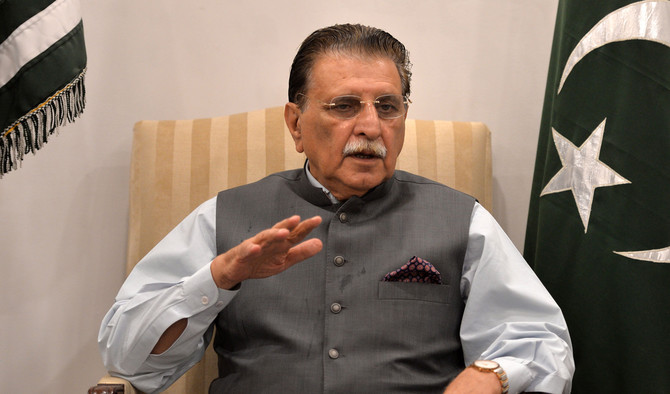
The Prime Minister of Azad Kashmir Raja Farooq Haider gestures as he speaks to media in Islamabad on Sept. 30, 2018. (AFP)
Updated 01 October 2018
Follow

Fire on my chopper was against the rules, PM Azad Kashmir tells Arab News

  • Indian forces fired on PM Azad Kashmir’s helicopter near the militarised Line of Control
  • Two ministers, a pilot and two other staff members of PM Azad Kashmir were on board

ISLAMABAD: Prime Minister of Azad Jammu and Kashmir Raja Farooq Haider strongly condemned the “unprovoked fire” by Indian forces on his civilian helicopter near the militarised Line of Control (LoC) in Haveli district on Sunday and said it was against the rules of engagement.
All on the chopper including Haider, his two ministers, pilot and two other staff members, escaped unhurt.
“The Indian forces’ act was against the diplomatic norms, rules of engagement and morality. They did not give us any warning,” he told Arab News on Monday.
Haider said that unprovoked fire on the civilian helicopter was a tactic used to raise tensions in the area, which is already stressed.
“The international community needs to tell India that any misadventure on the LoC will threaten the peace of this region,” he said, “because the LoC is an active border and the situation is already tense.
“The two ministers were with me in the chopper and we were in our own airspace, when Indian forces fired on us,” Haider said.
“The President of Pakistan (Arif Alvi), leader opposition in National Assembly Shehbaz Sharif, and People’s Party central leader Khurshid Shah spoke to me and said they would raise this issue in Pakistan’s National Assembly,” Azad Kashmir Prime Minister said.
The President of Azad Kashmir, Sardar Masood Khan, said in a statement from his office late on Sunday that “such acts by the Indian forces will not intimidate our leadership and civilians in their struggle toward ascertaining the right to self-determination of the Kashmiri people living under the oppressive Indian rule in the occupied territory.”
He added: “This act displays India’s insecurities and has exposed their aggressive posturing and warmongering.”
Leader of the opposition in Pakistan’s National Assembly and President of Pakistan Muslim League Nawaz Shehbaz Sharif also condemned the firing on Haider’s helicopter.
“India wants to hide its oppression on Kashmiris through such incidents. Pakistan will continue 2 stand by the people of Occupied Kashmir in their just struggle for right to self-determination,” he tweeted.
In Kashmir the LoC serves as a de-facto border dividing the contested region between Pakistan and India.
There has been a surge in cross-border firing and shelling, especially in the past two years between two nuclear-armed countries Pakistan and India.
The incident of fringing on the helicopter of the Prime Minister of Azad Kashmir came at a time when just a day ago at the United Nations General Assembly session in New York, the foreign ministers of Pakistan and India accused each other of being involved in cross-border terrorism and sabotaging the peace dialogue.


Pakistan president meets UAE counterpart, explores trade, investment opportunities

Updated 27 January 2026
Follow

Pakistan president meets UAE counterpart, explores trade, investment opportunities

  • Asif Ali Zardari is in UAE on four-day visit to strengthen bilateral ties, review bilateral cooperation
  • Both sides discuss regional, international developments, reaffirm commitment to promote peace

ISLAMABAD: President Asif Ali Zardari met his UAE counterpart Sheikh Mohammed bin Zayed Al-Nahyan in Abu Dhabi on Tuesday during which both sides explored new opportunities in trade, investment, energy and other sectors, Zardari's office said. 

Zardari arrived in Abu Dhabi on Monday evening with a high-level delegation on a four-day official visit to the UAE to review trade, economic and security cooperation. 

"The leaders discussed ways to further deepen the longstanding and brotherly relations between Pakistan and the UAE," a statement from Zardari's office said about his meeting with the UAE president. 

"They reviewed the full spectrum of bilateral cooperation and explored new opportunities in trade, investment, energy, infrastructure, technology, and people-to-people exchanges, highlighting the significant potential for expanding economic and strategic partnership.

Zardari highlighted the significance of Al-Nayhan's visit to Pakistan last month, the statement said, expressing appreciation for the UAE's continued support for strengthening bilateral ties.

It said both sides also exchanged views on a range of regional and international developments, reaffirming their commitment to promoting peace, stability and sustainable development.

The meeting was also attended by Pakistan's First Lady Aseefa Bhutto-Zardari, the Pakistani president's son Bilawal Bhutto-Zardari, who is also the chairman of the Pakistan Peoples Party, Interior Minister Mohsin Naqvi and Pakistan's ambassador to the UAE. 

ZARDARI MEETS AD PORTS CEO

Zardari earlier met AD Ports Group CEO Captain Mohamed Juma Al-Shamisi to discuss the group's investment initiatives in Karachi. 

"Both sides agreed that the expansion and modernization of port infrastructure would strengthen trade flows and support Pakistan’s broader economic development and country’s seaborne trade," the President's Secretariat said in a statement.

It added that Zardari described the AD Ports Group's long-term investment and expanding role in Pakistan's maritime and logistics sector as a key pillar of Pakistan–UAE economic cooperation.

Pakistan and the UAE maintain close political and economic relations, with Abu Dhabi playing a pivotal role in supporting Islamabad during periods of financial stress through deposits, oil facilities and investment commitments. 

The UAE is Pakistan's third-largest trading partner, after China and the United States, and a key destination for Pakistani exports, particularly food, textiles and construction services.

The Gulf state is also home to more than 1.5 million Pakistani expatriates, one of the largest overseas Pakistani communities in the world, who contribute billions of dollars annually in remittances, a crucial source of foreign exchange for Pakistan’s economy.

Beyond trade and labor ties, Pakistan and the UAE have steadily expanded defense and security cooperation over the years, including military training, joint exercises and collaboration in counter-terrorism and regional security matters.