

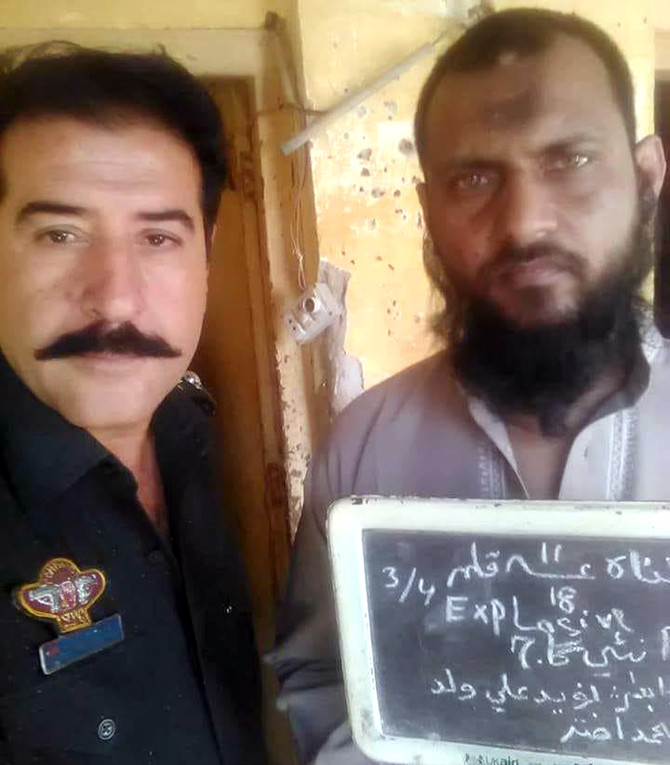
High value Al-Qaeda operative arrested in Pakistan, police announce

Naveed Ali, alias Sharif, in police custody (Photo by office of senior superintendent of police Hyderabad)
Updated 25 September 2018
Follow

High value Al-Qaeda operative arrested in Pakistan, police announce

  • Naveed Ali, alias Sharif, was arrested in Dadu, on his way back from Afghanistan, police reveal
  • Al-Qaeda sleeper cells still exist in Sindh and work independently

KARACHI: Police in Pakistani city of Hyderabad announced today that they had arrested a high-value Al-Qaeda operative.

The arrest took place last week from Dadu in a hilly area of Sindh province, a senior police officer told Arab News.
“Surveillance activities were already in full swing in Dadu — a town in Sindh that borders Balochistan — when the law enforcement agencies encountered Naveed Ali alias Sharif,” Hyderabad’s Senior Superintendent of Police Tanveer Hussain Tunio told Arab News.
“In the past, militants infiltrating through these routes have attacked Muharram processions and shrines, as a result security had already been stepped up,” Tunio said, explaining that the encounter was accidental, and that had Naveed entered the city unchecked a major catastrophe could have taken place.
“Naveed could have been traveling to Hyderabad, his native city, to visit his family, or perhaps to another city to meet men from Al-Qaeda sleeper cells,” Tunio said.
He hailed the arrest as a major victory against the international terrorist outfit.
“He [Naveed] is close associate of Tahir Minhas, mastermind of the Safoora incident (the bus attack in 2015 in which around 46 people were killed) and had been involved in dozens of target killings and terrorism in Hyderabad,” the official explained.
In 2014, Naveed, along with Tahir Minhas and other members of Al-Qaeda, targeted police vans, killing four policemen. Tunio added that Naveed carried a Rs2.5million bounty on his head.
The Hyderabad police described Naveed as a high-value Al-Qaeda target. Raja Umar Khattab, head of the transnational terrorist intelligence group of the Counter Terrorism Department (CTD), who has interrogated several Al-Qaeda terrorists over the past decade, said the arrest was a significant breakthrough.
“Several Al-Qaeda terrorists being interrogated by the CTD have disclosed his name,” Khattab told Arab News, adding that Naveed had been referred to by his alias Sharif. “He is responsible for several attacks on law enforcement agencies. He is also responsible or many bank robberies in the province,” said the official.
Naveed Ali was a close aide of Al-Qaeda leaders Tahir Saeen and Hajji Abdul Qadir Baloch aka Hajji Baloch.
“In 2014, after developing differences with Hajji Baloch, Tahir Minhas set up his own Islamic State-inspired youth network, which on May 13, 2015, carried out the Safoora bus shooting in Karachi, killing more than 46 men and women of the Ismaili community,” Khattab said.
Naveed had sided with Hajji Baloch and conducted several activities in Hyderabad before fleeing to Afghanistan. Baloch, who is also Naveed’s mentor, reportedly joined Daesh in Afghanistan.
“Hardcore Taliban militant groups have been weakened, but the threat of groups such as Al-Qaeda in the Indian Subcontinent (AQIS) still loom,” said Saqib Sagheer, a senior journalist who has written about militancy in the city.
“They operate in smaller groups and use new names to dodge law enforcers,” Sagheer told Arab News.
SSP Omar Shahid Hamid, a senior counter-terrorism officer, believes that Al-Qaeda, being the ideologically and organizationally, the strongest of the terrorist outfits, is still likely to be a threat to the city despite the successes made by law enforcement agencies.
“The Al-Qaeda sleeper cells, however, still exist and since these cells work independently and one sleeper cell becomes active at a time, it’s hard to bust them all,” Shahid told Arab News.


Pakistan, Canada explore deeper mineral investment as Reko Diq mine project advances

Updated 6 sec ago
Follow

Pakistan, Canada explore deeper mineral investment as Reko Diq mine project advances

  • Canadian envoy cites Reko Diq as model for expanding Pakistan-Canada mineral cooperation
  • Islamabad pitches vast copper-gold reserves as economic lifeline after years of stalled development

ISLAMABAD: Pakistan and Canada are exploring deeper cooperation in the minerals and energy sectors as Islamabad accelerates efforts to revive long-delayed mining projects, including the Reko Diq copper-gold mine, one of the world’s largest undeveloped mineral deposits, according to a statement from Pakistan’s Information Ministry this week. 

The Reko Diq copper-gold project is one of the world’s largest undeveloped mineral deposits, with estimated reserves of around 5.9 billion tons of ore containing both copper and gold. The project, in Balochistan’s Chagai District, was stalled for over a decade amid international legal disputes but was reconstituted in 2022 with Canadian mining giant Barrick Gold holding a 50 percent stake alongside Pakistani federal and provincial partners. 

Recent steps toward implementation include multilateral financing arrangements involving international banks and institutions, and major equipment contracts, such as a $440 million deal with Japan’s Komatsu for mining machinery, signaling readiness for construction phase activities starting in 2026. Last month, Washington approved $1.25 billion in US Export-Import Bank financing for Reko Diq, with the package also expected to unlock up to $2 billion in US equipment and service exports for the project.

First production is expected by late 2028 under the revived partnership, with estimates suggesting annual output of around 200,000 tons of copper and significant gold yields once operations scale up. This project is central to Islamabad’s strategy to position mining as a pillar of economic recovery, as it hosts international mineral investment forums, seeks partnerships with Western and Gulf countries, and signs cooperation agreements on critical minerals, including with the United States. Officials see large-scale mining projects as potential drivers of exports, foreign exchange earnings and job creation in a country grappling with debt pressures and slow growth.

Against this backdrop, Federal Minister for Petroleum Ali Pervaiz Malik met Canada’s High Commissioner to Pakistan, Tarik Ali Khan, on Wednesday to discuss expanding bilateral cooperation in mining and energy, the information ministry said.

“The success of Barrick Gold at Reko Diq is a strong example to build upon Pakistan–Canada mineral cooperation,” the high commissioner said, according to the statement, adding that Canada was actively working to encourage more Canadian companies to engage with Pakistan’s mining sector.

The envoy said Canada’s ministry of natural resources was ready to support cooperation with Pakistan, noting that Canadian expertise in large-scale mining, environmental standards and community development could play a role as Pakistan opens up its mineral sector. He also said Canada was encouraging participation in the Pakistan Minerals Investment Forum to attract global investors.

The Canadian high commissioner also invited Pakistan to participate in the Prospectors & Developers Association of Canada (PDAC) convention in 2026, one of the world’s largest mining investment forums, calling it an opportunity to showcase Pakistan’s mineral potential to international investors.

Petroleum Minister Malik welcomed Canadian interest, saying technical expertise and intellectual capital would help strengthen Pakistan’s systems and boost investor confidence, particularly among international mining companies, the statement said.

Both sides also discussed cooperation in the energy sector, with Canada offering technical assistance, according to the statement. 
...