

We need more support, says famous Pakistani artist

1 / 4
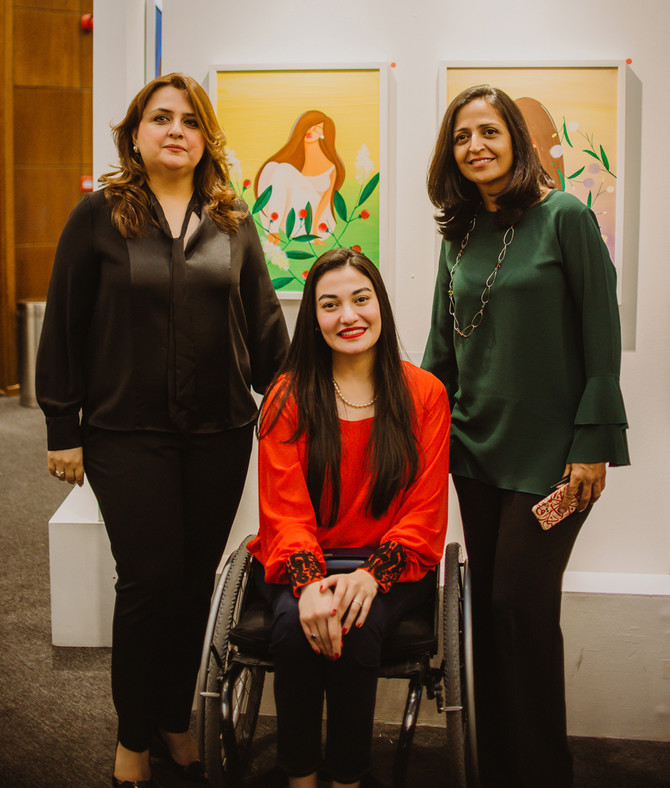
Muniba Mazari is in Dubai for her first international exhibition. (Photos by Muniba Mazari)
2 / 4
Muniba Mazari is in Dubai for her first international exhibition. (Photos by Muniba Mazari)
3 / 4
Muniba Mazari is in Dubai for her first international exhibition. (Photos by Muniba Mazari)
4 / 4
Muniba Mazari is in Dubai for her first international exhibition. (Photos by Muiba Mazari)
Updated 25 September 2018
Follow

We need more support, says famous Pakistani artist

  • Art should be accessible to the masses
  • The state has a responsibility to take care of its artists

DUBAI: Muniba Mazari is a famous Pakistani artist, model, activist, and motivational speaker. She uses a wheelchair because of injuries sustained in a car accident at the age of 21. She is also the National Ambassador for UN Women Pakistan.
She is in Dubai for her first international exhibition. Titled as “And I chose to live,” the exhibition was organized in Pakistan Association Dubai and hundreds of Pakistani community members attended and appreciated her work.
While speaking on the sideline of the exhibition, Mazari told Arab News that Pakistan is a very creative nation but a little more encouragement and a lot more exposure is all we need.
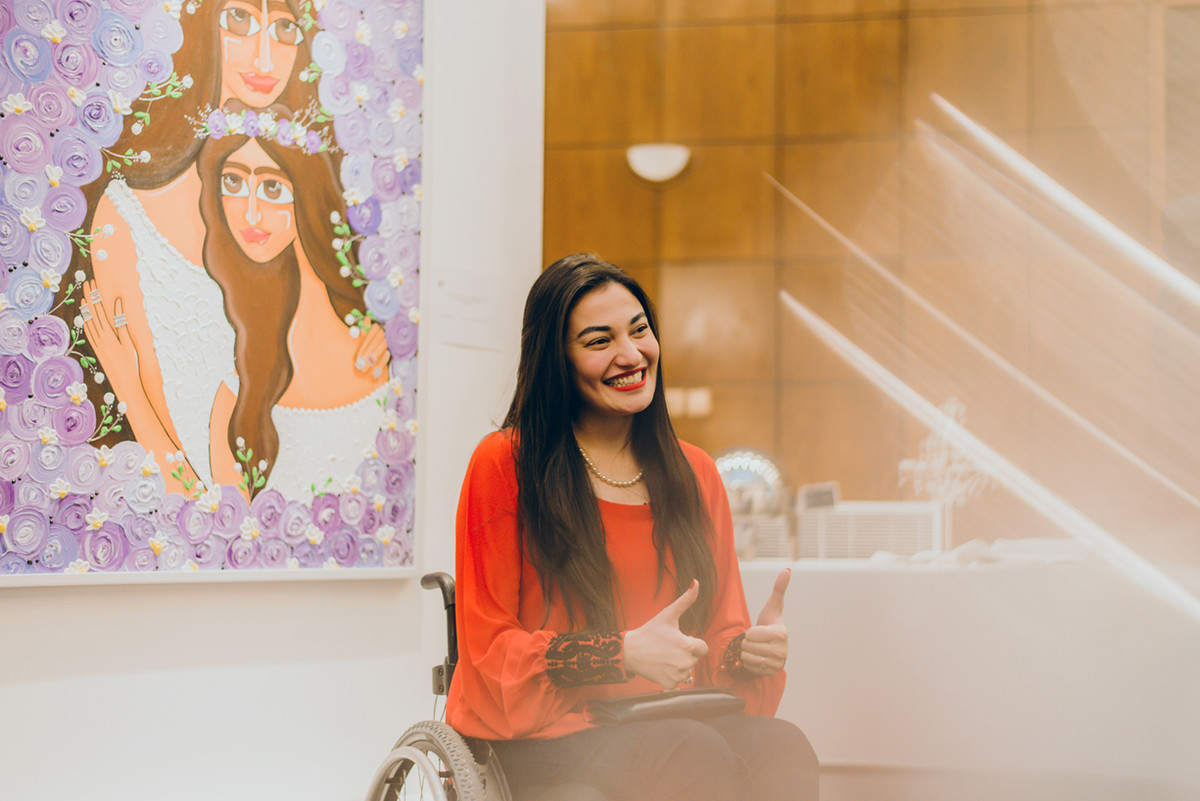


Mazari said creative expression needs a lot of courage. “Pakistani artists are very courageous because they choose challenging topics and depict social change in their artwork. (However) there are people on our society who don’t appreciate such art, but then there are those who understand and support those artists and their vision.” (Photo courtesy: Muniba Mazari)

She denied the notion that Pakistan has few women artists. On the contrary, she said: “There are a lot of women artists in Pakistan but unfortunately they don’t get a chance to exhibit their work at bigger level. That’s why you don’t see them in the mainstream. We need to encourage and promote their work or they’ll always be left behind.”
When asked about her most favorite artist, she said: “In Pakistan my most favorite artist is Saeed Akhtar and globally I love the works of Thomas Fedro and Frida Kahlo.”

Mazari said the state should take care of its artists. “It’s heartbreaking to see artists struggling for their basic rights. You cannot make a living as an artist and that’s one of the major reasons why people don’t want to pursue art as their main career. It comes with a lot of financial challenges. It is the responsibility of the state as well as our society to support the artists, especially the ones who are in need.”
She said Lahore was the most artistic city, rich with cultural diversity. Karachi comes second, whereas the rest of the cities were slowly evolving. “I wish we have more art galleries in all the cities of Pakistan where people can go and experience art.”
Mazari believes that art can fight extremism. “Art is the most powerful way of highlighting social issues and fighting taboos. But for that we need to make art more accessible to the masses.”

Tens of thousands flee northwest Pakistan over fears of military operation

Updated 28 January 2026
Follow

Tens of thousands flee northwest Pakistan over fears of military operation

  • More than 70,000 people, mostly women and children, have fled remote Tirah region bordering Afghanistan 
  • Government says no military operation underway or planned in Tirah, a town in Khyber Pakhtunkhwa province

BARA, Pakistan: More than 70,000 people, mostly women and children, have fled a remote region in northwestern Pakistan bordering Afghanistan over uncertainty of a military operation against the Pakistani Taliban, residents and officials said Tuesday.

Pakistan’s Defense Minister Khawaja Mohammad Asif has denied the claim by residents and provincial authorities. He said no military operation was underway or planned in Tirah, a town in Khyber Pakhtunkhwa province.

Speaking at a news conference in Islamabad, he said harsh weather, rather than military action, was driving the migration. His comments came weeks after residents started fleeing Tirah over fears of a possible army operation.

The exodus began a month after mosque loudspeakers urged residents to leave Tirah by Jan. 23 to avoid potential fighting. Last August, Pakistan launched a military operation against Pakistani Taliban in the Bajau r district in the northwest, displacing hundreds of thousands of people.

Shafi Jan, a spokesman for the provincial government in Khyber Pakhtunkhwa, posted on X that he held the federal government responsible for the ordeal of the displaced people, saying authorities in Islamabad were retracting their earlier position about the military operation.

Khyber Pakhtunkhwa Chief Minister Suhail Afridi, whose party is led by imprisoned former Prime Minister Imran Khan, has criticized the military and said his government will not allow troops to launch a full-scale operation in Tirah.

The military says it will continue intelligence-based operations against Pakistani Taliban, who are known as Tehrik-e-Taliban Pakistan, or TTP. Though a separate group, it has been emboldened since the Afghan

Taliban returned to power in 2021. Authorities say many TTP leaders and fighters have found sanctuary in Afghanistan and that hundreds of them have crossed into Tirah, often using residents as human shields when militant hideouts are raided.

Caught in the middle are the residents of Tirah, who continued arriving in Bara.

So far, local authorities have registered roughly 10,000 families — about 70,000 people — from Tirah, which has a population of around 150,000, said Talha Rafiq Alam, a local government administrator overseeing the relief effort. He said the registration deadline, originally set for Jan. 23, has been extended to Feb. 5.

He said the displaced would be able to return once the law-and-order situation improves.

Among those arriving in Bara and nearby towns was 35-year-old Zar Badshah, who said he left with his wife and four children after the authorities ordered an evacuation. He said mortar shells had exploded in villages in recent weeks, killing a woman and wounding four children in his village. “Community elders told us to leave. They instructed us to evacuate to safer places,” he said.

At a government school in Bara, hundreds of displaced lined up outside registration centers, waiting to be enrolled to receive government assistance. Many complained the process was slow.

Narendra Singh, 27, said members of the minority Sikh community also fled Tirah after food shortages worsened, exacerbated by heavy snowfall and uncertain security.

“There was a severe shortage of food items in Tirah, and that forced us to leave,” he said.

Tirah gained national attention in September, after an explosion at a compound allegedly used to store bomb-making materials killed at least 24 people. Authorities said most of the dead were militants linked to the TTP, though local leaders disputed that account, saying civilians, including women and children, were among the dead.