TOKYO: A Japanese space probe Friday released a pair of exploring rovers toward an egg-shaped asteroid to collect mineral samples that may shed light on the origin of the solar system.
The “Hayabusa2” probe jettisoned the round, cookie tin-shaped robots toward the Ryugu asteroid, according to the Japan Aerospace Exploration Agency (JAXA).
If the mission is successful, the rovers will conduct the world’s first moving, robotic observation of an asteroid surface.
Taking advantage of the asteroid’s low gravity, they will jump around on the surface — soaring as high as 15 meters and staying in the air for as long as 15 minutes — to survey the asteroid’s physical features with cameras and sensors.
So far so good, but JAXA must wait for the Hayabusa2 probe to send data from the rovers to Earth in a day or two to assess whether the release has been a success, officials said.
“We are very much hopeful. We don’t have confirmation yet, but we are very, very hopeful,” Yuichi Tsuda, JAXA project manager, told reporters.
“I am looking forward to seeing pictures. I want to see images of space as seen from the surface of the asteroid,” he said.
The cautious announcement came after a similar JAXA probe in 2005 released a rover which failed to reach its target asteroid.
Next month, Hayabusa2 will deploy an “impactor” that will explode above the asteroid, shooting a two-kilo (four-pound) copper object into the surface to blast a crater a few meters in diameter.
From this crater, the probe will collect “fresh” materials unexposed to millennia of wind and radiation, hoping for answers to some fundamental questions about life and the universe, including whether elements from space helped give rise to life on Earth.
The probe will also release a French-German landing vehicle named Mobile Asteroid Surface Scout (MASCOT) for surface observation.
Hayabusa2, about the size of a large fridge and equipped with solar panels, is the successor to JAXA’s first asteroid explorer, Hayabusa — Japanese for falcon.
That probe returned from a smaller, potato-shaped, asteroid in 2010 with dust samples despite various setbacks during its epic seven-year odyssey and was hailed a scientific triumph.
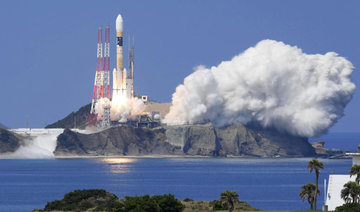
The Hayabusa2 mission was launched in December 2014 and will return to Earth with its samples in 2020.


![]()
![]()

Japan space probe Hayabusa2 drops hopping rovers toward asteroid

Japan space probe Hayabusa2 drops hopping rovers toward asteroid
- If the mission is successful, the rovers will conduct the world’s first moving, robotic observation of an asteroid surface
- The Hayabusa2 mission was launched in December 2014 and will return to Earth with its samples in 2020

Latest updates


© 2026 SAUDI RESEARCH & PUBLISHING COMPANY, All Rights Reserved And subject to Terms of Use Agreement.