



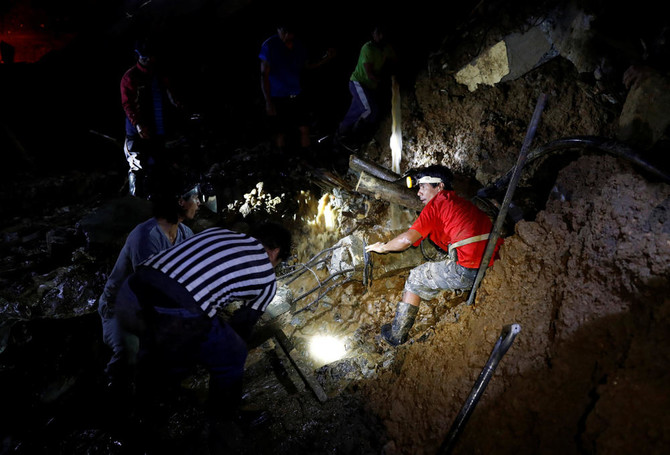

ITOGON, Philippines: Dozens of people believed buried in a landslide unleashed by Typhoon Mangkhut in the Philippines probably did not survive, a mayor said Monday, although rescuers kept digging through mud and debris covering a chapel where they had taken shelter.
Of the 40 to 50 miners and their families believed inside the chapel, there is a “99 percent” chance that they all were killed, said Mayor Victorio Palangdan of Itogon, the Benguet province town that was among the hardest hit by the typhoon that struck Saturday.
Mangkhut already is confirmed to have killed 66 people in the Philippines and four in China, where it weakened to a tropical storm as it churned inland Monday.
Palangdan said rescuers have recovered 11 bodies from the muddy avalanche, which covered a former bunkhouse for the miners that had been turned into a chapel. Dozens of people sought shelter there during the storm despite warnings it was dangerous.
“They laughed at our policemen,” he said. “They were resisting when our police tried to pull them away. What can we do?“
Police and soldiers were among the hundreds of rescuers with shovels and picks searching for the missing along a mountainside as grief-stricken relatives waited nearby, many of them praying quietly. Bodies in black bags were laid side by side. Those identified were carried away by relatives, some using crude bamboo slings.
Jonalyn Felipe said she had called her husband, Dennis, a small-scale gold miner in Itogon, and told him to return to their home in northern Quirino province as the powerful typhoon approached Friday.
“I was insisting because the storm was strong but he told me not to worry because he said they’re safe there,” said a weeping Felipe, adding that her husband was last seen chatting with fellow miners in the chapel before it was hit by the collapsing mountainside.
She said she screamed after hearing the news about her husband, and their 4-year-old son sensed what had happened and cried too.
Palangdan said authorities “will not stop until we recover all the bodies.”
Itogon resident Roel Ullani helped search for the missing, including several of his cousins and other relatives. “For me, it will just be retrievals,” he said.
Many of those who sought cover in the two-story building thought it was sturdy but the storm was just too severe, with the avalanche covering it “in just a few seconds,” Ullani said.
Environmental Secretary Roy Cimatu said the government will deploy soldiers and police to stop illegal mining in six mountainous northern provinces, including Benguet, to prevent such tragedies.
Philippine officials say that gold mines tunneled by big mining companies and by unauthorized small miners have made the hillsides unstable and more prone to landslides. Tens of thousands of small-time miners have come in recent years to the mountain provinces from the lowlands and established communities in high-risk areas such as the mountain foothills of Itogon.
On Monday, Mangkhut was still affecting southern China’s coast and the provinces of Guangdong, Guangxi and Hainan, and rain and strong winds were expected to continue through Tuesday.
The storm was about 200 kilometers (124 miles) west of the city of Nanning in Guangxi region on Monday afternoon, moving in a northwesterly direction and weakening as it progressed. There were no new reports of deaths or serious damage.
Life was gradually returning to normal along the hard-hit southern China coast, where high-rise buildings swayed, coastal hotels flooded and windows were blown out. Rail, airline and ferry services were restored and casinos in the gambling enclave of Macau reopened.
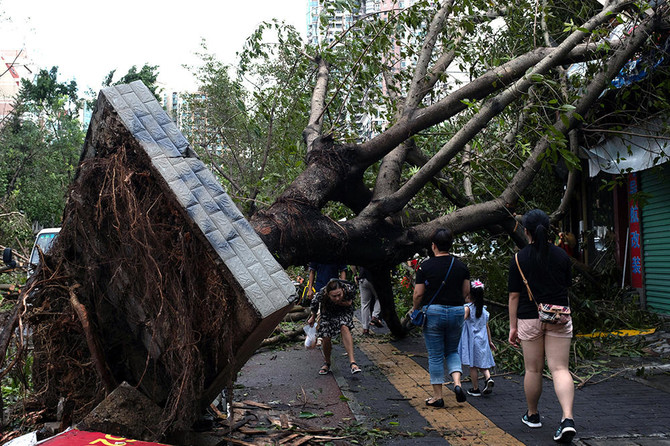
In Hong Kong, crews cleared fallen trees and other wreckage left from when the financial hub felt the full brunt of the storm Sunday.
“This typhoon really was super strong ... but overall, I feel we can say we got through it safely,” Carrie Lam, the territory’s chief executive, told reporters.
The Hong Kong Observatory said Mangkhut was the most powerful storm to hit the city since 1979, packing winds of 195 kph (121 mph).
The typhoon struck Asian population centers as Hurricane Florence caused catastrophic flooding in parts of North Carolina in the United States.


