

Super Typhoon Mangkhut smashes into Philippines

1 / 3
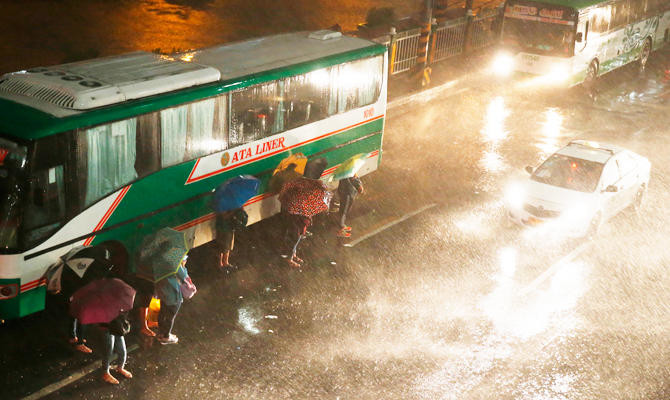
Motorists brave the rain and strong winds brought about by Typhoon Mangkhut which barrelled into northeastern Philippines before dawn Saturday, Sept. 15, 2018 in Manila, Philippines. (AP)
2 / 3
Commuters brave the rain and strong winds brought about by Typhoon Mangkhut which barrelled into northeastern Philippines before dawn Saturday, Sept. 15, 2018, in Manila, Philippines. (AP)
3 / 3
Commuters brave the rain and strong winds brought about by Typhoon Mangkhut which barrelled into northeastern Philippines before dawn Saturday, Sept. 15, 2018, in Manila, Philippines. (AP)
Updated 15 September 2018
Follow

Super Typhoon Mangkhut smashes into Philippines

  • An average of 20 typhoons and storms lash the Philippines each year, killing hundreds of people and leaving millions in near-perpetual poverty
  • The storm is not forecast to directly hit Hong Kong, though it will feel Mangkhut’s wind and rain through Sunday

TUGUEGARAO, Philippines: Super Typhoon Mangkhut slammed into the northern Philippines on Saturday with violent winds and torrential rains, as authorities warned millions in its path of potentially heavy destruction.
The massive storm, which forecasters have called the strongest typhoon this year, blew in windows, hurled debris and knocked out power lines when it made landfall on the island of Luzon in the pre-dawn darkness.
It packed powerful gusts of up to 255 kilometers (160 miles) per hour and sustained winds of 205 kilometers per hour while heading west across the disaster-prone archipelago toward China.
“As much as possible, stay indoors,” Chris Perez, a forecaster for the state weather service, warned the roughly four million people in the path of the storm after it landed at 1:40 am (1740 Friday GMT).
An average of 20 typhoons and storms lash the Philippines each year, killing hundreds of people and leaving millions in near-perpetual poverty.
Thousands of people fled their homes in high-risk areas ahead of the storm’s arrival because of major flooding and landslide risks.
Authorities hiked the storm alert on Friday to its second highest level in northern Luzon provinces and mobilized rescue teams.
The elevated warning level carried risks of “very heavy” damage to communities hit by the typhoon and a storm surge that was forecast to hit six meters in some areas, the weather service said.
Residents started lashing down their roofs and gathering supplies days before the arrival of the storm that forecasters said is the most powerful of 2018.

“Among all the typhoons this year, this one (Mangkhut) is the strongest,” Japan Meteorological Agency forecaster Hiroshi Ishihara told AFP on Friday.
“This is a violent typhoon. It has the strongest sustained wind (among the typhoons of this year),” he added.
After blasting the Philippines, Mangkhut is predicted to hurtle toward China’s heavily populated southern coast this weekend.
“They (authorities) said this typhoon is twice as strong as the last typhoon, that’s why we are terrified,” Myrna Parallag, 53, told AFP after fleeing her home in the northern Philippines.
“We learned our lesson last time. The water reached our roof,” she said, referring to when her family rode out a typhoon at home in 2016.
The country’s deadliest on record is Super Typhoon Haiyan, which left more than 7,350 people dead or missing across the central Philippines in November 2013.
Poor communities reliant on fishing are some of the most vulnerable to fierce typhoon winds and the storm surges that pound the coast.
“The rains will be strong and the winds are no joke... We may have a storm surge that could reach four storys high,” Michael Conag, a spokesman for local civil defense authorities, told AFP.
The storm is not forecast to directly hit Hong Kong, though it will feel Mangkhut’s wind and rain through Sunday.
However, the Hong Kong Observatory warned that the massive typhoon will pose a “severe threat” to China’s southern coast before moving on to northern Vietnam.


Italy approves new migration bill including powers to impose ‘naval blockades’ on migrant ships

Updated 3 sec ago
Follow

Italy approves new migration bill including powers to impose ‘naval blockades’ on migrant ships

ROME: Italy’s conservative government led by Premier Giorgia Meloni on Wednesday approved a bill introducing new measures aimed at fighting illegal immigration, including a so-called “naval blockade” for migrant ships trying to reach Italian shores.
A cabinet meeting in the late afternoon gave the go-ahead to the bill, which now needs to be discussed and approved in both chambers of parliament before becoming effective.
Italy’s new migration package — which also includes stricter surveillance at borders and cooperation with European agencies — comes a day after the approval of the new EU pact on migration and asylum, which Rome plans to implement swiftly.
The package includes new powers that would enable Italian authorities to impose a naval blockade on migrant ships trying to enter Italy’s territorial waters, under certain conditions.
Authorities can ban the crossing into Italian waters for up to 30 days, in cases in which the migrant ship poses “serious threats to public order or national security,” as in the concrete risk of terrorist acts or terrorist infiltration, the bill says. The blockade is extendable up to a maximum of six months.
It would also be possible to stop the ships from entering Italian waters in the case of a drastic influx in migrants that could jeopardize the secure management of borders.
Those violating the rules would face fines of up to 50,000 euros ($59,400) and would see their boats confiscated in the case of repeated violations, a measure that seems to target humanitarian rescue ships.
In those cases, the intercepted migrants could be “transported to third countries other than their country of origin, with which Italy has entered into specific agreements,” the bill says.
Under those rules, the Meloni government aims at restarting offshore processing hubs similar to the two controversial ones created in Albania, which have been substantially inactive for about two years due to legal hurdles.
These centers — a major effort by the Meloni government to manage migration flows — have constantly sparked debates about their legality and efficacy, raising strong opposition from humanitarian groups.
The Italian bill’s approval comes after European lawmakers on Tuesday voted to approve new immigration policies that allow nations to deny asylum and deport migrants because they either hail from a country designated safe or could apply for asylum in a country outside the 27-nation bloc.
Italy’s Foreign Minister Antonio Tajani hailed the new rules on Tuesday, saying the confirmation from the European Parliament on the list of safe countries “proves Italy right.”