Missile attack in Syria targets Assad stronghold Latakia

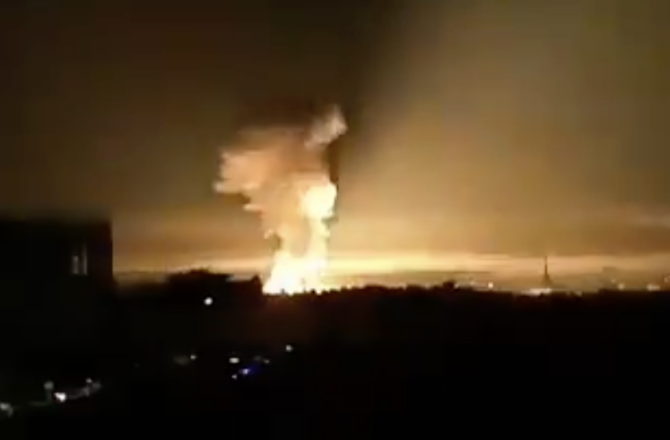
A screengrab from a video showing a large explosion near Latakia, Syria, on Monday night. (Twitter)
Updated 18 September 2018
Follow

Missile attack in Syria targets Assad stronghold Latakia

  • At least 10 people were reported injured in the strikes targeting state technical industry institutions
  • State media said Syrian air defenses intercepted some missiles targeting the provincial capital

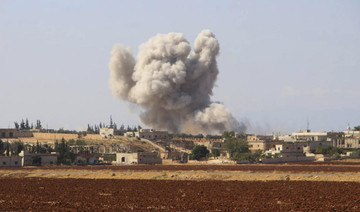
BEIRUT: Missiles were fired at several locations in the Syrian coastal province of Latakia on Monday but were intercepted and downed by air defenses, Syrian state media said.
Explosions continued for nearly a half hour, said Al-Ikhbariya TV, which aired footage showing streaks of white light flashing across the sky.

An unidentified military official was quoted as saying Syrian air defenses intercepted some missiles heading for the provincial capital of Latakia from the sea.
The official SANA news agency also said state technical industry institutions had been targeted and at 10 people were injured. It added that it was not immediately known who fired the missiles.
"Air defenses have confronted enemy missiles coming from the sea in the direction of the Latakia city, and intercepted a number of them," SANA quoted a military source as saying.
The Britain-based Syrian Observatory for Human Rights, which initially reported the explosions, also reported 10 wounded, saying all of them were soldiers and some were in critical condition.
The war monitoring group said the target appeared to be an ammunition depot that in the compound of the state Institute for Technical Industries. The group it was not clear if the depot was for Iranian or Syrian forces.
The strikes followed a similar attack on Damascus International Airport late Saturday, which Syrian state media also blamed on Israel. A military official quoted then on state media said Syrian air defenses intercepted some missiles coming from the sea.
Other attacks were reported on Sept. 4 that targeted sites in the coastal Tartus area and in Hama province. The Observatory said at the time that the Sept. 4 attacks were believed aimed at Iranian military posts.
Israel is widely believed to have been behind a series of airstrikes mainly targeting Iranian and Hezbollah forces in Syria that have joined the country’s war fighting alongside the government. Israel rarely acknowledges attacks inside Syria, but has said it will use military action to prevent weapons transfers to its enemies. Earlier this month, an Israeli military official said the Jewish state has struck over 200 Iranian targets in Syria over the past 18 months.
US and Israeli officials have said that Iran and Hezbollah should end their armed presence in Syria. Israel says it will not tolerate Iran’s growing presence in Syria.
Monday’s attack came hours after Russia and Turkey announced an agreement that effectively prevents a Syrian government offensive against Idlib, a rebel-held area in northwestern Syria.

(With AP)


Virtual museum preserves Sudan’s plundered heritage

Updated 6 sec ago
Follow

Virtual museum preserves Sudan’s plundered heritage

CAIRO: Destroyed and looted in the early months of Sudan’s war, the national museum in Khartoum is now welcoming visitors virtually after months of painstaking effort to digitally recreate its collection.
At the museum itself, almost nothing remains of the 100,000 artefacts it had stored since its construction in the 1950s. Only the pieces too heavy for looters to haul off, like the massive granite statue of the Kush Pharaoh Taharqa and frescoes relocated from temples during the building of the Aswan Dam, are still present on site.
“The virtual museum is the only viable option to ensure continuity,” government antiquities official Ikhlass Abdel Latif said during a recent presentation of the project, carried out by the French Archaeological Unit for Sudanese Antiquities (SFDAS) with support from the Louvre and Britain’s Durham University.
When the museum was plundered following the outbreak of the war between the regular army and the paramilitary Rapid Support Forces (RSF) in April 2023, satellite images showed trucks loaded with relics heading toward Darfur, the western region now totally controlled by the RSF.
Since then, searches for the missing artefacts aided by Interpol have only yielded meagre results.
“The Khartoum museum was the cornerstone of Sudanese cultural preservation — the damage is astronomical,” said SFDAS researcher Faiza Drici, but “the virtual version lets us recreate the lost collections and keep a clear record.”
Drici worked for more than a year to reconstruct the lost holdings in a database, working from fragments of official lists, studies published by researchers and photos taken during excavation missions.
Then graphic designer Marcel Perrin created a computer model that mimicked the museum’s atmosphere — its architecture, its lighting and the arrangement of its displays.
Online since January 1, the virtual museum now gives visitors a facsimile of the experience of walking through the institution’s galleries — reconstructed from photographs and the original plans — and viewing more than 1,000 pieces inherited from the ancient Kingdom of Kush.
It will take until the end of 2026, however, for the project to upload its recreation of the museum’s famed “Gold Room,” which had housed solid-gold royal jewelry, figurines and ceremonial objects stolen by looters.
In addition to the virtual museum’s documentary value, the catalogue reconstructed by SFDAS is expected to bolster Interpol’s efforts to thwart the trafficking of Sudan’s stolen heritage.