

PM House to be turned into an educational facility

1 / 2
An aerial photo of the Prime Minister house in Islamabad. (Released by PTI Government)
2 / 2
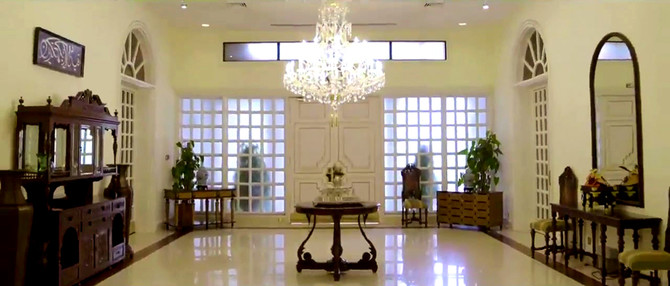
Prime Minister house from inside. (Released by PTI Government)
Updated 13 September 2018
Follow

PM House to be turned into an educational facility

  • Requires Rs470m each year for its upkeep
  • Despite a cash-strapped economy, PM Khan has so far avoided external borrowing

ISLAMABAD: Sticking true to his promise of protecting people’s tax money, Prime Minister Imran Khan on Thursday announced plans to convert the Prime Minister House in Islamabad into a top-quality postgraduate university.

Speaking on behalf of the PM, Education Minister Shafqat Mehmood said that Rs 470 million was being spent each year towards the maintenance of the prime minister’s official residence -- an amount which the ruling Pakistan Tehreek-e-Insaf party thought could be utilized for greater public good. 

“I promise that I will protect the people's tax money. We will cut all of our expenses…the PM House, this huge mansion ... in a country where there are so many poor people, I would be embarrassed to live there,” PM Khan had said during his victory speech on July 26.

Detailing the plans for the educational institute, Mehmood said that the PM House – covering an area of 135 acres and inaugurated nearly two decades ago by former PM Nawaz Sharif – would be “unique in terms of its education in Pakistan”. 

Situated on the main Constitution Avenue in Islamabad’s highly-guarded Red Zone, the Mughal architecture-inspired structure houses a fruit orchard, five spacious lawns, several swimming pools and residences for security officers, staff and members; among other things.

Faced with a cash-strapped economy, PM Khan has so far avoided external borrowing and has instead resorted to austerity measures. Media reports also suggest that the present political administration wants to rationalize public spending and is willing to take hard-hitting financial decisions to fix the economic woes of the country. 

Keeping that in mind, Mehmood -- who also heads a committee to determine the future of government installations -- said that the Punjab House in Murree and a Punjab Government rest house in Rawalpindi could feature next on the list.

While the Murree structure – which requires Rs25 million each year for its upkeep -- could be converted into a tourist resort; plans are in place to either turn the rest house in Rawalpindi into an information technology center or hand it over to the National College of Arts. 

Mehmood also talked about plans to convert Governor Houses across the country into museums for public use.


Pakistan mulls 'Super App' for public services, document verification in major technology push

Updated 15 February 2026
Follow

Pakistan mulls 'Super App' for public services, document verification in major technology push

  • Pakistan has been urging technology adoption in public, private sectors as it seeks to become a key tech player globally
  • The country this month launched the Indus AI Week to harness technology for productivity, skills development and innovation

KARACHI: Pakistan is planning to launch a “Super App” to deliver public services and enable digital document verification, the country's information technology (IT) minister said on Sunday, amid a major push for technology adoption in public and private sectors.

Pakistan, a country of 240 million people, seeks to become a key participant in the global tech economy, amid growing interest from governments in the Global South to harness advanced technologies for productivity, skills development and innovation.

The country's information and communications technology (ICT) exports hit a record $437 million in Dec. last year, according to IT Minister Shaza Fatima Khawaja. This constituted a 23% increase month on month and a 26% increase year on year.

Pakistan's technology sector is also advancing in artificial intelligence (AI) and cloud computing, marked by the launch of Pakistan’s first sovereign AI cloud in November, designed to keep sensitive data domestic and support growth in the broader digital ecosystem.

“In developed countries, citizens can access all government services from a mobile phone,” Fatima said, announcing plans for the Super App at an event in Karachi where more than 7,000 students had gathered for an AI training entrance test as part of the ‘Indus AI Week.’

“We will strive to provide similar facilities in the coming years.”

Khawaja said the app will reduce the need for in-person visits to government offices such as the National Database and Registration Authority (NADRA) and the Higher Education Commission (HEC).

The Indus AI Week initiative, which ran from Feb. 9 till Feb. 15. was aimed at positioning Pakistan as a key future participant in the global AI revolution, according to the IT minister.

At the opening of the weeklong initiative, Prime Minister Shehbaz Sharif announced that Pakistan would invest $1 billion in AI by 2030 to modernize the South Asian nation’s digital economy.

“These initiatives aim to strengthen national AI infrastructure and make the best use of our human resource,” Khawaja said, urging young Pakistanis to become creators, inventors and innovators rather than just being the consumers of technology.