

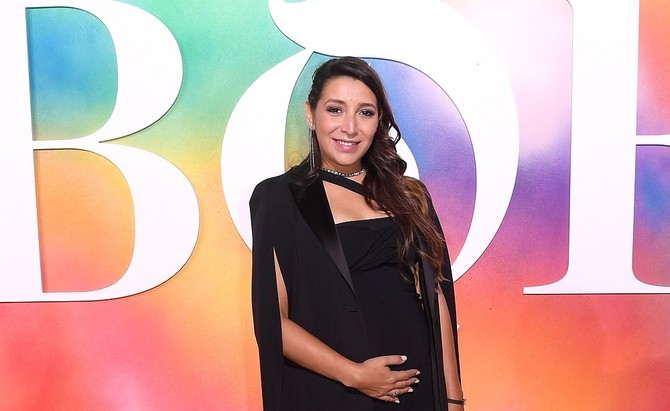
Business of Fashion handpicks Mideast powerhouses

US-based organization the Business of Fashion has released its sixth annual index of the people shaping the global fashion industry. (AFP)
Updated 11 September 2018
Follow

Business of Fashion handpicks Mideast powerhouses

DUBAI: US-based organization the Business of Fashion has released its sixth annual index of the people shaping the global fashion industry — and Saudi powerhouse Marriam Mossalli made the cut alongside three other women from the Middle East and a bevy of men from the region.

Known as the BoF 500, the index is widely regarded as the go-to list of international fashion’s who’s who.

Featured for the first time, alongside 95 other new names on the list, Saudi national Mossalli started her career as a journalist, before founding luxury consultancy agency Niche Arabia in 2011.

According to the Business of Fashion website, “Mossalli’s entrepreneurial company has been praised as a key player in elevating the global status of the Saudi Arabian fashion industry.”

Born in Sri Lanka, Mossalli lived in Korea and Malaysia before attending boarding school in Switzerland and eventually moving to Washington to study at George Washington University. After taking on positions at Arab News, the fashion heavyweight went on to write, curate and edit a series of books, including “Under The Abaya,” which features streetstyle images submitted by Saudi women.

“It’s moments like these that reaffirm one’s career choices and truly humble oneself. This goes to you, Saudi Arabia — my home, our future!” Mossalli wrote on Instagram.

“I’m humbled by the honor to represent the Khaleej as a new addition to the prestigious BoF 500 list! It’s such an honor and a true benchmark in my decade-long career to have this validation from the global fashion community,” she added in a statement to Arab News.

Mossalli joins three other women from the region who have been singled out by the organization, including Egyptian-Sudanese model Anok Yai, fashion editor Jamila Halfichi and Moroccan entrepreneur Salwa Idrissi Akhannouch.

Their achievements were celebrated at a gala dinner on the sidelines of New York Fashion Week on Monday — a celebrity-filled party that was attended by the likes of Somali-American model Halima Aden, model sisters Gigi and Bella Hadid, Canadian model Winnie Harlow and British model Rosie Huntington-Whiteley.

“For the sixth annual BoF 500, we focused on the change agents building and shaping a better fashion industry,” said Imran Amed, founder and chief executive of Business of Fashion. "There’s no doubt it has been a challenging time for the fashion business, a time for reflection. But, as we discovered in putting this issue together, there are many positive stories to tell and we are very happy to tell them.”


At Jazan festival, Suad Al-Asiri paints memory, land and leadership

Updated 13 January 2026
Follow

At Jazan festival, Suad Al-Asiri paints memory, land and leadership

  • Local artist channels personal hardship into works that reflect Jazan’s identity, heritage
  • Jazan: A Nation and a Prince, places region at the heart of a composition featuring Prince Mohammed bin Abdulaziz and Prince Nasser bin Mohammed bin Abdullah bin Jalawi

RIYADH: At the Ahad Al-Masarihah pavilion at Jazan Festival 2026, Suad Al-Asiri’s paintings blend memory, place and personal history, offering visual narratives shaped by beauty and hardship. 

A novelist and visual artist, Al-Asiri has long used art as a storytelling tool. After a near-fatal car accident in March 2024, her work took on a new urgency. Bedridden for 11 months, cut off from the public world for more than a year, she describes that period as one of the most painful in her life — yet also transformative. 

“First of all, praise be to God for granting me life, as the accident was extremely severe,” she said. “By God’s grace, I was given a new life. All my thinking after the accident was about becoming an inspiration to others — about enduring pain and obstacles, and still leaving an impact.” 

Her return to public life came in 2025, when she participated in National Day celebrations with the ministry of interior. By the time she arrived at Jazan Festival, she was ready to channel that experience into her art. 

The centerpiece of her display, “Jazan: A Nation and a Prince,” places the region at the heart of a composition featuring Prince Mohammed bin Abdulaziz and Prince Nasser bin Mohammed bin Abdullah bin Jalawi, governor and deputy governor of Jazan respectively. 

Visitors linger over the details: the painting incorporates coffee beans, sesame and khudair — materials drawn from local products.

“I wanted people to recognize these products immediately,” she said. “They are part of Jazan’s daily life, and using them makes the work more tangible, more connected to everyday experience.” 

The painting sparks conversation. Visitors discuss leadership, identity, and the intimate relationship between people and their environment. 

Beyond the central piece, Al-Asiri presents individual portraits of the two princes, expanding the dialogue into a broader exploration of heritage and memory.  

Her journey into art is tied to her life as a storyteller. Early experiments with charcoal and pencil evolved into abstract art, drawn by its expressive freedom. 

From there, she explored realism, surrealism, and eventually modern art, particularly pop art, which has earned her wide recognition in artistic circles. Her novels and media work complement her visual practice, earning her the title “the comprehensive artist” from the governor.

Yet what stands out most in this exhibition is how Al-Asiri’s personal resilience flows through each piece. Her experience of surviving a devastating accident, enduring months of immobility, and returning to the public eye informs every brushstroke. 

Visitors sense not just her artistic skill, but her determination to turn life’s hardships into inspiration for others. 

Walking through the pavilion, one can see it in the way she blends heritage symbols, southern landscapes, and scenes of daily life. 

Each painting becomes both a document and a dialogue — a celebration of Jazan’s culture, a reflection on identity, and a testament to the power of human perseverance. 

At Jazan Festival 2026, Suad Al-Asiri’s art is a quiet, persistent inspiration for anyone who pauses long enough to listen.