

Alibaba founder Jack Ma to step down in 2019, pledges ‘smooth transition’

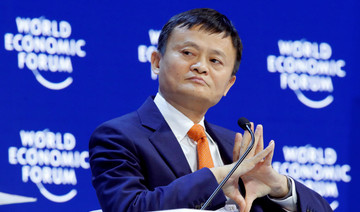
Jack Ma, who founded e-commerce giant Alibaba Group and helped to launch China’s online retailing boom, announced Monday, Sept. 10, 2018 that he will step down as the company’s chairman next September. (AP)
Updated 10 September 2018
Follow

Alibaba founder Jack Ma to step down in 2019, pledges ‘smooth transition’

  • Ma, who has expressed a desire to follow in the philanthropy footsteps of Microsoft founder Bill Gates, said he would remain on Alibaba’s board until 2020
  • Ma was an English teacher before starting Alibaba in his apartment in the eastern city of Hangzhou in 1999

SHANGHAI: Alibaba co-founder Jack Ma announced on Monday he would step down as head of the pioneering Chinese e-commerce giant in one year, a departure already drawing comparisons to the retirement of late Apple founder Steve Jobs.
Analysts said the early withdrawal of the 54-year-old Ma, who became the charismatic face of a company that has revolutionized how and what China’s people consume, will test the company’s ability to carry on Ma’s vision amid rising competition.
But like Apple’s transition to current boss Tim Cook, Alibaba CEO and anointed successor Daniel Zhang may be less magnetic than his predecessor but has proven an able steward since effectively taking the operational reins years ago, they said.
“Day-to-day operations-wise Alibaba will not be affected that much. But since he’s (Ma) the face of the company, people may lose a little bit of faith,” said Jackson Wong, associate director with Huarong Securities in Hong Kong.
“But where Jobs died, Ma is expected to stay on in an advisory role, so there shouldn’t be too much impact.”
Ma — who turned 54 on Monday — said in a statement that he will stay on as executive chairman until his 55th birthday before handing over that role to Zhang.
“While remaining as executive chairman in the next 12 months, I will work closely with Daniel to ensure a smooth and successful transition,” Ma said.
Ma, who has expressed a desire to follow in the philanthropy footsteps of Microsoft founder Bill Gates, said he would remain on Alibaba’s board until 2020.

“The one thing I can promise everyone is this: Alibaba was never about Jack Ma, but Jack Ma will forever belong to Alibaba,” he said.
Ma was an English teacher before starting Alibaba in his apartment in the eastern city of Hangzhou in 1999 — where its headquarters remain to this day — building it into an e-commerce colossus and becoming one of the world’s richest men and most recognizable figures in China.
He has a net worth of more than $40 billion according to the Bloomberg Billionaires Index, and Alibaba, which has shares listed in New York, was valued at $420.8 billion as of last Friday.
“Ma possesses an enviable clarity about how everything fits together,” said Mark Tanner, founder of Shanghai-based research and marketing company China Skinny, told Bloomberg News.
“He has understood Chinese consumer needs better than anyone and provided online services to meet them through convenience, entertainment and efficiencies.”
Alibaba sought to reassure investors of the change, with Ma saying he had “full confidence” that a leadership hierarchy in place for years will “win support from customers, employees and shareholders.”
But while Alibaba may lose the company’s face, analysts said the business brains remain with Zhang.
With his impish grin, Ma in recent years has largely assumed a role as a globe-hopping ambassador, marked by playful antics such as dressing up as Michael Jackson for a dance routine at a company gathering last year.
But it has been largely under the more reserved Zhang’s stewardship that Alibaba’s two main e-commerce platforms, Taobao and Tmall, have turned into richly profitable cash cows and other arms such as digital payments have flourished, said Wong of Huarong Securities.
The company has wowed investors year after year with sterling revenue growth with Zhang at the helm.
But Alibaba faces intense competition in China from the likes of rivals Tencent, JD.com, and other rising upstarts.
Alibaba still dominates Chinese e-commerce, however, and is pouring investment into new initiatives to broaden its ecosystem and stake out position in fast-growing future arms.
These include bricks-and-mortar retail, cloud computing, digital media, movies, the grocery sector, meal deliveries and advertising.
It also has upped investments in overseas ventures and in 2015 bought the South China Morning Post newspaper.
Alibaba did not specify exactly what Ma has planned post-retirement, but the former teacher has in recent years taken on education initiatives as pet projects.
“I still have lots of dreams to pursue. Those who know me know that I do not like to sit idle,” he said.

Reforms target sustained growth in Saudi real estate sector, says Al-Hogail

Updated 26 January 2026
Follow

Reforms target sustained growth in Saudi real estate sector, says Al-Hogail

RIYADH: The Real Estate Future Forum opened its doors for its first day at the Four Seasons Riyadh, with prominent global and local figures coming together to engage with one of the Kingdom’s most prospering sectors.

With new regulations, laws, and investments underway, 2026 is expected to be a year of momentous progress for the real estate sector in the Kingdom.

The forum opened with a video highlighting the sector’s progress in the Kingdom, during which an emphasis was placed on the forum’s ability to create global reach, representation, as well as agreements worth a cumulative $50 billion

With the Kingdom now opening up real estate ownership to foreigners, this year’s Real Estate Future Forum is placing a great deal of importance on this new milestone and its desired outcomes and impact on the market. 

Aside from this year’s forum’s unique discussions surrounding those developments, it will also be the first of its kind to launch the Real Estate Excellence Award and announce its finalist during the three-day summit.

Minister of Municipalities and Housing and Chairman of the Real Estate General Authority Majed Al-Hogail took to stage to address the diverse audience on the real estate market’s achievements thus far and its milestones to come.

Of those important milestones, he underscored “real estate balance” as a key pillar of the sector’s decisions to implement regulatory tools “with the aim of constant growth which can maintain the vitality of this sector.” He pointed to examples of those regulatory measures, such as the White Land Tax.

On 2025’s progress, the minister highlighted the jump in Saudi family home ownership, which went from 47 percent in 2016 to 66 percent in 2025, keeping the Kingdom’s Vision 2030 goal of 70 percent by the end of the decade on track.

He said the opening of the real estate market to foreigners is an indicator of the sector’s maturity under the leadership of Crown Prince Mohammed bin Salman. He said his ministry plans to build over 300,000 housing units in Riyadh over the next three years.

Speaking to Arab News,  Al-Hogail elaborated on these achievements, stating: “Today, demand, especially local demand, has grown significantly. The mortgage market has reached record levels, exceeding SR900 billion ($240 billion) in mortgage financing, we are now seeing SRC (Saudi Real Estate Refinance Co.) injecting both local and foreign liquidity on a large scale, reaching more than SR54 billion”

Al-Hogail described Makkah and Madinah as unique and special points in the Kingdom’s real estate market as he spoke of the sector’s attractiveness.

 “Today, the Kingdom of Saudi Arabia has become, in international investment indices, one that takes a good share of the Middle East, and based on this, many real estate investment portfolios have begun to come in,” he said. 

Al-Ahsa Gov. Prince Saud bin Talal bin Badr Al-Saud told Arab News the Kingdom’s ability to balance both heritage sites with real estate is one of its strengths.

He said: “Actually the real estate market supports the whole infrastructure … the whole ecosystem goes back together in the foundation of the real estate; if we have the right infrastructure we can leverage more on tourism plus we can leverage more on the quality of life … we’re looking at 2030, this is the vision … to have the right infrastructure the time for more investors to come in real estate, entertainment, plus tourism and culture.”