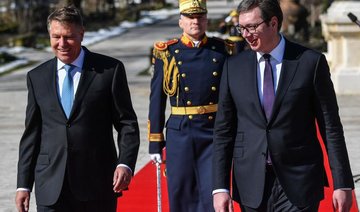
MITROVICA, Kosovo: Hundreds of Kosovar Albanians blocked access to a village due to be visited by Serbian President Aleksandar Vucic Sunday, an AFP journalist said, as a festering row over Kosovo independence clouds hopes that the war foes can normalize relations.
Demonstrators used vehicles and tree trunks to create a barricade on the main road between Mitrovica, in the north of Kosovo, and the village of Banje, a Serbian enclave some 60 kilometers (40 miles) away.
“Vucic does not pass” and “Those who committed genocide against innocent civilians cannot pass” read messages on placards at the blockade, which according to Serbian state television RTS was one of five set up by protesters to cut off all road access to Banje.
Serbia refuses to recognize Kosovo, an Albanian-majority former southern province that broke away from the then Yugoslav republic in a bloody war in 1998-1999 and declared independence a decade later.
According to RTS, Vucic’s route was blocked by former members of the Kosovo Liberation Army, the pro-independence guerrilla movement that fought Serb armed forces in the conflict.
The Serbian president is making a two-day visit to Kosovo, just days after planned talks with Kosovo president Hashim Thaci in Brussels under EU auspices fell apart at the last minute.
The talks have been stalled for months but started generating attention in recent months after Thaci and Vucic signalled an openness to the idea of border changes to resolve their longstanding differences over Kosovo’s independence.
The presidents have not laid out any detailed plans but the talk has alarmed critics, who say redrawing the map of the Balkans could wreak havoc in a fragile region scarred by war.
Vucic is due to speak at a public event later Sunday in Serb-majority Mitrovica.
Serbia needs a deal with Pristina to move forward in EU accession talks, while Kosovo is hoping that recognition from Belgrade that would unlock its path into the United Nations.
Kosovo is recognized by more than 110 countries, but outliers include Russia, China and five EU countries, including Spain, which does not want to set an independence precedent for its own regions.

Protesters block route of Serbian leader on Kosovo trip
- Demonstrators used vehicles and tree trunks to create a barricade on the main road between Mitrovica
- The Serbian president is making a two-day visit to Kosovo
Trump cuts India tariffs as Modi ‘agrees’ to stop buying Russian oil
- US will impose an 18 percent tariff on Indian goods, down from the earlier 50 percent punitive levy
- Withdrawal from Russian oil may affect India’s relations with BRICS, expert says
NEW DELHI: The US and India have announced reaching a trade agreement after months of friction, with President Donald Trump saying that Prime Minister Narendra Modi had “agreed” to halt purchases of Russian oil.
In August, Trump accused India, which imports most of its crude oil, of funding Moscow’s war in Ukraine and subjected it to a combined tariff rate of about 50 percent on most of the exports.
Following a call with Modi on Monday, Trump took to social media to say that he would cut with immediate effect US levies on Indian goods to 18 percent after Modi “agreed to stop buying Russian Oil, and to buy much more from the United States and, potentially, Venezuela.”
At the same time, India, Trump wrote, would “reduce their Tariffs and Non Tariff Barriers against the United States, to ZERO,” committing to buy “over $500 BILLION DOLLARS of US Energy, Technology, Agricultural, Coal, and many other products.”
Modi confirmed the agreement on social media, saying: “Made in India products will now have a reduced tariff of 18 percent,” without commenting on Russian oil or duty-free imports of American goods.
When the US announced its punitive tariffs last year, India quickly moved forward with free trade negotiations with other countries — signing a deal with Oman and finalizing negotiations with New Zealand and the EU.
While the agreements were expected to partially offset the loss of exports to the US, economists did not expect they would immediately mitigate it, as shifting supply chains takes time.
The newly announced agreement with the US will therefore offer short-term relief for Indian exporters — especially of textiles, gems, jewelry and marine products — who were facing the threat of a market exit.
“In that case, the trade deal with the US is a welcome step. It provides short-term relief, allowing India to continue exporting to the US without being forced to exit the US market and diversify with a huge transition cost,” said Anisree Suresh, geoeconomics researcher at the Takshashila Institution.
“However, one shouldn’t look at it as a comprehensive long-term trade deal like the one India signed with the EU. The unpredictability of the Trump administration remains a major concern, regardless of whether there is a trade deal with the US ... India cannot treat this deal the same as other FTAs, as it is limited in scope and subject to reversal.”
When the US imposed its punitive tariffs on India, about 66 percent of total Indian exports were subject to that rate. Overall, India recorded a negative margin of 19.5 percent, meaning its exports were taxed more heavily than those of its competitors.
“From that point of view, Indian goods will have a larger market over there. However, there’s a problem when we talk about a 0 percent tariff on the US,” said Prof. Arun Kumar, a development economist.
“The US will be able to export a lot more to India, and therefore it will affect our production within the economy. And that will be a setback, so while exports may rise, the internal economy may actually suffer because of this decrease in tariffs on American goods. And especially if it affects agriculture.”
The sudden withdrawal from India’s partnership with Russia may not have a serious economic impact but politically could affect New Delhi’s relations, also with other countries, especially those from BRICS — a grouping that besides India and Russia includes also Brazil and China, and is the most powerful geopolitical forum outside of the Western world.
“You can always substitute Russian oil with some other oil, but I think it’s more of a strategic question, because India and Russia have had long-standing relationships, and if we bend to US pressure and reduce purchases from Russia, then it will affect in future also our relationship with Russia, because we will not be seen as a stable ally,” Kumar said.
“BRICS nations will not trust India very much in the future ... and that’s what Trump wants. He wants to disrupt BRICS. That’s what he has been doing right since the beginning to divide nations and deal with them individually.”