KSA wants a prosperous, stable, vibrant Pakistan, says visiting Saudi minister

1 / 3
Dr. Awwad bin Saleh Al-Awwad, Saudi Minister for Culture and Information, arrived in Islamabad on Sept. 7. Pakistan’s Federal Minister for Information Chaudhry Fawad Hussain received Awwad and his delegation on Sept. 7. (Photo by PID)
2 / 3
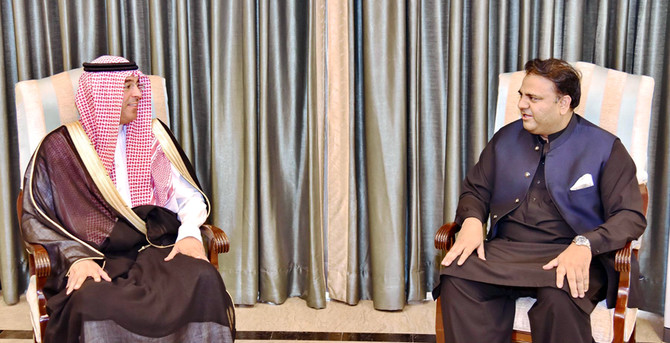
Chaudhry Fawad Hussain, Pakistan’s Federal Minister for Information, with Dr. Awwad bin Saleh Al-Awwad, Saudi Minister for Culture and Information — Sept. 7. (Photo by PID)
3 / 3
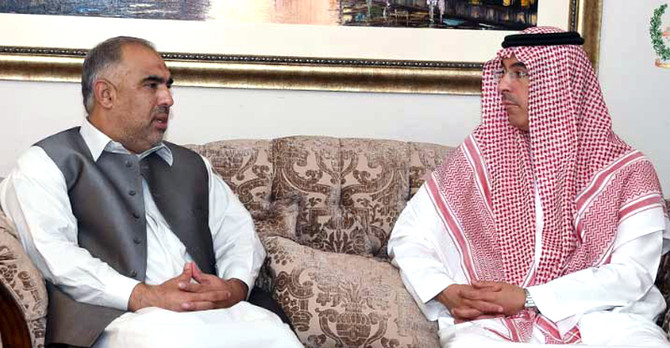
Saudi Minister for Information and Culture Dr. Awwad Bin Saleh Al-Awwad called on Speaker National Assembly Asad Qaiser in Islamabad on Saturday Sept. 8. (Photo by PID)
Updated 08 September 2018
Follow

KSA wants a prosperous, stable, vibrant Pakistan, says visiting Saudi minister

  • Dr. Awwad bin Saleh Al-Awwad, KSA Information Minister, is on an official visit to Islamabad
  • Visiting minister met Pakistan’s Senate speaker and discussed issues of mutual interest

ISLAMABAD: Saudi Minister of Culture and Information Dr. Awwad bin Saleh Al-Awwad on Saturday met the Speaker of the National Assembly Asad Qaiser, and discussed a number of issues of mutual interest between the two brotherly countries, and ways of strengthening relations.

Al-Awwad is on an official visit to Islamabad.
Saudi Ambassador to Pakistan Nawaf bin Saeed Ahmad Al-Maliki and Pakistan’s Federal Minister for Information Fawad Chaudhry were also present in the meeting, which took place at the speaker’s house.
“Asad Qaiser acknowledged that our respective governments have maintained a time-tested friendship based on strong emotional links where we have supported each other through thick and thin and have stood by each other during every regional or international issue,” the Speaker’s office said in a statement.
The Speaker added: “We are bound in irrevocable ties of common faith, culture, history and heritage ... the Parliament of Pakistan has also remained in the forefront to further cement the brotherly relations between our two countries.”
The Speaker symbolized the true friendship of Pakistan with Saudi Arabia by quoting the famous saying, “Friendship is a sweet responsibility; not an opportunity.”
Asad Qaiser also discussed the problem faced by Pakistani expatriates in Saudi Arabia and also spoke about the issue of Pakistanis imprisoned over there.
Al-Awwad “assured the Speaker to resolve the problems of Pakistani imprisons in Saudi Arabia and Pakistani citizens serving there,” the statement read.
The minister said Saudi Arabia would always stand by its Pakistani brethren whenever needed.
“He (the Minister) further said that Saudi Arabia strongly desires to see a prosperous, stable and economically vibrant Pakistan,” the statement added.


Pakistanis at remote border describe scramble to leave Iran

Updated 6 sec ago
Follow

Pakistanis at remote border describe scramble to leave Iran

  • Returning Pakistani nationals recount missile fire in Tehran, transport gridlock as people rush to exit Iran
  • PM Sharif condemns targeting of Iranian leader as embassies urge citizens to leave amid escalating strikes

TAFTANT, Pakistan: Pakistani nationals hauled suitcases across the border from neighboring Iran, describing missiles being launched and travel chaos as they scrambled to leave the country after the US and Israel launched strikes over the weekend.

AFP journalists saw a steady trickle of people passing through large metal gates at the remote border crossing between Iran’s Mirjaveh and Taftan in Pakistan’s western Balochistan province.

Powerful explosions have rocked Iran’s capital Tehran since Saturday, with embassies from countries around the world telling their citizens to leave.

“All our Pakistani brothers who were in Tehran and other cities had started to leave and were arriving at the terminal, which caused a lot of crowd pressure,” 38-year-old trader Ameer Muhammad told AFP on Monday.

“Due to the crowds, there were major transport problems.”

The isolated Taftan border lies around 500 kilometers (310 miles) from Balochistan’s capital and largest city, Quetta.

AFP journalists saw the Iranian flag flying at half-mast as soldiers stood guard.

Most people wheeled bulky luggage over the frontier’s foot crossing, while freight lorries formed a long line.

Irshad Ahmed, a 49-year-old pilgrim, told AFP he was staying at a hostel in Tehran when he saw missiles being fired nearby.

“There was an army base near the hostel, and we saw many missiles being fired,” he said.

“After that, we went to the Pakistani embassy so that they could evacuate us from there. They brought us here safely.”

Pakistan’s Prime Minister Shehbaz Sharif has said the killing of Ayatollah Ali Khamenei was a “violation” of international law.

“It is an age old convention that the Heads of State/Government should not be targeted,” Sharif wrote on X.

The “people of Pakistan join the people of Iran in their hour of grief and sorrow and extend the most sincere condolences on the martyrdom” of Khamenei, he added.

A teacher at Tehran’s Pakistani embassy, who gave his name as Saqib, told AFP: “Before we left, the situation was normal. The situation was not that bad.”

The 38-year-old said the strikes on Tehran on Saturday “pushed us to leave the city.”

“The situation became bad on Saturday night, when attacks caused precious lives to be lost,” he said.