ISLAMABAD: With an eye on improving bilateral ties with Pakistan’s newly-formed government, Saudi Arabia on Saturday said that it was looking to explore areas of mutual cooperation, especially in the media and culture sectors.
Awwad bin Saleh Al-Awwad, the kingdom’s information minister, also commended Pakistan for its “very energetic government”. “We discussed the changes in the media outlets and the new devices, [and the advancements in] Internet [connectivity], moving away from the traditional media to the new media,” Al-Awwad told Arab News on the sidelines of a dinner hosted by Nawaf Al-Malki, the kingdom’s ambassador to Pakistan.
Pakistan’s Information Minister Fawad Chaudhry and other officials also attended the meeting. Al-Awwad said that, as part of Prime Minister Imran Khan’s 2030 vision, Pakistan would have a huge role to play in the transformation and progress of Saudi Arabia.
He emphasized the role of digital media in helping people from both countries participate in a cultural exchange, in a more robust manner. “Through the media, we want the people of Pakistan and Saudi Arabia to know each other’s culture, especially through dramas and movies,” he said.
Adding that “there is room for improvement”, Al-Awwad said he was looking forward to Chaudhry’s support to streamline the process. “There is a need for both Islamabad and Riyadh to work in tandem to further deepen ties. We need to work together to explore new areas of cooperation,” he said.
Al-Awwad said a visit by Prime Minister Khan would seal the deal. “We are looking forward to the visit. In this regard, the time and announcement will be left to the diplomatic channel,” he said.

Riyadh-Islamabad to switch on the channel for better ties
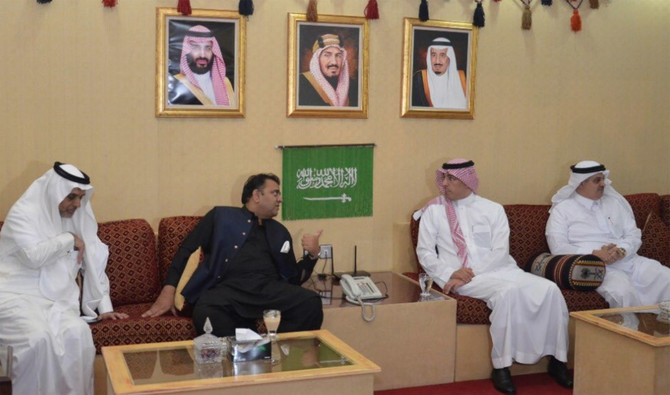
- Saudi Information Minister seeks more cooperation in media, culture sectors
- Dramas and movies can help people from both countries understand each other better, he says
Klija Festival in Buraidah empowers small businesses
- Half a million attend 15-day celebration of heritage; event creates 1,500 seasonal jobs
RIYADH: The 17th Klija Festival in Buraidah drew more than half a million visitors during its 15-day run, celebrating the region’s heritage and entrepreneurial spirit.
Organized by the Qassim Chamber of Commerce, the event highlighted small businesses, providing a platform for entrepreneurs to showcase local products.
More than 340 sales outlets, marketing corners and points of sale welcomed attendees, while the festival provided 1,500 seasonal job opportunities, the Saudi Press Agency reported.
The small business pavilions featured families in the cottage industry, artisans and startups presenting traditional foods, and handicrafts and heritage items that reflect the region’s identity.
Participants said that the festival was a key marketing platform, boosting sales, increasing brand awareness, facilitating knowledge exchange and fostering connections with organizations supporting SMEs.
Mohammed Al-Hanaya, Qassim Chamber secretary-general and festival supervisor, said that the event brought together families, artisans, SMEs, companies and institutions, stimulating commercial activity, opening direct marketing channels and enhancing economic returns.
He added that the festival provided seasonal jobs for more than 1,500 young men and women across operations, marketing and services, supporting the labor market, empowering national talent, and connecting youth to the events and creative economy.
Klija, a traditional cookie made from wheat flour, dates or sugar, date syrup and natural ingredients such as cardamom and lemon, is a rich source of energy, carbohydrates, dietary fiber and natural proteins.
A cultural icon rooted in Qassim’s traditions, the cookie has gained international exposure through the festival, expanding the availability of packaged products.
Starting next year, the festival will be renamed the International Klija Festival, a rebranding approved by Qassim Gov. Prince Faisal bin Mishaal, who described it as a “successful model for turning local initiatives into global economic engines.”
This year’s festival, held at the King Khalid Cultural Center, included international participants from Egypt, Turkiye and Morocco, marking its evolution into a cross-cultural platform.


