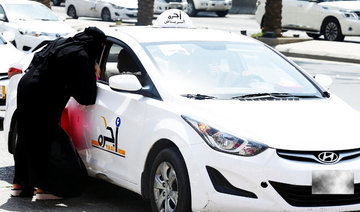
Taxi drivers say that they had “good days” before the arrival of Uber, Kareem and other ride-sharing apps in Saudi Arabia.
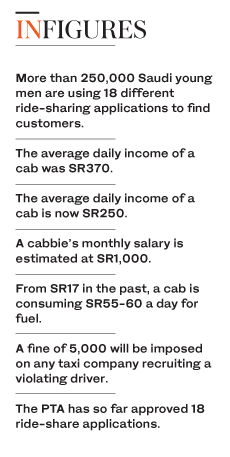
Abrar Hussein, a Pakistan taxi driver, said that previously cabbies used to earn from SR350 ($93) to SR400 a day. “At that time, I used to give the company SR170 but that was fine for me as I worked from seven in the morning and got back to my house for a rest at one in the afternoon. I would then go out at four until it was midnight,” Hussein said.
Nowadays, he gives SR140 to his company. “Everyday, we suffer until we get that amount. It takes me 15-17 hours of hard searching for passengers. The maximum amount I can collect every day is SR250,” he said.
He said that he used to pay SR17 to supply his car with fuel, then that increased to SR33. Now he fills his car with SR55-60 per day. According to him, only a sum of SR40-60 remains in his pocket. He spends most of that amount on his daily needs.
“I receive a monthly salary from my company of some SR1,000, but that is not enough for a dignified life of a family,” he said.
Asked why he is not using an application to hunt for passengers, Hussein replied that he could do that, although it is not allowed, but he thinks the applications are useless. “I don’t want to waste my time waiting for a service-seeker who might not show up or delay me,” Hussein said.
As a father of two children, Hussein remits from SR1,500 to SR2,000 to his family. Despite that, Hussein is thinking of returning to his country after 10 years of what he described as “good days” in Saudi Arabia.
“It is true that the amount I send to my family is somehow enough, but I myself can’t continue in such excruciating circumstances. I have my own personal needs that I can’t secure, unless I deduct something from the amount I remit to my family, which will worsen their financial situation,” he said.
 Battle for passengers
Another Pakistani taxi driver, Mohammed Azeem, who has been in Saudi Arabia for three months, told Arab News that he has to pay SR100 to his company every day.
“I start working at 7 a.m. and continue until 10 p.m. The 15-hour work can sometimes bring me up to SR200. Half of this amount goes to my company while I spend the other portion on fueling my car and getting my daily needs of food,” Azeem said.
Azeem said that they are not allowed to use any ride-sharing applications such as Uber, Kareem and Easy Taxi. He revealed that such applications have caused them to work hard to find customers.
“Sometimes, I go around the city for more than an hour without finding a taxi-service seeker. These applications seem to have lured passengers,” he said. Azeem added that he is not optimistic about staying in Saudi Arabia with such “unfair” competition. “This is not fair, and I think taxis will disappear from the scene,” he said.
Abdullah Al-Mutairi, spokesman for the Public Transportation Authority (PTA), told Arab News that there are more than 250,000 Saudi drivers using ride-sharing applications, and the authority has so far approved 18 applications as per the third quarter of 2018.
Responding to a question about using an unlicensed application to find passengers, Al-Mutairi said that in addition to blocking the application, the PTA imposes harsh fines on both the driver and the company.
“We count on the awareness of the public in following the regularly updated list of authorized applications, which we have announced through our website and Twitter accounts,” he said.
Al-Mutairi added the fines against violators vary according to the regulations. For example, any cabbie who is caught or reported to be using an unlicensed application will be fined.
“Moreover, a fine of SR5,000 will be imposed on the company recruiting him. We will also demand the blocking of unapproved applications,” he said.
The PTA has announced on its official account that they warned customers against dealing with some illegal applications such as Taxifyksa meaning (Taxi in KSA), Saeqty (My Chauffeuse) and Twadeeny (Give me a ride?)
Air pollution
The measure came as part of the PTA’s concern about the safety and security of citizens and residents.
The spokesperson noted that taxis driving around the city looking for business could contribute to increasing rates of air pollution. “Furthermore, such taxis can cause traffic congestions on the streets. There are cab ranks in front of malls, hospitals airports and many other places where taxi drivers can wait to be hired,” he said.
Al-Mutairi warned that violating drivers would expose themselves to financial penalties. “A violation of such a kind would bring a fine of SR500.
“All transport service providers should adhere to the instructions and rules to avoid punishment,” he said.
Fawaz Al-Sahli, PTA vice president of the Land Transport Sector, said that it is working on reforming taxi-application services to ensure the interests of both the companies and Saudi drivers. “We are also keen to make the services available for customers at reasonable prices,” he said.
Al-Sahli said that the PTA had stopped issuing licenses for new non-shared services until the PTA finalizes an overall systemization for the business.